All species › Trogons › Trogons › Green-backed Trogon
Green-backed Trogon | Trogon viridis
Groenrugtrogon | Trogón dorsiverde | Surucuá-grande-de-barriga-amarela
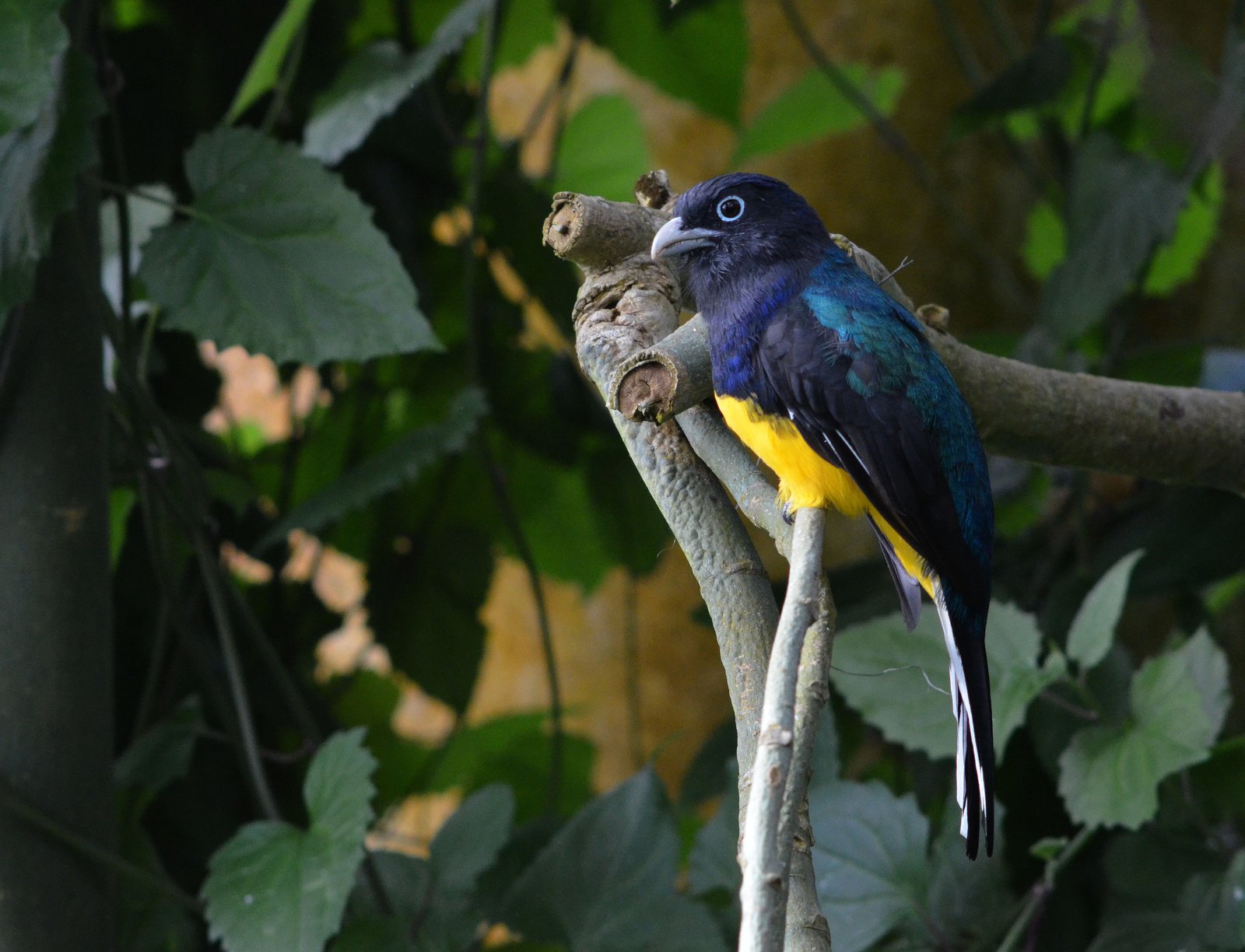
The Green-backed Trogon is the large yellow-bellied trogon of the Amazonian lowlands. It sits motionless for long periods in the middle and upper storeys and eats more fruit than most other trogons. It was formerly treated as one species together with White-tailed Trogon west of the Andes.
Voice
A long series of about twenty hollow cow notes that starts slowly and accelerates towards the end. Also a dry chuck and a rattling churr when alarmed.
Recording: Juan Freile — CC BY-NC-SA 4.0 · xeno-canto
Identification
28–30 cm. The male has a dark blue to violet-black head and breast, a green to blue-green back, an orange-yellow belly and a complete pale blue bare eye-ring. The wing is black with fine white vermiculation. The undertail is largely white: each feather has a black base and a broad white tip and outer edge. The female is grey on the head, breast and back, with a yellow belly, a pale blue eye-ring and a black-and-white barred undertail.
Confusion species
Amazonian Trogon Trogon ramonianus is smaller, has a yellow eye-ring and, in the male, a finely black-and-white barred undertail; the female has a broken white eye-ring. Amazonian Black-throated Trogon Trogon rufus has a green head and breast and a yellow eye-ring in the male; the female is brown. Blue-crowned Trogon Trogon curucui and Black-tailed Trogon Trogon melanurus have a red belly. White-tailed Trogon Trogon chionurus lives only west of the Andes.
Habitat
Humid terra firme lowland forest, várzea, forest edges and old secondary forest, up to about 1000 m on the lower eastern slope. It sits in the middle storey and below the canopy and eats mainly small fruits, supplemented with insects. It excavates a nest cavity in an arboreal termite nest or in rotten wood.
Where the bird is most at home, classified by the vegetation units of the Andes and the west coast.


Range and movements
In Colombia in the lowlands east of the Andes. In Ecuador and Peru in the Amazonian lowlands and on the lower eastern slope. In Bolivia in the lowlands of the north and east. Absent west of the Andes and from the Galápagos. Outside the guide area in Venezuela, the Guianas, Trinidad, Amazonian Brazil and the Atlantic Forest of eastern Brazil.
- Resident
- dark = core range, pale = thinly spread
How and when to look
In the Amazonian lowlands it often perches at eye level for observers on canopy towers and walkways, for example at lodges along the Napo in Ecuador and in Tambopata in Peru. The accelerating series of cow notes is the first clue; the largely white undertail separates the male from Amazonian Trogon.
Conservation status
Least Concern. A fairly common resident of Amazonian forest; it disappears where the forest is cleared entirely.
Scientific name
Trogon viridis | Linnaeus, 1766
Linnaeus described the species in 1766 and placed it straight away in the genus where it still stands. The genus Trogon was introduced in 1760 by Brisson. The genus name comes from Greek trōgōn, 'nibbling', from trōgō, 'to gnaw'; trogons gnaw out their nest holes in rotten wood. Viridis is Latin for 'green', after the green back. The specimen the first description was based on came from Cayenne, French Guiana.