All species › Passerines › Ovenbirds and woodcreepers › Chotoy Spinetail
Chotoy Spinetail | Schoeniophylax phryganophilus
Witwangstekelstaart | Chotoy | Bichoita
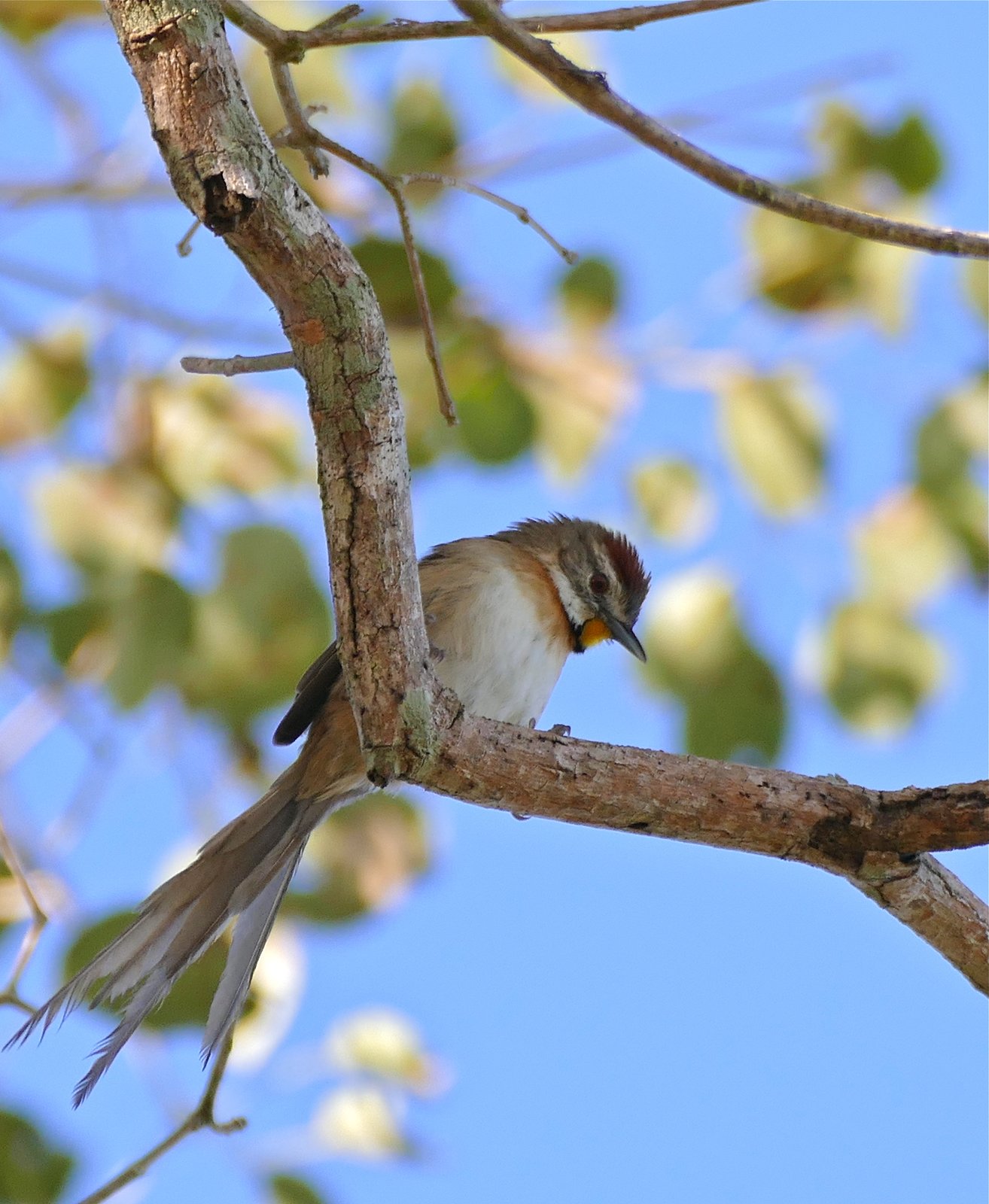
The Chotoy Spinetail is a large spinetail with a very long, graduated tail, from the open lowlands of central South America. A bright yellow chin above a black throat patch is characteristic. In the guide area it occurs only in eastern Bolivia.
Voice
The song is a series of low notes, cho-cho-cho, that sounds as if it comes from a larger bird. The call is a quick, rattling series of notes.
Recording: Guillermo Treboux — CC BY-NC-SA 4.0 · xeno-canto
Identification
20–22 cm, more than half of which is tail; the tail is long, graduated and pointed. White supercilium, light brown ear coverts and a chestnut shoulder patch. The back is sandy brown with dark streaks, the wings and tail mostly light brown. The chin and upper throat are bright yellow, with a black patch below that is bordered with white. The upper breast is apricot, the rest of the underparts buffy white to brownish buff. The sexes are alike.
Confusion species
Yellow-chinned Spinetail Certhiaxis cinnamomeus is smaller, with a much shorter tail, plain rufous upperparts without streaks and only a small yellow chin spot. Greater Thornbird Phacellodomus ruber is larger and plain brown, with a rufous crown, wings and tail and no yellow chin or black throat patch.
Habitat
Open to semi-open lowlands: wooded savanna, gallery forest, scrub along streams, dry woodland and marsh edges, up to about 500 m. It forages singly or in pairs for insects on thin twigs and leaves close to the ground. The nest is a large ball of thorny sticks with a side entrance tube, usually in a bush or small tree up to about 3.5 m high; clutches of four to five eggs.
Where the bird is most at home, classified by the vegetation units of the Andes and the west coast.


Range and movements
Bolivia: in the eastern lowlands. Absent from Colombia, Ecuador, Peru and the Galápagos. Outside the guide area in southern and south-western Brazil, most of Paraguay, north-eastern Argentina and Uruguay; a smaller subspecies lives separately in north-eastern Brazil.
- Resident
- dark = core range, pale = thinly spread
How and when to look
Search scrub along streams and marsh edges in the savannas of Beni and Santa Cruz. The bird gives itself away by its low notes and by the large stick nests in bushes.
Conservation status
Least Concern. The species has a large range and also occurs in ranchland with shrubs and copses.
Scientific name
Schoeniophylax phryganophilus | (Vieillot, 1817)
Vieillot described the species in 1817 as Sylvia phryganophila; because it was later moved to another genus, the author and year stand in brackets. The genus Schoeniophylax was introduced in 1909 by Ridgway. The genus name combines Greek skhoinion, 'little rush' or 'reed', and phulax, 'guardian'. The species name phryganophilus combines Greek phruganon, 'dry sticks' or 'brushwood', and philos, 'loving'. The specimen the first description was based on came from Paraguay.