All species › Passerines › Ovenbirds and woodcreepers › Red-billed Woodcreeper
Red-billed Woodcreeper | Hylexetastes perrotii
Roodsnavelmuisspecht | Trepatroncos piquirrojo | Arapaçu-de-bico-vermelho
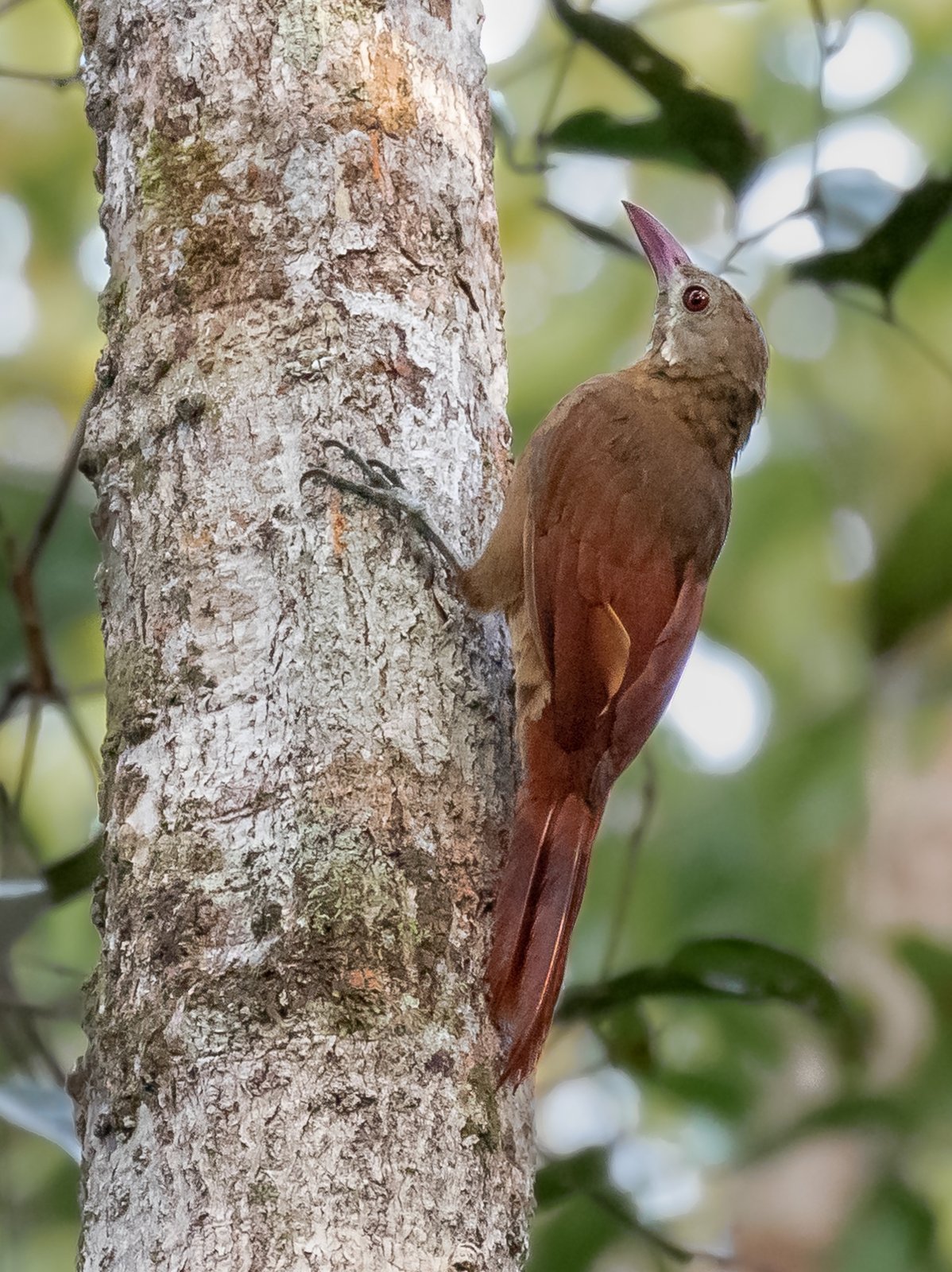
The Red-billed Woodcreeper is a large, heavy woodcreeper with a short, massive, red bill, of undisturbed rainforest north and south of the Amazon in Brazil and the Guianas. It has not been definitely recorded in the guide area and counts at most as a rare vagrant. Reports from north-eastern Bolivia probably refer to Uniform Woodcreeper Hylexetastes uniformis, which some classifications include in this species.
Voice
A loud series of clear whistles, mainly at first light, similar to that of the Bar-bellied Woodcreeper.
Recording: Cameron Rutt — CC BY-NC-SA 4.0 · xeno-canto
Identification
26–30 cm, heavily built, with a short tail and a short, very heavy, red bill. The plumage is almost plain brown to olive-brown, with rufous wings and tail and a greyish face with a pale stripe below the cheek. The underparts are plain brown, without clear streaks or bars. The sexes are alike.
Confusion species
Bar-bellied Woodcreeper Hylexetastes stresemanni has a streaked throat and a finely barred belly. Amazonian Barred Woodcreeper Dendrocolaptes certhia is barred all over and has a slimmer bill. Plain-brown Woodcreeper Dendrocincla fuliginosa is much smaller, with a thin, dark bill.
Habitat
The interior of undisturbed humid terra firme rainforest in the lowlands. It forages on trunks at middle levels, joins mixed flocks and sometimes follows army-ant swarms. Very sensitive to forest disturbance.
Where the bird is most at home, classified by the vegetation units of the Andes and the west coast.

Range and movements
Not definitely recorded in the guide area; any records from north-eastern Bolivia probably refer to Uniform Woodcreeper. Absent from Colombia, Ecuador, Peru and the Galápagos. Outside the guide area in eastern Venezuela, the Guianas and Brazilian Amazonia north of the Amazon; in the broader sense also south of it.
How and when to look
A heavy woodcreeper with a red bill in north-eastern Bolivia is more likely a Uniform Woodcreeper; check for a plain, unbarred belly and document records with photos or sound recordings.
Conservation status
Least Concern. The species has a large range, but is scarce everywhere and very sensitive to deforestation.
Scientific name
Hylexetastes perrotii | (de Lafresnaye, 1844)
De Lafresnaye described the species in 1844 as Dendrocolaptes Perrotii; because it was later moved to another genus, the author and year stand in brackets. The genus Hylexetastes was introduced in 1889 by Sclater. The genus name comes from Greek hulē, 'forest', and exetastēs, 'examiner': 'forest examiner'. The species name honours Jean Perrot (1790–1858), French taxidermist at the Natural History Museum in Paris. The specimen the first description was based on came from Cayenne, French Guiana.