All species › Passerines › Ovenbirds and woodcreepers › Chilean Seaside Cinclodes
Chilean Seaside Cinclodes | Cinclodes nigrofumosus
Strandwipstaart | Churrete costero | Pedreiro-costeiro-do-chile
The Chilean Seaside Cinclodes is a large, sooty cinclodes of the rocky coast of Chile that forages in the intertidal zone. It is the southern counterpart of the Peruvian Seaside Cinclodes; the two are sometimes treated as one species. In the guide area it is only a very rare vagrant.
Voice
The song is a bright, trilled series of piping whistles, sometimes in duet; the male sings from a high rock with wings spread. The call is a short, sharp, slightly metallic chik.
Recording: Cristian Pinto — CC BY-NC-SA 4.0 · xeno-canto
Identification
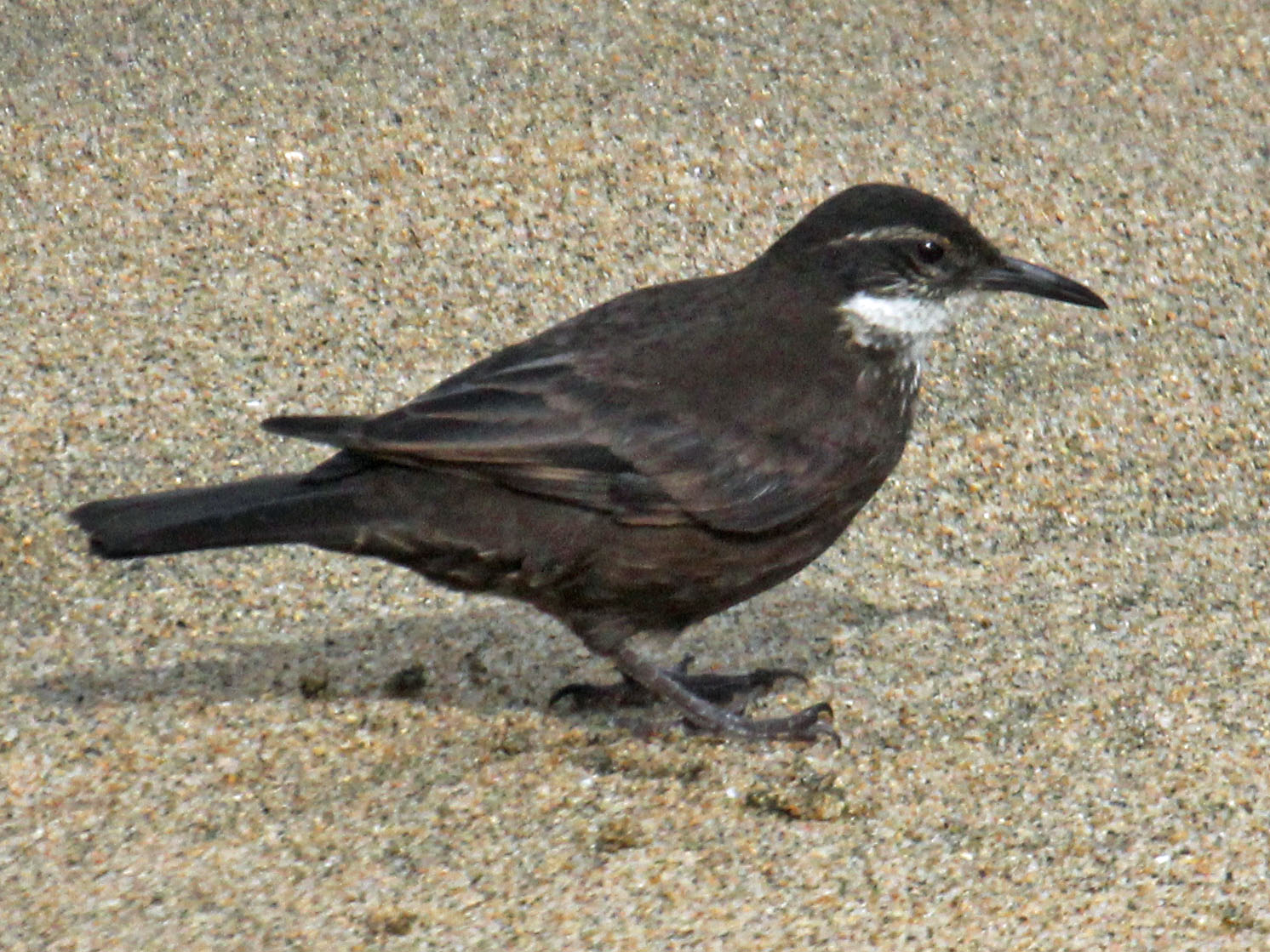
21–23 cm, a robust, very dark cinclodes with a straight, strong bill. The head, upperparts and wings are sooty black to blackish brown, with a narrow pale eyebrow. The throat and sides of the neck are white, the breast smoky grey with white or cinnamon spots, the belly plain smoky grey. In flight a pale rufous wing band is visible. The black tail has pale tips to the outer feathers. The sexes are alike.
Confusion species
Peruvian Seaside Cinclodes Cinclodes taczanowskii, the cinclodes of the rocky coast of Peru, is browner, with a dirty white, dusky-spotted throat and a brown breast with short pale streaks; a clean white throat and greyer underparts point to Chilean Seaside Cinclodes. Buff-winged Cinclodes Cinclodes fuscus is smaller and paler brown and lives in the high Andes, not on the coast.
Habitat
The intertidal zone of rocky shores and adjacent sandy beaches, seldom far from the water's edge. It forages on wet rocks and among seaweed for small crustaceans, molluscs and insects. The nest is an untidy cup of herbs, seaweed and lichen in a rock cavity, a bank or a building; the clutch is two to four eggs.
Where the bird is most at home, classified by the vegetation units of the Andes and the west coast.


Range and movements
In the guide area only a very rare vagrant; a bird is most likely on the rocky coast of the far south of Peru, near the Chilean border. Not known from Colombia, Ecuador, Bolivia or the Galápagos. Outside the guide area endemic to the coast of Chile, from Arica y Parinacota south to Los Ríos, including nearshore islands.
How and when to look
When checking cinclodes on the rocky coast of southern Peru, look for a clean white throat and a grey belly. Document an unusual bird with photographs and a sound recording.
Conservation status
Least Concern. The range is fairly large and the population is considered stable; construction and other changes to the intertidal zone may play a role locally.
Scientific name
Cinclodes nigrofumosus | (d'Orbigny, ACVMD & de Lafresnaye, 1838)
D'Orbigny, ACVMD & de Lafresnaye described the species in 1838 as Uppucerthia nigro-fumosa; because it was later moved to another genus, the author and year stand in brackets. The genus Cinclodes was introduced in 1840 by Gray. The genus name combines Ancient Greek kinklos, an unidentified waterside bird, with -oidēs, 'resembling'. The species name comes from Latin niger, 'black', and fumosus, 'smoky'. The specimen the first description was based on came from Cobija, Antofagasta, Chile.