All species › Passerines › Ovenbirds and woodcreepers › Freckle-breasted Thornbird
Freckle-breasted Thornbird | Phacellodomus striaticollis
Spikkelborststekelkruin | Espinero pecho manchado | Tio-tio
The Freckle-breasted Thornbird is an ovenbird of marsh edges and riverside scrub in south-eastern South America. It has a rufous crown and a finely freckled throat and breast. In the guide area it has been reported only as a very rare vagrant; there is no established population.
Voice
A loud, accelerating series of notes, often as a duet. The call is a dry chek.
Recording: Dante Buzzetti — CC BY-NC-SA 4.0 · xeno-canto
Identification
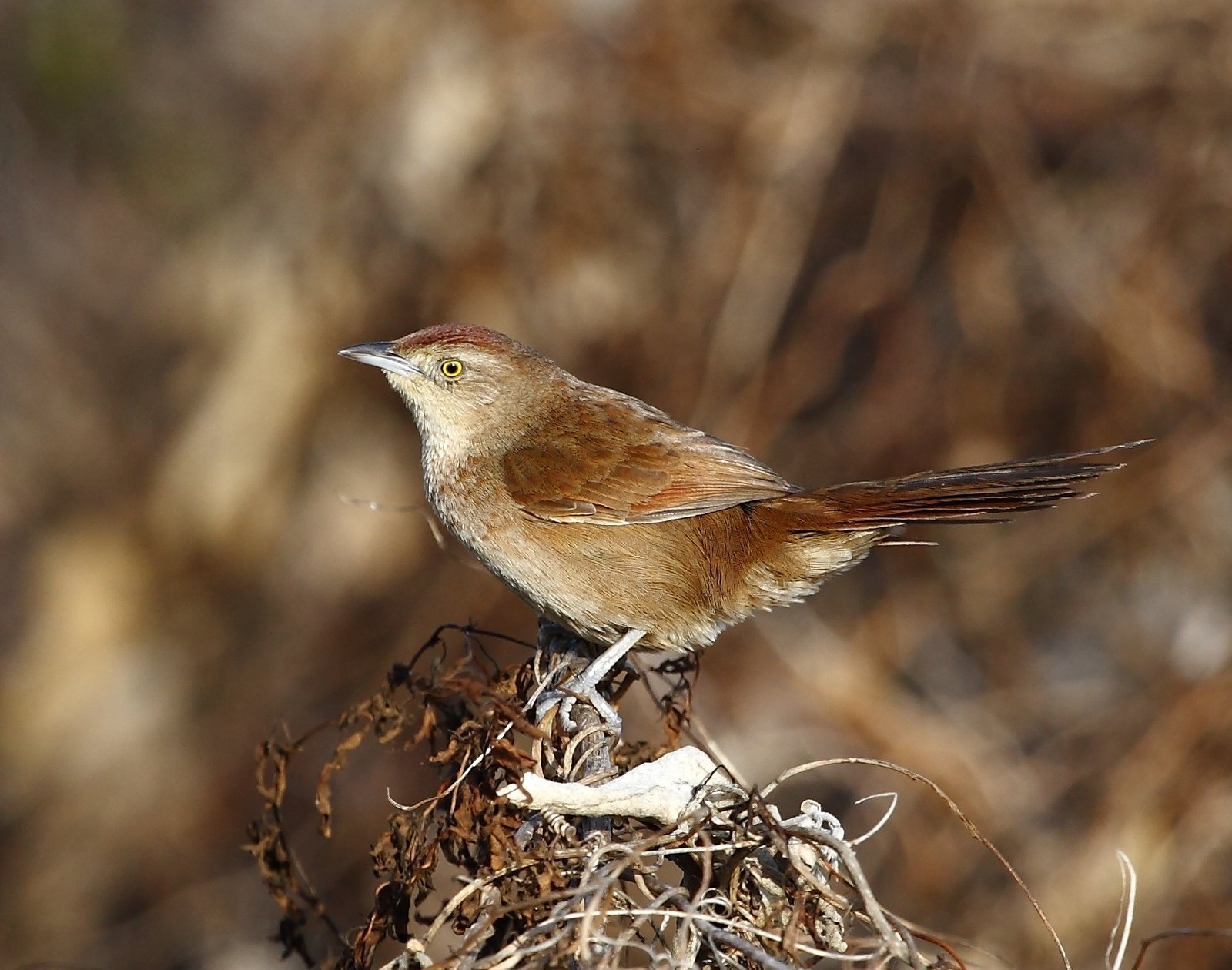
17 cm, with a straight, pointed bill and a fairly long tail. The crown and forehead are rufous, the upperparts brown, the wings and tail warmer rufous. A pale supercilium. The throat and upper breast are white with fine dark freckles, the rest of the underparts pale buff. The eye is pale. The sexes are alike.
Confusion species
Spot-breasted Thornbird Phacellodomus maculipectus has coarser spots on a buff breast and lives in montane forest. Greater Thornbird Phacellodomus ruber is larger, without freckles on the breast, and has a yellow eye. Rufous-fronted Thornbird Phacellodomus rufifrons has only a rufous forehead and an unspotted breast.
Habitat
Scrub at the edge of marshes, riverside woodland and overgrown forest edges in the lowlands. It searches for insects in dense vegetation. The nest is a pile of twigs in shrubs or low trees, often over water.
Where the bird is most at home, classified by the vegetation units of the Andes and the west coast.


Range and movements
In the guide area only a few isolated reports; there is no established population in Colombia, Ecuador, Peru, Bolivia or the Galápagos. Outside the guide area in south-eastern Brazil, eastern Paraguay, Uruguay and north-eastern Argentina.
How and when to look
A vagrant is most likely in eastern Bolivia, in riverside scrub and marsh edges; every record deserves good documentation with photographs or a sound recording.
Conservation status
Least Concern. As a vagrant the species is of no significance in the guide area.
Scientific name
Phacellodomus striaticollis | (d'Orbigny, ACVMD & de Lafresnaye, 1838)
D'Orbigny, ACVMD & de Lafresnaye described the species in 1838 as Anumbius striaticollis; because it was later moved to another genus, the author and year stand in brackets. The genus Phacellodomus was introduced in 1853 by Reichenbach. The genus name combines Greek phakellos, 'bundle of twigs', and domos, 'house', after the large stick nests. The species name striaticollis comes from Latin striatus, 'streaked', and collum, 'neck': 'streak-necked'. The specimen the first description was based on came from Buenos Aires, Argentina.