All species › Passerines › Tanagers and allies › Cinereous Conebill
Cinereous Conebill | Conirostrum cinereum
Grijze spitssnavel | Picocono cinéreo | Figuinha-cinzenta
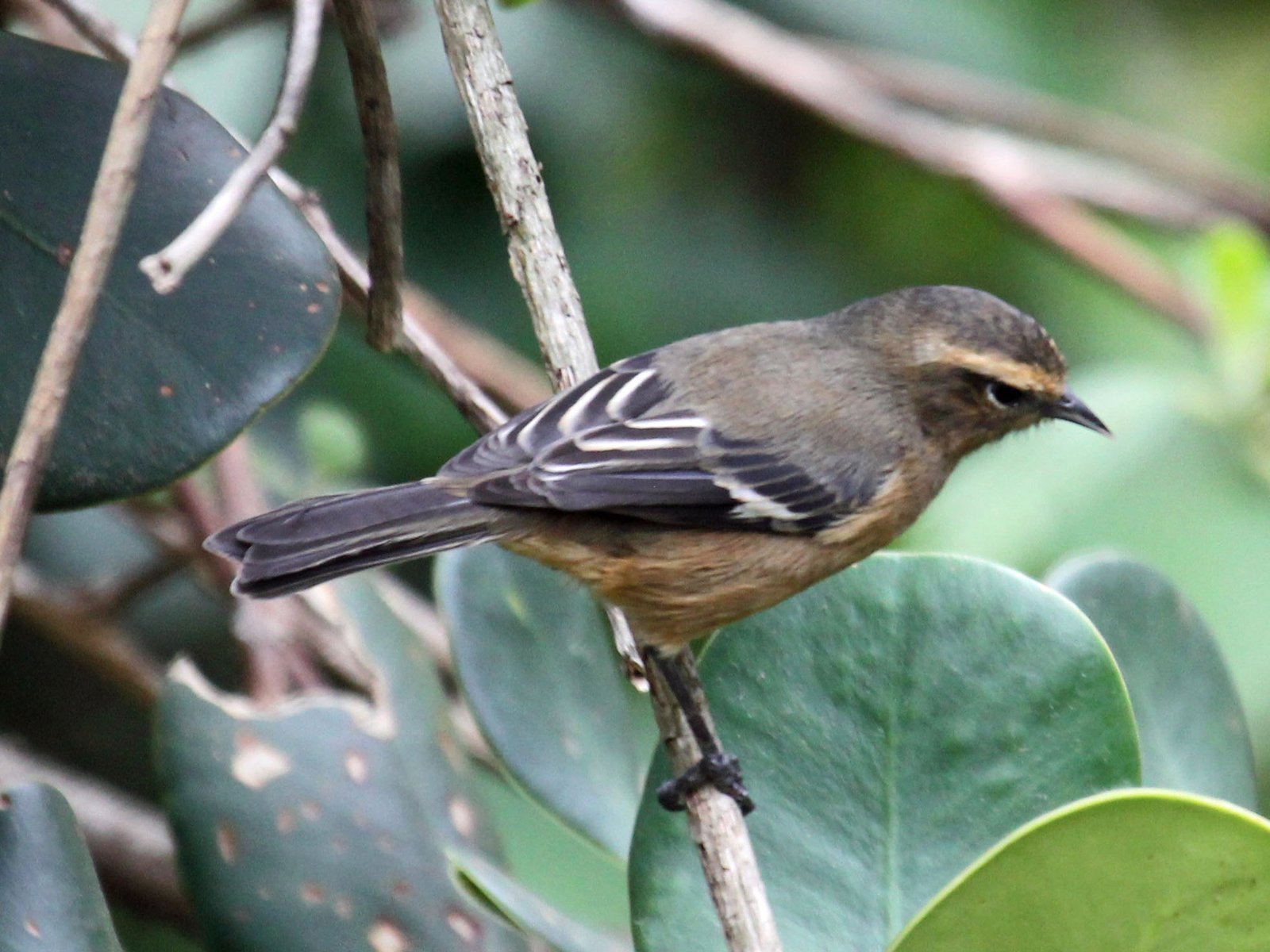
The Cinereous Conebill is a small grey conebill with a white eyebrow and a white wing patch, the most widespread conebill of the open, dry highlands. It lives in scrub, Polylepis groves, hedgerows and gardens, and in Peru also along the desert coast. Pairs and small groups move restlessly among the twigs in search of insects.
Voice
High, thin tsip calls. The song is a rapid, high, rather scratchy series of twittering notes.
Recording: Étienne Leroy — CC BY-NC-SA 4.0 · xeno-canto
Identification
12–13 cm, with a fine, pointed bill. The upperparts are grey to olive-grey, the crown darker, with a conspicuous white to yellowish eyebrow. The wings are dark, with a white patch at the base of the primaries and often a pale wing bar. The underparts are buff to pale grey. Birds from Ecuador and southern Colombia (fraseri) are warmer buff below; the coastal form littorale in Peru is paler and greyer. The sexes are alike. Juveniles are browner, with a fainter eyebrow.
Confusion species
Tamarugo Conebill Conirostrum tamarugense in southern Peru has a rufous eyebrow and throat. White-browed Conebill Conirostrum ferrugineiventre is dark slate-grey with a rufous belly and lives in humid montane forest. Flowerpiercers (Diglossa) have a hook-tipped bill and no white wing patch.
Habitat
Dry and semi-humid scrub, Polylepis groves, hedgerows, field edges, gardens and eucalyptus plantations in the Andes, roughly between 2000 and 4300 m. The coastal form in Peru lives in gardens, riparian scrub and lomas down to sea level. It forages in pairs or small groups for insects in foliage and at flowers, often in small mixed groups.
Where the bird is most at home, classified by the vegetation units of the Andes and the west coast.


Range and movements
In Colombia only in the south, in Nariño and Cauca. In Ecuador in the Andes and inter-Andean valleys. In Peru in the Andes throughout the country and along the central and southern coast. In Bolivia in the Andes and dry valleys. Absent from the Galápagos. Outside the guide area in northern Chile.
- Resident
- dark = core range, pale = thinly spread
How and when to look
Check hedgerows, gardens and shrubs around Andean villages and Polylepis groves; the white eyebrow and white wing patch stand out as the bird moves among the twigs. In Lima the coastal form lives in parks and gardens.
Conservation status
Least Concern. Common; the species adapts well to farmland, hedgerows and plantations.
Scientific name
Conirostrum cinereum | d'Orbigny, ACVMD & de Lafresnaye, 1838
D'Orbigny, ACVMD & de Lafresnaye described the species in 1838 and placed it straight away in the genus where it still stands. He introduced the genus Conirostrum in that same work. The genus name combines Latin conus, 'cone', and rostrum, 'bill'. The species name is Latin cinereus, 'ash-grey'. The specimen the first description was based on came from Yungas, Bolivia.