All species › Passerines › Tanagers and allies › Guira Tanager
Guira Tanager | Hemithraupis guira
Guiratangare | Tangara güira | Saíra-de-papo-preto
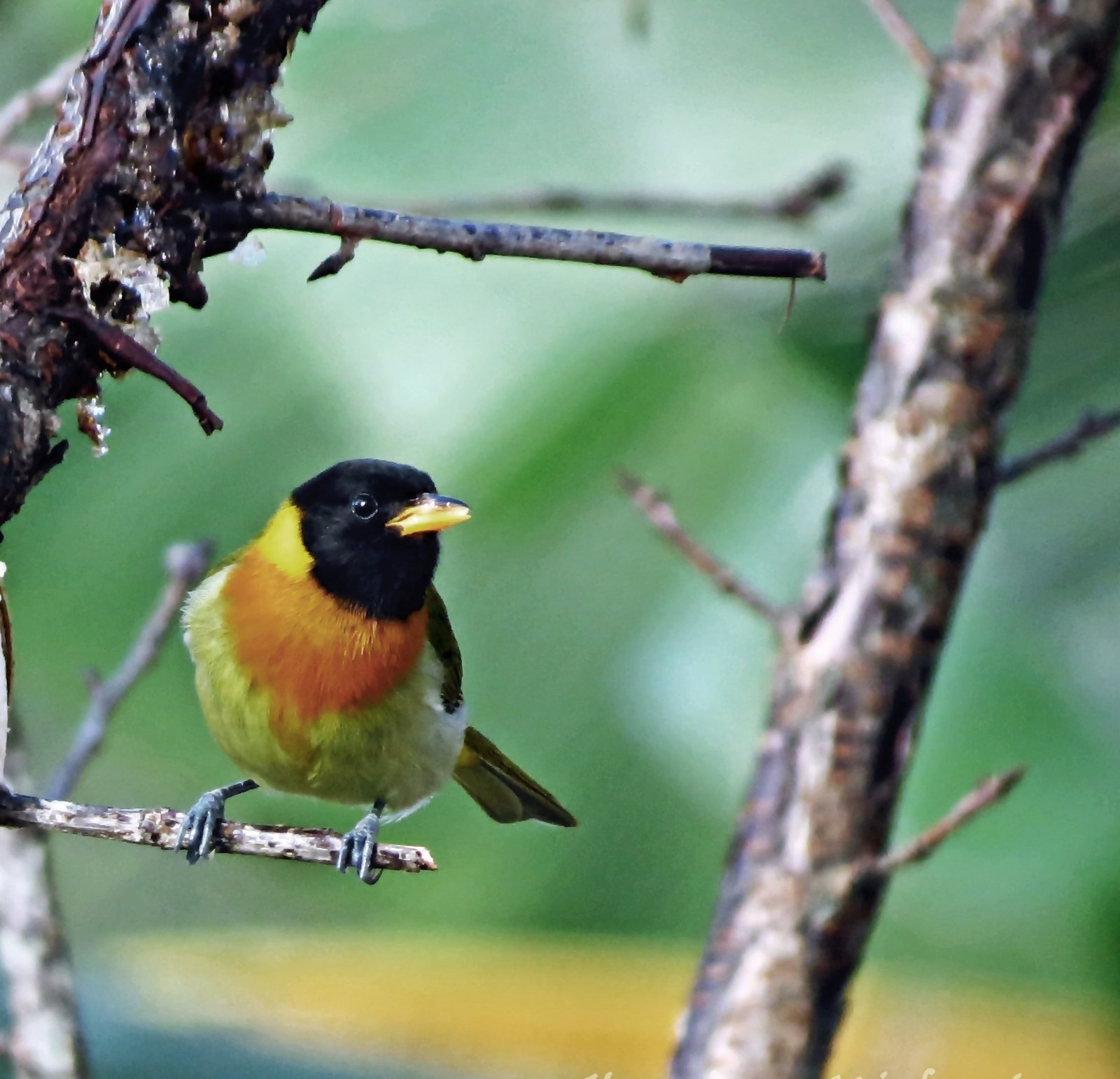
The Guira Tanager is a small, active canopy tanager, widespread in South America. The male has a black face and throat bordered by a yellow stripe, and an orange-red breast. In the guide area it lives both in dry forest on the west coast and in humid and dry forest east of the Andes.
Voice
The song is a rapid, high series of thin notes, tsee-tsee-tsee-tsee; also high tsip calls.
Recording: JAYRSON ARAUJO DE OLIVEIRA — CC BY-NC-SA 4.0 · xeno-canto
Identification
13 cm, with a thin, pointed bill, dark above and paler below. The male is olive-green above with a yellow rump. Face and throat are black, bordered by a yellow eyebrow that curves down the side of the neck behind the eye; the breast is orange-red to rufous, the belly greyish-yellow. The female is olive-green above and yellowish below, with a faint yellow eye-ring and eyebrow and a yellowish rump. Young birds resemble the female.
Confusion species
The male Yellow-backed Tanager Hemithraupis flavicollis has black upperparts, a yellow throat and a whitish belly. The females of the two species are much alike; the female Yellow-backed Tanager is darker above and has a whitish belly. Tropical Parula Setophaga pitiayumi has blue-grey upperparts and white wingbars.
Habitat
Canopy and edges of dry and semi-humid forest, gallery forest and humid lowland forest, also secondary forest and trees in semi-open country, up to about 1500 m, locally higher. It actively searches the foliage for insects and also eats small fruits, in pairs or in mixed flocks. The nest is a small cup high in a tree.
Where the bird is most at home, classified by the vegetation units of the Andes and the west coast.


Range and movements
In Colombia in the Caribbean lowlands and the Magdalena valley, and east of the Andes in the llanos and Amazonia. In Ecuador in the west in dry and semi-humid forest, and in the eastern lowlands. In Peru in the north-west (Tumbes and Piura) and east of the Andes. In Bolivia widespread in the lowlands and in the dry valleys at the foot of the Andes. Absent from the Galápagos. Outside the guide area in Venezuela, the Guianas, Brazil, Paraguay and northern Argentina.
- Resident
- dark = core range, pale = thinly spread
How and when to look
In the Tumbesian dry forest of western Ecuador and north-western Peru, and in Bolivia in lowland dry forest and gallery forest, where pairs move through the canopy with mixed flocks. The high song helps in tracking it down.
Conservation status
Least Concern. Widespread and locally common, also in secondary forest and semi-open landscapes.
Scientific name
Hemithraupis guira | (Linnaeus, 1766)
Linnaeus described the species in 1766 as Motacilla Guira; because it was later moved to another genus, the author and year stand in brackets. The genus Hemithraupis was introduced in 1851 by Cabanis. The genus name comes from Greek hēmi, 'half, small', and thraupis, an unknown small bird. The species name is a Guaraní word meaning 'bird'. The specimen the first description was based on came from Pernambuco, Brazil.