All species › Passerines › Tanagers and allies › Yellow-backed Tanager
Yellow-backed Tanager | Hemithraupis flavicollis
Geelstuittangare | Tangara lomiamarilla | Saíra-galega
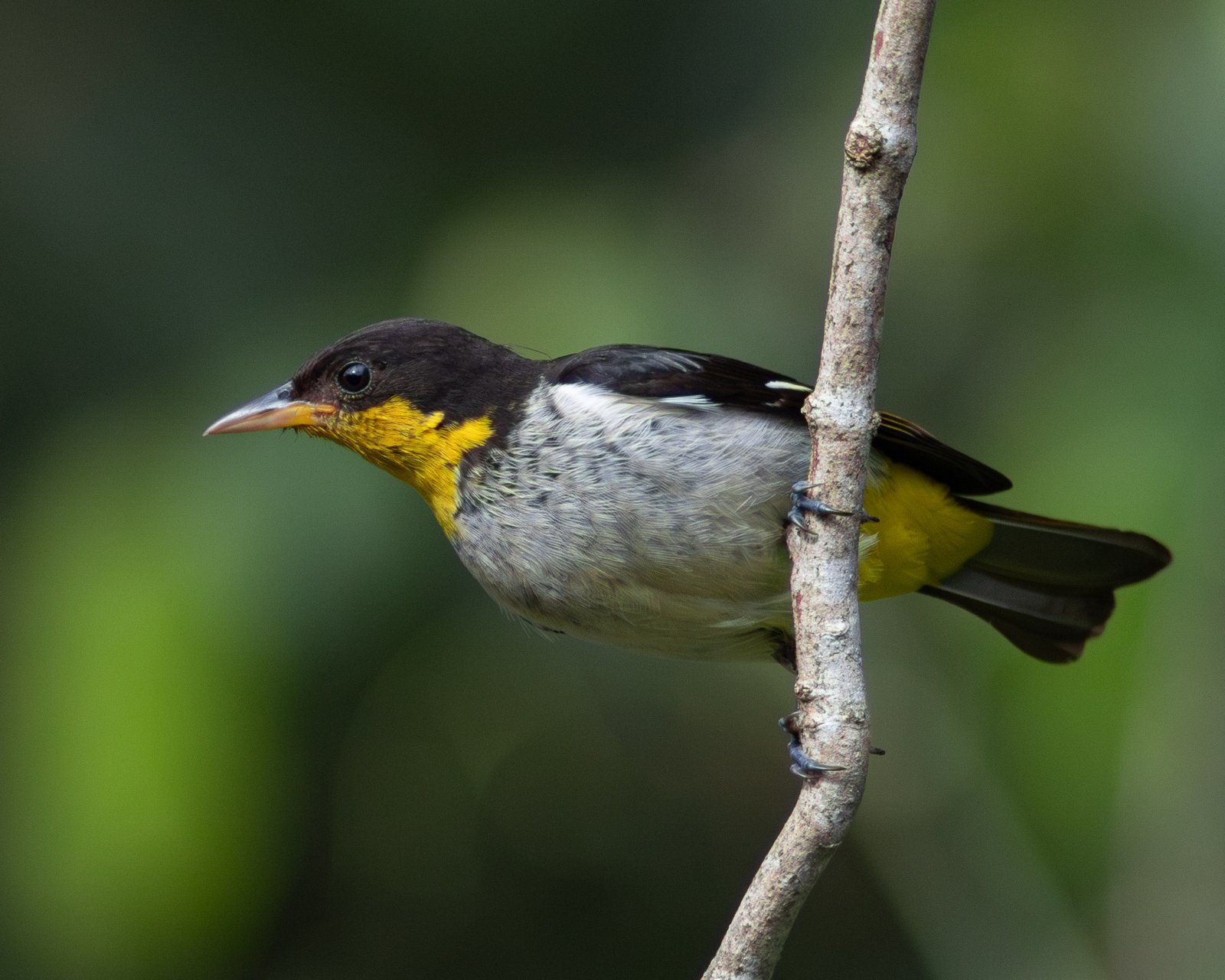
The Yellow-backed Tanager is a small canopy tanager of the humid lowlands. The male has black upperparts, a bright yellow throat and a yellow lower back and rump. It almost always travels with mixed flocks high in the canopy.
Voice
High, thin tsit calls; the song is a rapid series of high, squeaky notes.
Recording: Juan Freile — CC BY-NC-SA 4.0 · xeno-canto
Identification
13 cm, with a thin, pointed bill, dark with a paler lower mandible. The male has a black head, mantle, wings and tail, a yellow lower back and rump, a bright yellow throat and white to greyish-white underparts. The female is olive-green above, with a yellowish throat and breast and a whitish belly. Young birds resemble the female.
Confusion species
The male Guira Tanager Hemithraupis guira has olive-green upperparts, a black face bordered with yellow and an orange-red breast. The females of the two species are alike; the female Guira Tanager is paler above and more uniformly yellow below. The male Black-and-yellow Tanager Chrysothlypis chrysomelas, only on the border with Panama, has a yellow head and entirely yellow underparts.
Habitat
Canopy and edges of humid lowland forest, both terra firme and várzea, and of foothill forest, up to about 1100 m. It actively searches the foliage for insects and eats small fruits, almost always in mixed flocks with tanagers and dacnises.
Where the bird is most at home, classified by the vegetation units of the Andes and the west coast.


Range and movements
In Colombia in the north-west and north, and east of the Andes in Amazonia. In Ecuador and Peru in the lowlands and foothills east of the Andes. In Bolivia in the north. Absent from the Galápagos. Outside the guide area in eastern Panama, Venezuela, the Guianas and Brazil, including part of the Atlantic Forest.
- Resident
- dark = core range, pale = thinly spread
How and when to look
From canopy towers and walkways at lodges in Amazonian Ecuador and Peru, where it travels with mixed flocks. Watch for the yellow throat and rump on birds foraging high in the treetops.
Conservation status
Least Concern. Widespread in large, continuous forest, but locally affected by deforestation.
Scientific name
Hemithraupis flavicollis | (Vieillot, 1818)
Vieillot described the species in 1818 as Nemosia flavicollis; because it was later moved to another genus, the author and year stand in brackets. The genus Hemithraupis was introduced in 1851 by Cabanis. The genus name comes from Greek hēmi, 'half, small', and thraupis, an unknown small bird. The species name comes from Latin flavus, 'yellow', and collis, 'neck': yellow-necked. The specimen the first description was based on came from Cayenne, French Guiana.