All species › Passerines › Tanagers and allies › Yellow-shouldered Grosbeak
Yellow-shouldered Grosbeak | Parkerthraustes humeralis
Geelschouderkardinaal | Picogrueso humeral | Furriel-de-encontro
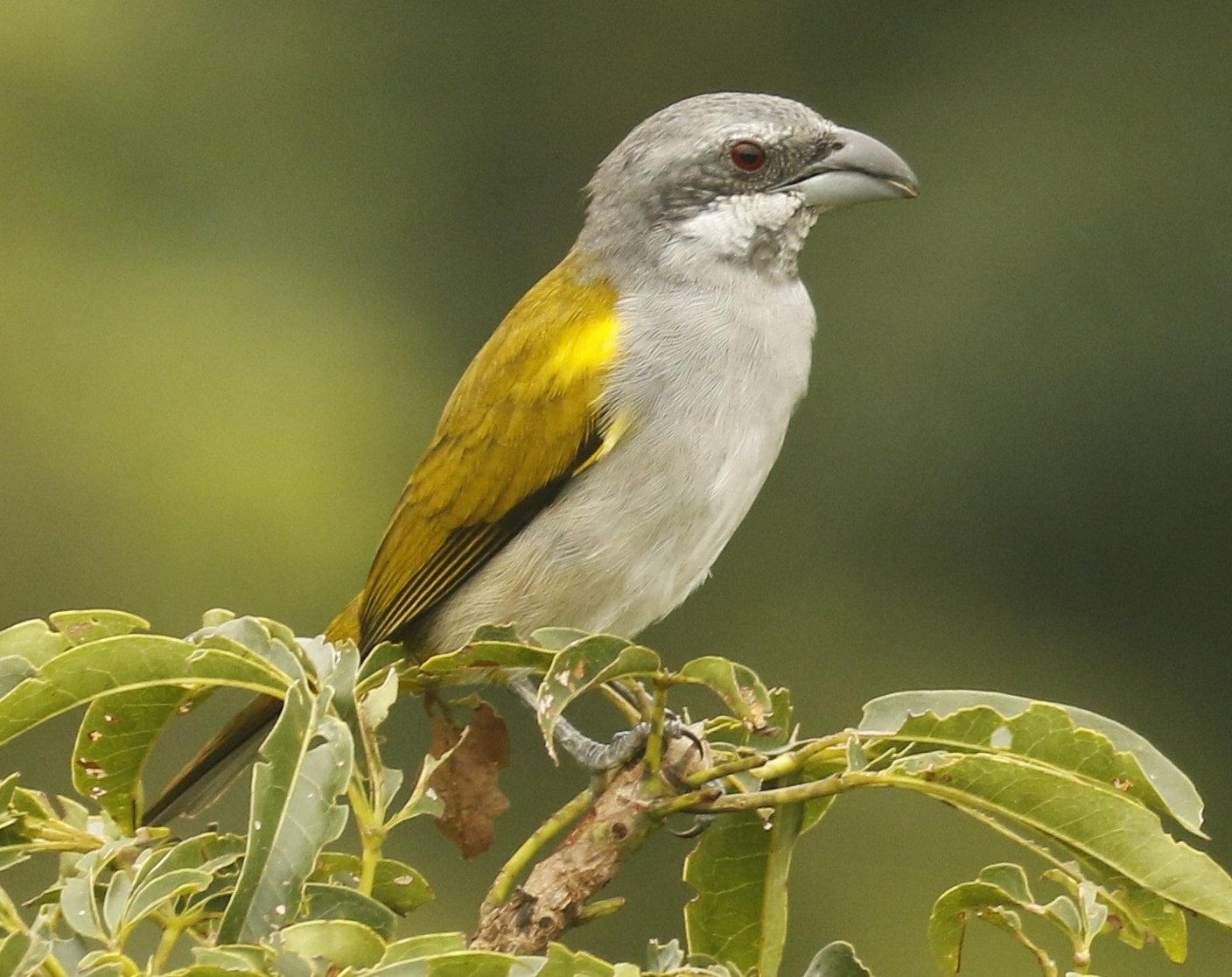
The Yellow-shouldered Grosbeak is a sturdy, grey and olive-green tanager with a thick black bill from the canopy of Amazonian forest. It is the only species in its genus and was formerly placed with the cardinal-grosbeaks. It usually moves in pairs or small groups with mixed flocks high in the canopy.
Voice
Gives high, thin tseep notes; the song is a short series of high, clear whistles. Its voice is inconspicuous among the calls of a mixed flock.
Recording: JAYRSON ARAUJO DE OLIVEIRA — CC BY-NC-SA 4.0 · xeno-canto
Identification
16 cm, stocky, with a heavy, conical black bill. The crown and hindneck are blue-grey; the face is black, the throat white and bordered black on each side. The back, wings and tail are olive-green; on the shoulder there is a yellow patch that is often hidden by the feathers. The underparts are grey, the undertail coverts yellow. The sexes are alike; juveniles are duller, with less black on the face.
Confusion species
Buff-throated Saltator Saltator maximus is larger and longer-tailed, with a pale supercilium and an ochre throat bordered black. Slate-colored Grosbeak Saltator grossus is uniformly slate-grey with a red bill. Yellow-green Grosbeak Caryothraustes canadensis has a yellow-green head with a black mask and no grey crown.
Habitat
Canopy and tall edges of humid terra firme lowland forest, locally also in the foothills up to about 1000 m. It searches the canopy for insects and also eats seeds and fruit. It almost always joins canopy mixed flocks. Little is known about the nest.
Where the bird is most at home, classified by the vegetation units of the Andes and the west coast.


Range and movements
In Colombia scarce in the south-east, east of the Andes. In Ecuador and Peru widespread in the Amazonian lowlands and lower foothills. In Bolivia in the north and along the base of the Andes. Does not occur on the Galápagos. Outside the guide area in Amazonian Brazil and locally in southern Venezuela.
- Resident
- dark = core range, pale = thinly spread
How and when to look
From canopy towers and walkways at lodges in Amazonian Ecuador and Peru, where it moves with mixed flocks through the canopy. Look for a grey head with a black face among the tanagers.
Conservation status
Least Concern. Scarce but widespread in large, continuous forest; suffers locally from deforestation.
Scientific name
Parkerthraustes humeralis | (Lawrence, 1867)
Lawrence described the species in 1867 as Pytilus (Caryothraustes) humeralis; because it was later moved to another genus, the author and year stand in brackets. The genus Parkerthraustes was introduced in 1997 by Remsen. The genus name honours the American ornithologist Theodore A. 'Ted' Parker III (1953–1993), a specialist in Neotropical birds, combined with -thraustes from Caryothraustes, from Greek thraustēs, 'breaker'. The species name comes from Latin humerus, 'shoulder', after the yellow shoulder patch. The specimen the first description was based on came from Bogotá, Colombia.