All species › Passerines › Tanagers and allies › Scarlet-browed Tanager
Scarlet-browed Tanager | Heterospingus xanthopygius
Wenkbrauwkuiftangare | Tangara cejirroja | Tiê-de-sobrancelha-vermelha
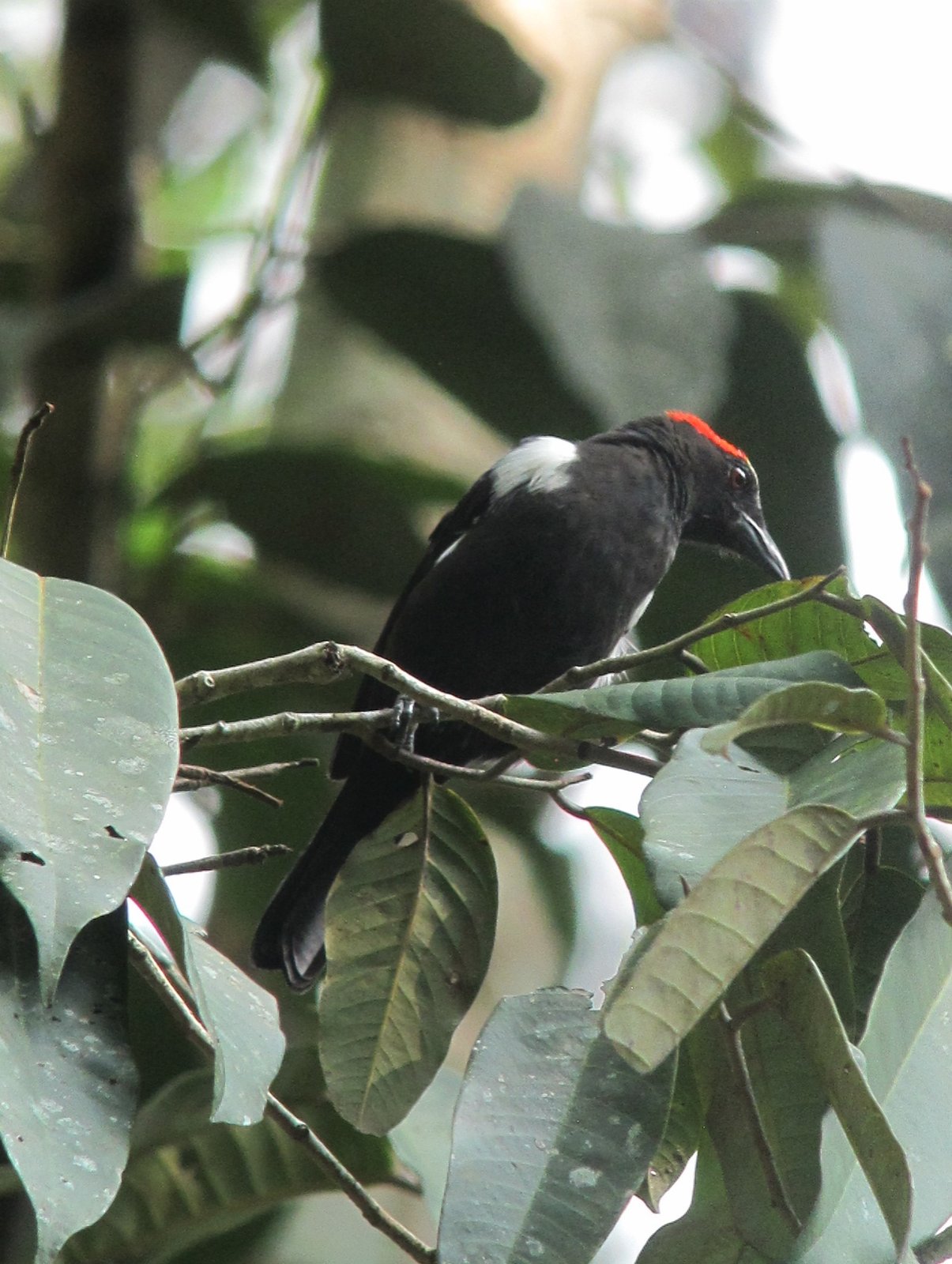
The Scarlet-browed Tanager is a tanager of the Chocó lowlands; the black male has a red stripe behind the eye, white breast tufts and a yellow rump. Pairs often perch high on bare branches above the canopy and join mixed flocks.
Voice
Sharp, metallic chip calls and a short song of high, squeaky notes; rather poorly described.
Recording: Juan Freile — CC BY-NC-SA 4.0 · xeno-canto
Identification
16–17 cm, with a fairly heavy, dark bill. The male is black, with a narrow scarlet stripe behind the eye, a white tuft on the side of the breast and a bright yellow rump. The female is dark grey, paler below, likewise with a yellow rump and white breast tufts but without red. Young birds resemble the female.
Confusion species
Sulphur-rumped Tanager Heterospingus rubrifrons of Costa Rica and Panama closely resembles the female; see that species. The male White-shouldered Tanager Loriotus luctuosus is smaller, black with a large white shoulder patch and no yellow rump. The male Flame-rumped Tanager Ramphocelus flammigerus is black with a yellow to orange-red rump, but has a pale bill and no red eye-stripe.
Habitat
Canopy and edges of wet lowland and foothill forest, also tall secondary forest and forest edges along clearings, up to about 1000 m. It eats fruit and insects, often in pairs in mixed flocks with other tanagers.
Where the bird is most at home, classified by the vegetation units of the Andes and the west coast.


Range and movements
In Colombia in the Pacific lowlands and foothills from Chocó to Nariño, and in the north in Córdoba and Antioquia into the Magdalena valley. In Ecuador in the north-western lowlands and foothills, mainly in Esmeraldas and northern Pichincha. Absent from Peru, Bolivia and the Galápagos. Outside the guide area in eastern Panama.
- Resident
- dark = core range, pale = thinly spread
How and when to look
In north-western Ecuador at Río Silanche and other forest remnants in the foothills, where pairs move through the canopy with mixed flocks; a canopy tower gives a view of the bare branches where it often perches.
Conservation status
Least Concern. The lowlands of western Ecuador are heavily deforested, so there the species is confined to forest remnants.
Scientific name
Heterospingus xanthopygius | (Sclater, 1855)
Sclater described the species in 1855 as Tachyphonus xanthopygius; because it was later moved to another genus, the author and year stand in brackets. The genus Heterospingus was introduced in 1898 by Ridgway. The genus name combines Greek heteros, 'different', with spingos, 'finch'. The species name comes from Greek xanthos, 'yellow', and pugē, 'rump'. The specimen the first description was based on came from Colombia (Bogotá skin).