All species › Passerines › Tanagers and allies › Cinereous Finch
Cinereous Finch | Piezorina cinerea
Dikbekgors | Yal cinéreo | Tico-tico-cinéreo
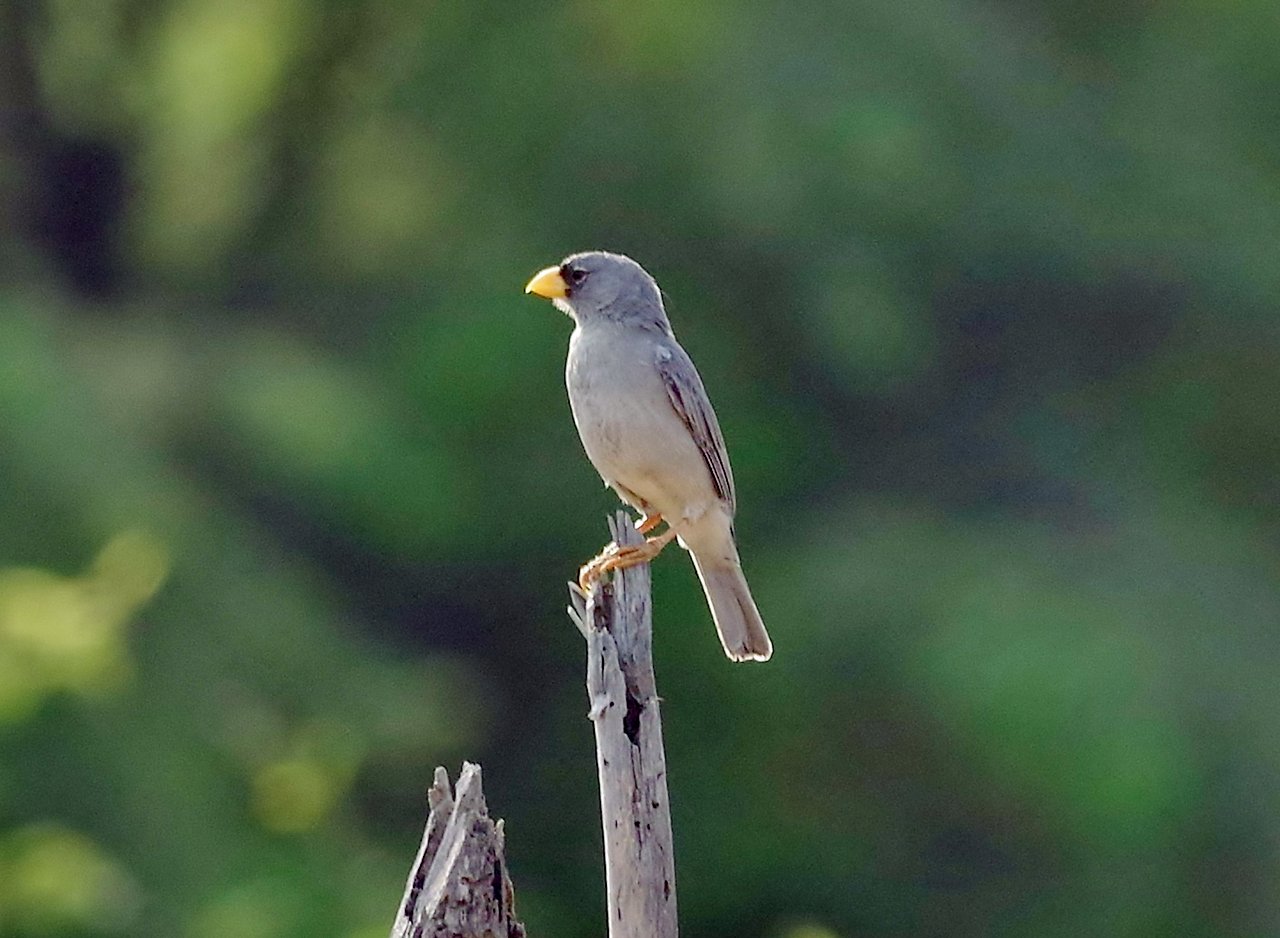
The Cinereous Finch is a large, pale grey finch of the coastal desert of north-western Peru and the only species in its genus. The heavy, orange-yellow bill and the black lores stand out against the pale plumage. The species does not occur outside the guide area.
Voice
The song is a short, repeated series of clear, rather shrill whistles and chips, often given from a bush or post. The call is a metallic chip.
Recording: Bob Planqué — CC BY-NC-SA 3.0 · xeno-canto
Identification
16 cm, stocky, with a heavy, conical, orange-yellow bill and yellowish legs. Upperparts uniform pale grey, underparts dull white, greyer on the breast and flanks. A small black loral spot and a narrow black edge around the base of the bill. Wings and tail slightly darker grey. The sexes are alike. Young birds are browner grey, with a duller bill.
Confusion species
Slender-billed Finch Xenospingus concolor is darker bluish grey, with a thin, pointed yellow bill and a longer tail, and lives further south, in vegetated river valleys. Grey-winged Inca Finch Incaspiza ortizi and Little Inca Finch Incaspiza watkinsi also have a yellow bill, but a black face and throat and rufous on the back or wings; they live in dry inland valleys. Collared Warbling Finch Poospiza hispaniolensis is smaller, with a pointed bill, a white eyebrow and, in the male, a black breast band.
Habitat
Coastal desert with scattered shrubs, dry scrub and open Prosopis woodland, also along field edges and near farms in the coastal lowlands, from sea level to roughly 300 m, locally higher. It forages mainly on the ground, on seeds, insects and small fruits. The nest is a cup in a shrub or low tree.
Where the bird is most at home, classified by the vegetation units of the Andes and the west coast.


Range and movements
Only in Peru: in the coastal desert of the north-west, from Tumbes and Piura through Lambayeque to La Libertad, with scattered records in western Cajamarca and south to Ancash. There is one record from Ecuador, probably of a wandering bird. Absent from Colombia, Bolivia and the Galápagos.
- Resident
- dark = core range, pale = thinly spread
How and when to look
Search dry Prosopis scrub and desert edges in Lambayeque and Piura. The birds forage on the ground between shrubs and fly up into a tree or bush when disturbed.
Conservation status
Least Concern. The range is limited, but the species is locally fairly common. Clearing of Prosopis woodland for charcoal and farming reduces its habitat.
Scientific name
Piezorina cinerea | (de Lafresnaye, 1843)
De Lafresnaye described the species in 1843 as Guiraca cinerea; because it was later moved to another genus, the author and year stand in brackets. The genus Piezorina was introduced in 1843 by De Lafresnaye. The genus name combines Ancient Greek piezō, 'to crush', and rhis (rhinos), 'nose'. The species name is Latin cinereus, 'ash-grey'. The specimen the first description was based on came from northwestern Peru.