All species › Passerines › Tanagers and allies › Red-crested Cardinal
Red-crested Cardinal | Paroaria coronata
Roodkuifkardinaal | Cardenal común | Cardeal
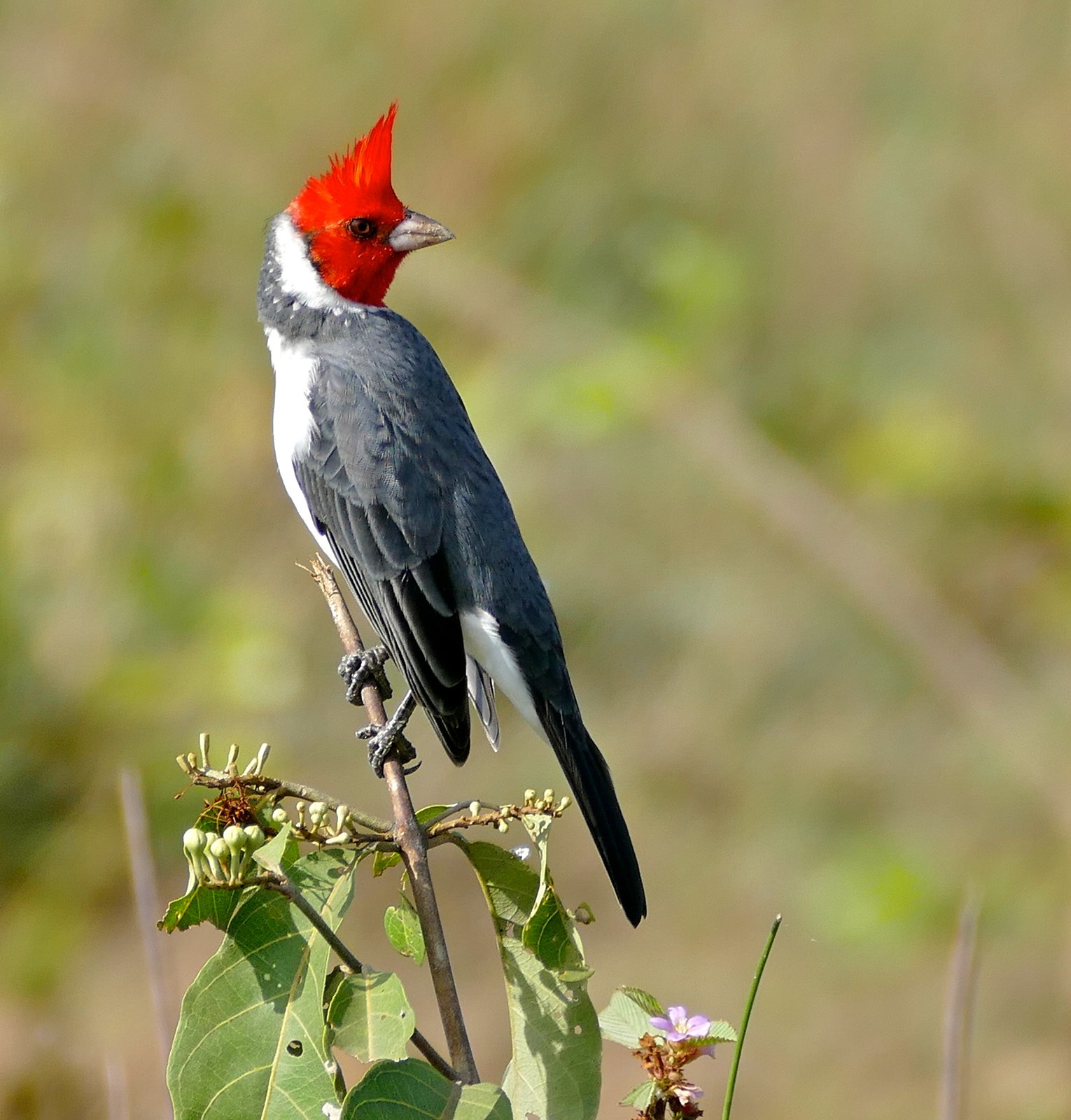
The Red-crested Cardinal is a grey-and-white cardinal with a red head, a pointed red crest and a red throat, of the dry and semi-open lowlands of southern South America. In the guide area it occurs only in eastern and south-eastern Bolivia. It is widely kept as a cage bird and has been introduced outside its native range, among other places in Hawaii.
Voice
The song is a series of clear, whistled phrases, often repeated from a perch in a shrub or tree. The call is a sharp chip.
Recording: Pedro Sanetti — CC0 1.0 · xeno-canto
Identification
19 cm, with a conical, whitish to horn-coloured bill. The head, crest, throat and a point on the upper breast are bright red. The upperparts, wings and tail are grey; a white band runs from the underparts onto the sides of the neck; the underparts are white. The sexes are alike. Juveniles have an orange-brown instead of red head.
Confusion species
Yellow-billed Cardinal Paroaria capitata has no crest, a black throat and blackish upperparts, and an orange-yellow bill and legs. Red-capped Cardinal Paroaria gularis also lacks a crest, has a black throat and blackish upperparts, and lives along rivers in Amazonia.
Habitat
Dry scrub, open dry woodland, savanna with shrubs, riparian woodland and marsh edges, also pasture with trees, farmyards, gardens and parks, in the lowlands. It forages much on the ground for seeds and insects, and also eats fruit. The nest is a cup of grass and twigs in a shrub or tree.
Where the bird is most at home, classified by the vegetation units of the Andes and the west coast.


Range and movements
In Bolivia in the lowlands of the east and south-east, mainly in the Chaco. Absent from Colombia, Ecuador, Peru and the Galápagos. Outside the guide area in Paraguay, northern and central Argentina, Uruguay and southern Brazil; introduced in Hawaii.
- Resident
- dark = core range, pale = thinly spread
How and when to look
Search the Chaco of south-eastern Bolivia along shrubby roadsides, around farms and near water; pairs often forage in the open on the ground.
Conservation status
Least Concern. Widespread and locally common, but heavily trapped for the cage-bird trade.
Scientific name
Paroaria coronata | (Miller, 1776)
Miller described the species in 1776 as Loxia coronata; because it was later moved to another genus, the author and year stand in brackets. The genus Paroaria was introduced in 1832 by Bonaparte. The genus name comes from Tupi paroára, a name for a small yellow, red and grey bird. The species name is Latin coronatus, 'crowned', referring to the red crest. The specimen the first description was based on came from Rio Grande do Sul, Brazil.