All species › Passerines › Tanagers and allies › Masked Cardinal
Masked Cardinal | Paroaria nigrogenis
Maskerkardinaal | Cardenal enmascarado | Cardeal-de-máscara
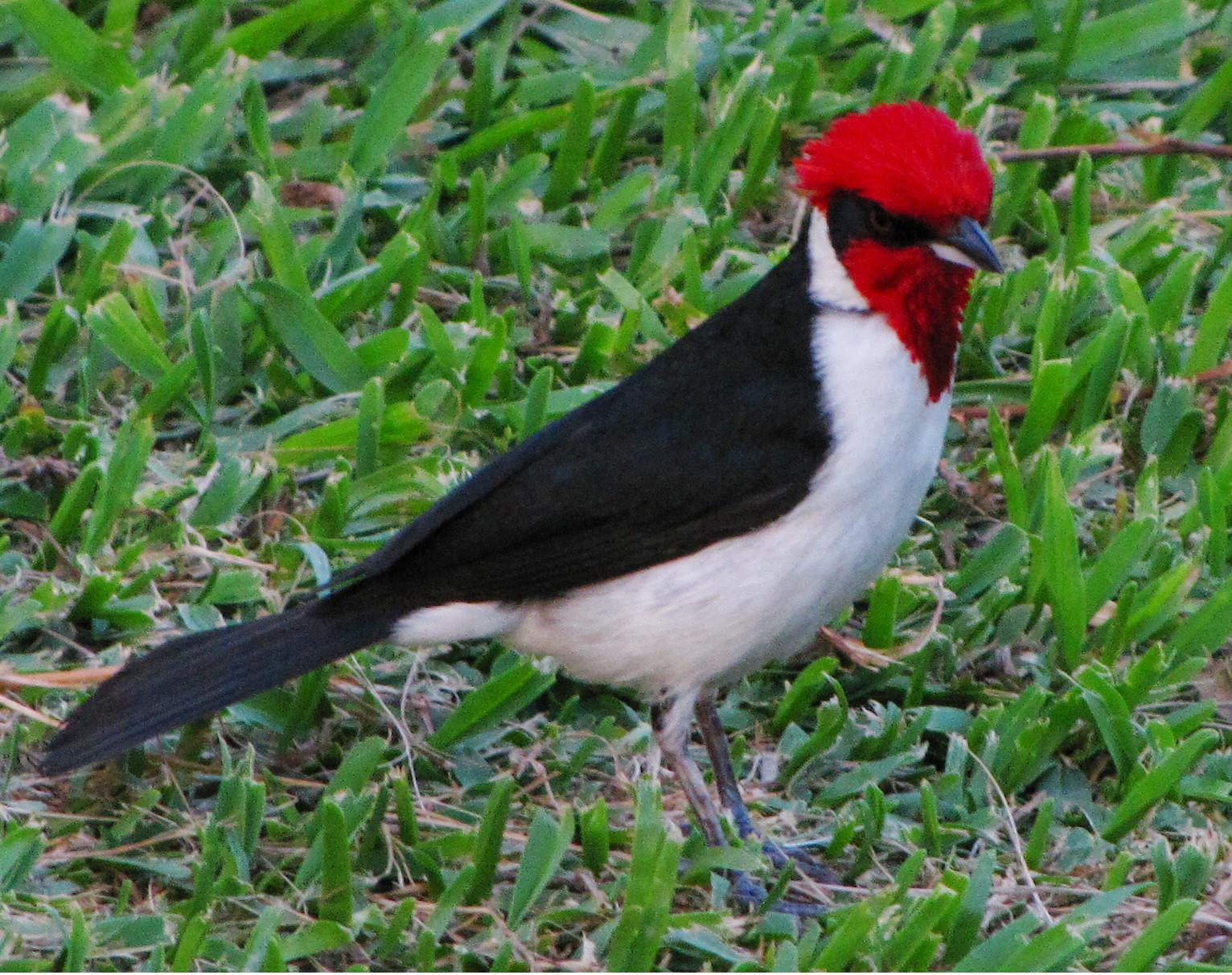
The Masked Cardinal is a red, black and white cardinal of the Llanos and the wet savannas of northern South America. It was long included in Red-capped Cardinal, but differs in its black cheeks and red instead of black throat. In the guide area it occurs only in north-eastern Colombia.
Voice
The song is a short, repeated series of clear, whistled notes. The call is a sharp chip.
Recording: Rosendo Manuel Fraga — CC BY-NC-SA 4.0 · xeno-canto
Identification
16–17 cm, with a conical bill, the upper mandible black and the lower mandible whitish to pale flesh. The head, throat and upper breast are red; the lores, ear-coverts and cheeks are black and form a mask. The upperparts, wings and tail are black; the underparts white. The sexes are alike. Juveniles have a brown instead of red head.
Confusion species
Red-capped Cardinal Paroaria gularis has a black throat and red cheeks; in the guide area it lives mainly farther south in Amazonia. Red-crested Cardinal Paroaria coronata has a crest and a grey back and occurs in the guide area only in Bolivia.
Habitat
Banks of rivers, lakes and lagoons, marshes, flooded savanna and shrubs and trees along water in the lowlands. It forages low in the vegetation and on the ground along the waterline for insects and seeds. The nest is an open cup in a shrub or tree, often over or near water.
Where the bird is most at home, classified by the vegetation units of the Andes and the west coast.


Range and movements
In Colombia only in the far north-east, adjoining the Llanos of Venezuela. Absent from Ecuador, Peru, Bolivia and the Galápagos. Outside the guide area in northern and central Venezuela and on Trinidad.
- Resident
- dark = core range, pale = thinly spread
How and when to look
Search the banks of rivers and lagoons in the Llanos; pairs often perch low in shrubs or on branches over the water.
Conservation status
Least Concern. Locally common in suitable habitat.
Scientific name
Paroaria nigrogenis | (de Lafresnaye, 1846)
De Lafresnaye described the species in 1846 as Nemosia nigro-genis; because it was later moved to another genus, the author and year stand in brackets. The genus Paroaria was introduced in 1832 by Bonaparte. The genus name comes from Tupi paroára, a name for a small yellow, red and grey bird. The species name comes from Latin niger, 'black', and gena, 'cheek', referring to the black mask. The specimen the first description was based on came from Orinoco Delta, Venezuela.