All species › Passerines › Tanagers and allies › Red-capped Cardinal
Red-capped Cardinal | Paroaria gularis
Zwartkeelkardinaal | Cardenilla capirroja | Cardeal-da-amazônia
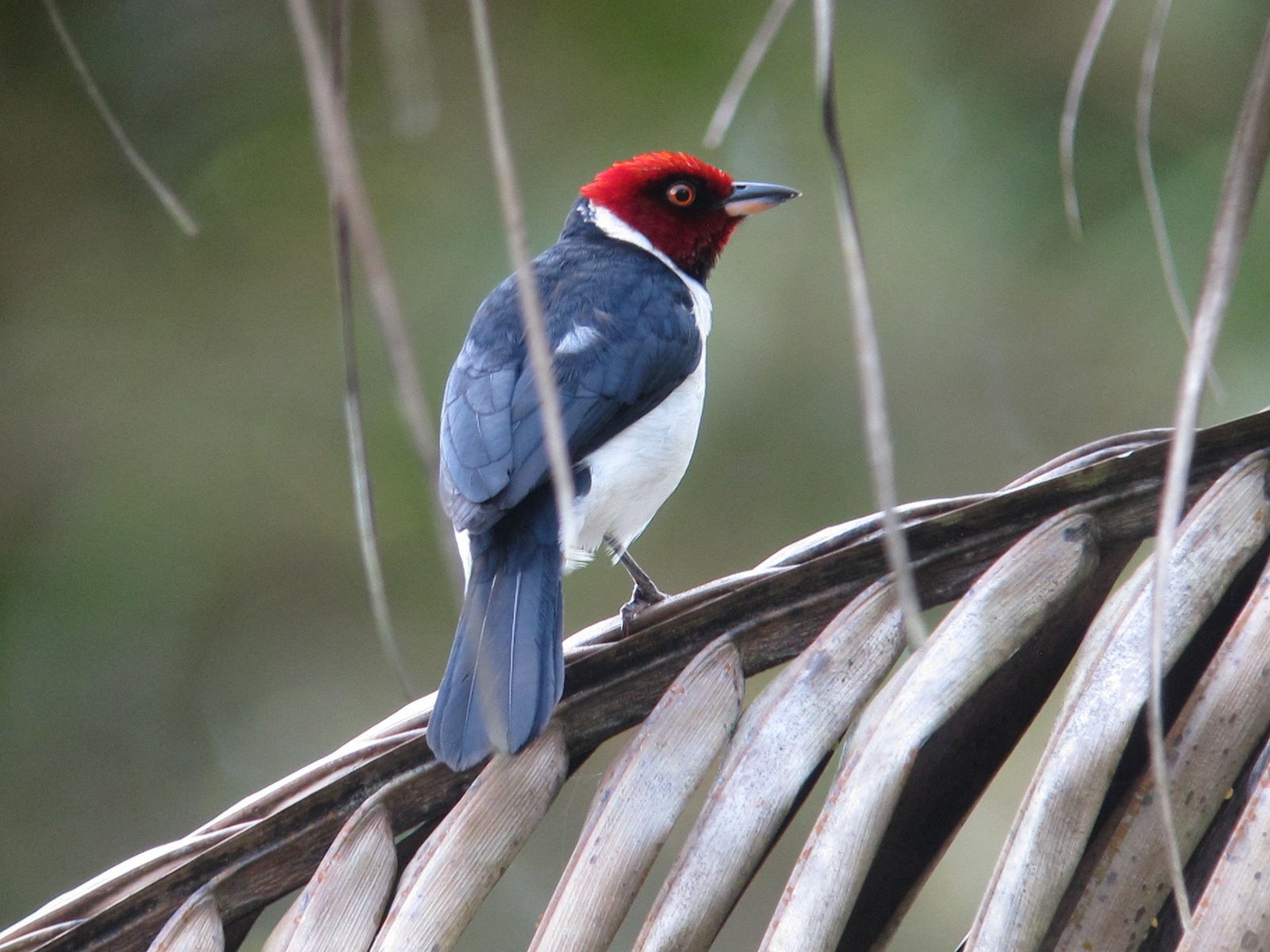
The Red-capped Cardinal is a small, red, black and white cardinal of river and lake shores in Amazonia. Pairs and family groups perch low in the bankside vegetation and forage down to just above the water. It is the commonest cardinal of the lowlands east of the Andes.
Voice
The song is a short, clear series of whistled notes, often repeated. The call is a sharp, metallic chip.
Recording: Mauricio Cuellar Ramirez (@Birding.travel) — CC BY-NC-SA 4.0 · xeno-canto
Identification
16–17 cm, with a conical bill, the upper mandible black and the lower mandible pale flesh. The head and crown are bright red, the lores black; a black throat patch ends in a point on the upper breast. The upperparts, wings and tail are glossy blue-black; a white band runs from the underparts onto the sides of the neck; the underparts are white. The sexes are alike. Juveniles have a brown head and a paler, buffy throat.
Confusion species
Yellow-billed Cardinal Paroaria capitata has an orange-yellow bill and orange-yellow legs; the ranges meet in Bolivia. Masked Cardinal Paroaria nigrogenis has black cheeks and a red throat and occurs only in north-eastern Colombia. Red-crested Cardinal Paroaria coronata has a crest, a red throat and a grey back.
Habitat
Bankside vegetation along rivers, lakes and oxbows (cochas), várzea, river islands, marshes and palm swamps, also around villages by the water, in the lowlands up to about 500 m. It forages low in shrubs, on floating vegetation and on the ground along the waterline for insects and seeds. The nest is an open cup in a shrub or tree, often over water.
Where the bird is most at home, classified by the vegetation units of the Andes and the west coast.


Range and movements
In Colombia east of the Andes in the Amazon and Orinoco basins. In Ecuador in the eastern lowlands. In Peru throughout the eastern lowlands. In Bolivia in the lowlands of the north and east. Absent west of the Andes and from the Galápagos. Outside the guide area in southern Venezuela, the Guianas and Amazonian Brazil.
- Resident
- dark = core range, pale = thinly spread
How and when to look
Travel by boat along the banks of rivers and cochas in Amazonia, for example around Iquitos or in Cuyabeno; birds often perch low in bankside vegetation and walk on floating plants.
Conservation status
Least Concern. Widespread and common along water in Amazonia.
Scientific name
Paroaria gularis | (Linnaeus, 1766)
Linnaeus described the species in 1766 as Tanagra gularis; because it was later moved to another genus, the author and year stand in brackets. The genus Paroaria was introduced in 1832 by Bonaparte. The genus name comes from Tupi paroára, a name for a small yellow, red and grey bird. The species name comes from Latin gula, 'throat', referring to the black throat. The specimen the first description was based on came from Cayenne, French Guiana.