All species › Passerines › Tanagers and allies › Yellow-billed Cardinal
Yellow-billed Cardinal | Paroaria capitata
Geelsnavelkardinaal | Cardenilla piquigualda | Cavalaria
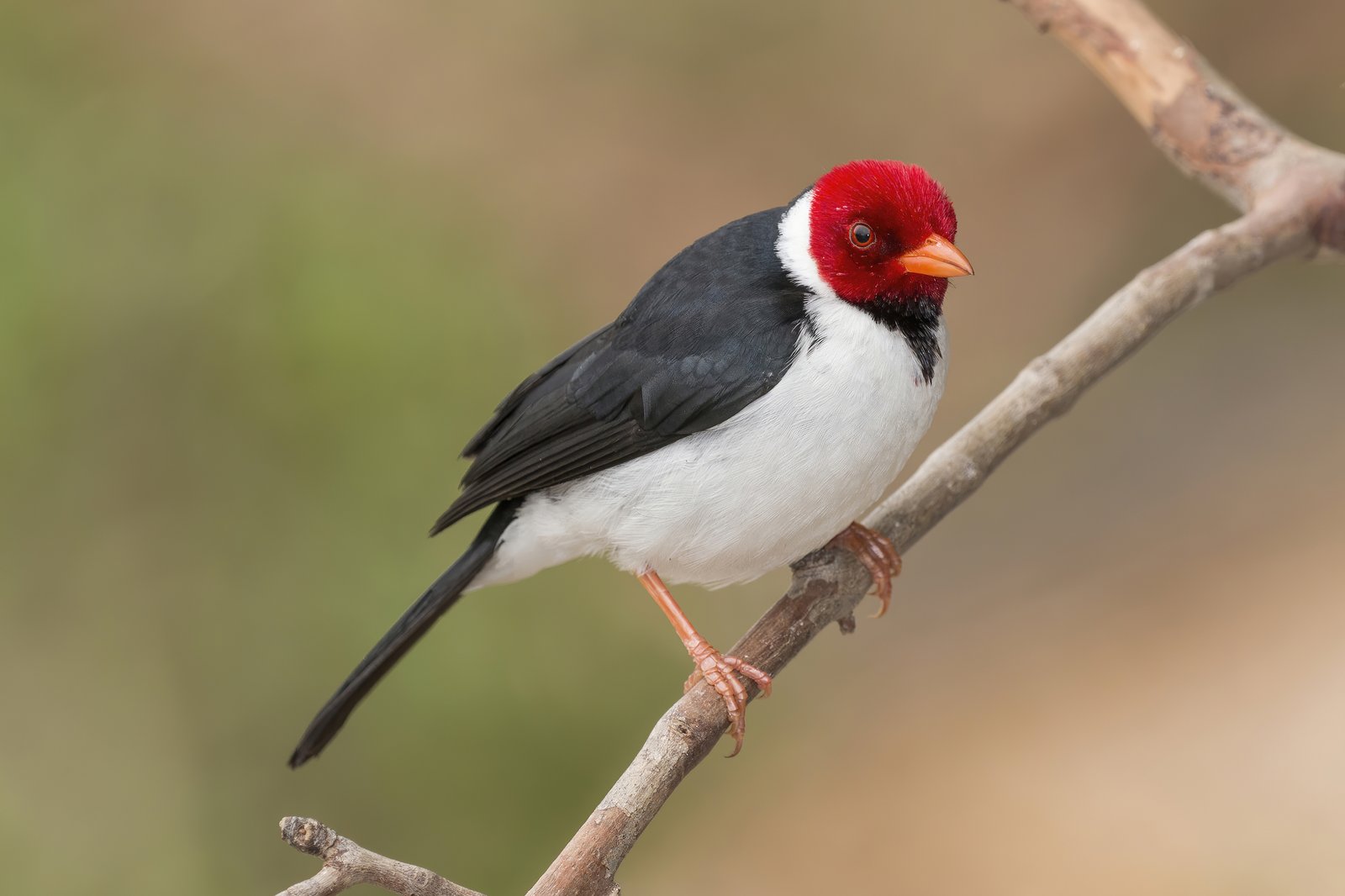
The Yellow-billed Cardinal is a small cardinal with a red head, a black throat and an orange-yellow bill and legs, of marshes and shores in the lowlands of central South America. In the guide area it occurs only in eastern Bolivia. Pairs and small groups perch low in vegetation along water.
Voice
The song is a short, repeated series of clear, whistled notes. The call is a sharp chip.
Recording: Luciano Buck — CC BY-NC-SA 4.0 · xeno-canto
Identification
16–17 cm, with a conical, orange-yellow bill and orange-yellow legs. The head and crown are red; a small black throat patch extends onto the upper breast. The upperparts, wings and tail are blackish; a white band runs onto the sides of the neck; the underparts are white. The sexes are alike. Juveniles have a brown head and a duller bill.
Confusion species
Red-capped Cardinal Paroaria gularis has a black upper mandible, dark legs and a larger black throat patch. Red-crested Cardinal Paroaria coronata has a crest, a red throat and a grey back.
Habitat
Marshes, flooded savanna, banks of rivers and lakes, shrubs along water and pasture with ponds, also around farms and villages, in the lowlands. It forages low in vegetation and on the ground along the water for seeds and insects. The nest is an open cup in a shrub or tree near water.
Where the bird is most at home, classified by the vegetation units of the Andes and the west coast.


Range and movements
In Bolivia in the lowlands of the east, mainly in Santa Cruz and southern Beni. Absent from Colombia, Ecuador, Peru and the Galápagos. Outside the guide area in Paraguay, south-western Brazil (Pantanal) and northern Argentina; introduced in Hawaii.
- Resident
- dark = core range, pale = thinly spread
How and when to look
Search eastern Bolivia along marshes, riverbanks and ponds on cattle ranches; birds often perch low in shrubs or on fences close to the water.
Conservation status
Least Concern. Locally common, but trapped for the cage-bird trade.
Scientific name
Paroaria capitata | (d'Orbigny, ACVMD & de Lafresnaye, 1837)
D'Orbigny, ACVMD & de Lafresnaye described the species in 1837 as Tachyphonus capitatus; because it was later moved to another genus, the author and year stand in brackets. The genus Paroaria was introduced in 1832 by Bonaparte. The genus name comes from Tupi paroára, a name for a small yellow, red and grey bird. The species name is Latin capitatus, 'headed', referring to the red head. The specimen the first description was based on came from Corrientes, Argentina.