All species › Passerines › Tanagers and allies › Rufous-bellied Mountain Tanager
Rufous-bellied Mountain Tanager | Pseudosaltator rufiventris
Roodbuikbergtangare | Pepitero colorado | Sanhaço-montanhês-de-barriga-ruiva
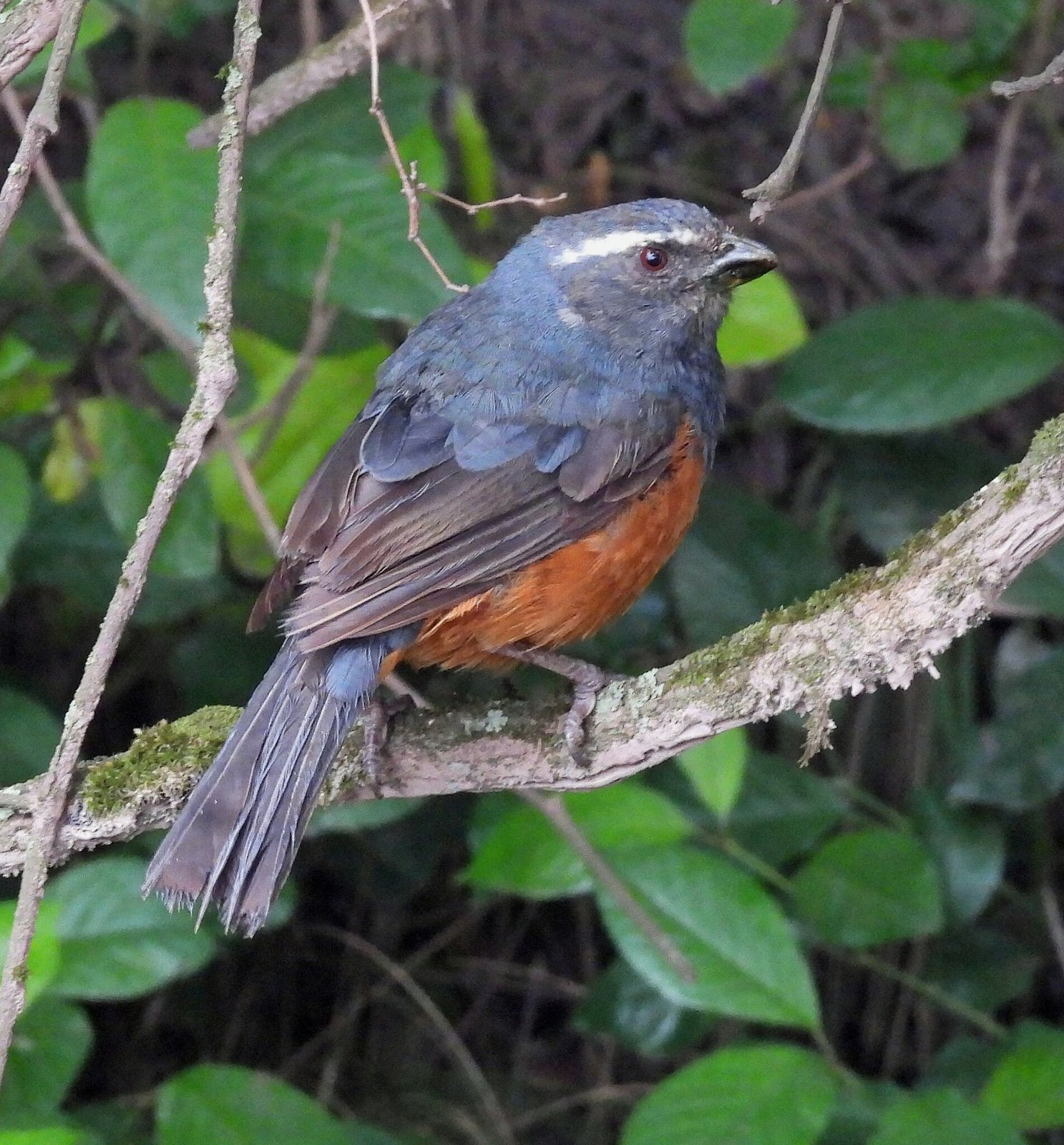
The Rufous-bellied Mountain Tanager is a large, heavy tanager of dry scrub and small woods high in the Andes of Bolivia, blue-grey with a long white eyebrow and an orange-rufous belly. It was long placed among the saltators, and the heavy bill and build still recall that.
Voice
Gives short, hard notes; the song is a series of clear whistles, often from the top of a shrub.
Recording: Eduardo Quintanilla — CC BY-NC-SA 4.0 · xeno-canto
Identification
22 cm, with a heavy, conical bill that is grey with a pale base to the lower mandible. Head, upperparts and upper breast are blue-grey, with a long white eyebrow behind the eye. From the lower breast to the undertail coverts the underparts are orange-rufous. The sexes are alike. Juveniles are duller, with a less sharp eyebrow.
Confusion species
Golden-billed Saltator Saltator aurantiirostris lives in the same area, but is smaller and has an orange bill, a black face and a black breast band. Cochabamba Mountain Finch Poospiza garleppi is also grey with rufous underparts, but much smaller and slimmer, with a fine bill and a rufous rather than white eyebrow. Black-backed Grosbeak Pheucticus aureoventris also has a heavy bill, but is black and yellow.
Habitat
Semi-arid scrub on mountain slopes, edges of Polylepis and alder woodland, hedgerows and field edges with scattered shrubs, mostly from about 3000 to 4000 m, sometimes lower. It eats plant food such as buds, flowers and fruit, as well as seeds and insects. Little is known about the nest.
Where the bird is most at home, classified by the vegetation units of the Andes and the west coast.


Range and movements
Does not occur in Colombia, Ecuador, Peru or on the Galápagos. In Bolivia in the Andes of the centre and south, mainly in Cochabamba, Chuquisaca, Potosí and Tarija. Outside the guide area only in the far north-west of Argentina.
- Resident
- dark = core range, pale = thinly spread
How and when to look
Search scrub and Polylepis groves on dry slopes above 3000 m in Cochabamba and Chuquisaca; the birds often perch on top of a shrub, where the white eyebrow and rufous belly can be seen.
Conservation status
Least Concern. Locally fairly common within a restricted range; sensitive to cutting and grazing of scrub and Polylepis woodland.
Scientific name
Pseudosaltator rufiventris | (d'Orbigny, ACVMD & de Lafresnaye, 1837)
D'Orbigny, ACVMD & de Lafresnaye described the species in 1837 as Saltator rufiventris; because it was later moved to another genus, the author and year stand in brackets. The genus Pseudosaltator was introduced in 2016 by Burns, Unitt & Mason. The genus name combines Ancient Greek pseudos, 'false', with the genus Saltator, in which the species was first placed. The species name comes from Latin rufus, 'rufous', and venter, 'belly'. The specimen the first description was based on came from Sica Sica, La Paz, Bolivia.