All species › Passerines › Tanagers and allies › Scarlet-and-white Tanager
Scarlet-and-white Tanager | Chrysothlypis salmoni
Rood-witte tangare | Tangara escarlatiblanca | Tiê-escarlate-e-branco
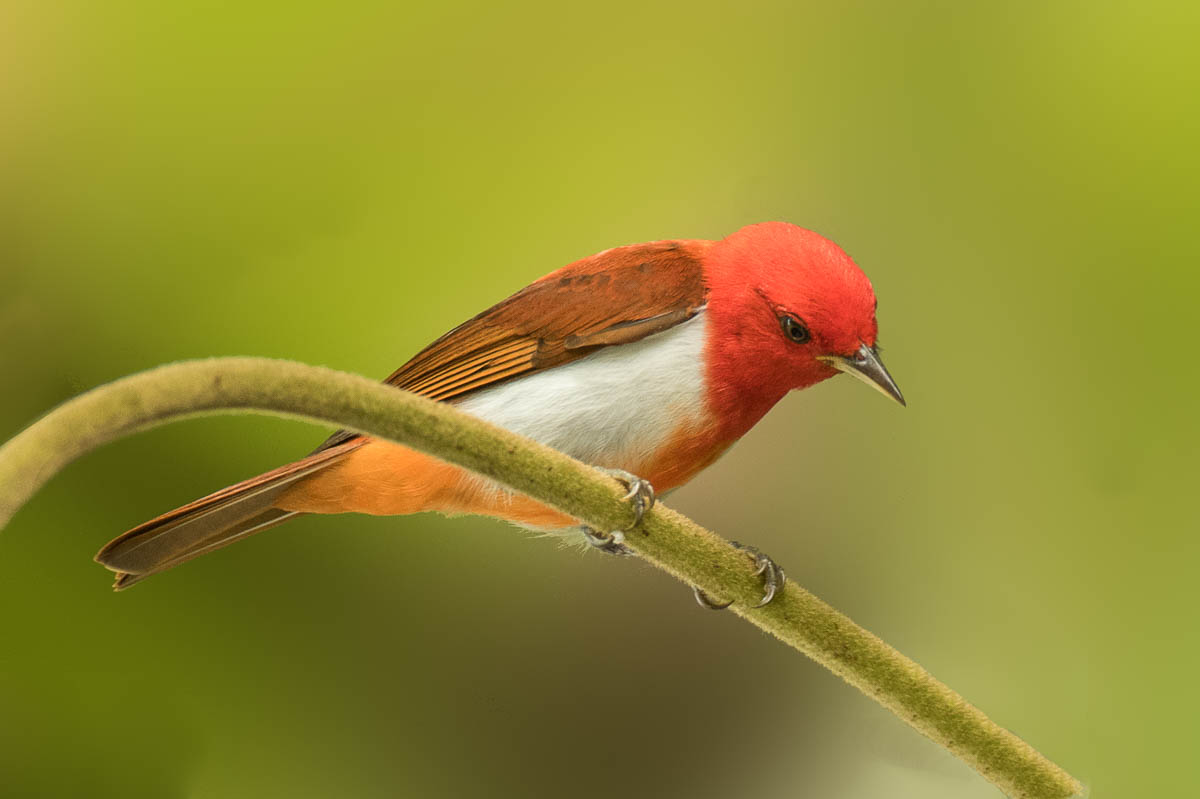
The Scarlet-and-white Tanager is a small tanager of the Chocó region of western Colombia and north-western Ecuador, and occurs only in the guide area. The male is scarlet with a white centre to the underparts, the female olive-brown and whitish. Small groups search the foliage for insects, often in mixed flocks.
Voice
High, thin tsit calls and a short series of high, sibilant notes; poorly described.
Recording: Patricio Mena Valenzuela — CC BY-NC-SA 4.0 · xeno-canto
Identification
12–13 cm, with a thin, pointed, dark bill. The male is scarlet on the head, throat and upperparts, with darker wings and tail and a white centre to the breast and belly. The female is olive-brown above and whitish below, with a greyish to ochre wash on the flanks. Young males at first resemble the female.
Confusion species
Within its range the male, with its combination of scarlet and white, cannot be confused with other species. The female White-shouldered Tanager Loriotus luctuosus has a grey head and yellowish underparts. The female Scarlet-thighed Dacnis Dacnis venusta is bluish-green above and ochre below, with a shorter bill.
Habitat
Canopy and edges of wet lowland and foothill forest, mainly between about 100 and 1100 m, also at forest edges along roads. It searches the foliage for insects and eats small fruits, usually in pairs or small groups in mixed flocks with tanagers and dacnises. Little is known about the nest.
Where the bird is most at home, classified by the vegetation units of the Andes and the west coast.


Range and movements
In Colombia on the Pacific slope and in the adjacent lowlands, from northern Chocó and Antioquia to Nariño. In Ecuador in the north-west, mainly in Esmeraldas, Imbabura and north-western Pichincha. Absent from Peru, Bolivia and the Galápagos. Does not occur outside the guide area.
- Resident
- dark = core range, pale = thinly spread
How and when to look
In the foothills of Esmeraldas and north-western Pichincha in Ecuador and of Valle del Cauca and Nariño in Colombia, at forest edges and along roads where mixed flocks move through the canopy.
Conservation status
Least Concern. The range is restricted to the Chocó, where deforestation in the lowlands and foothills continues.
Scientific name
Chrysothlypis salmoni | (Sclater, 1886)
Sclater described the species in 1886 as Dacnis salmoni; because it was later moved to another genus, the author and year stand in brackets. The genus Chrysothlypis was introduced in 1912 by Berlepsch. The genus name comes from Greek khrusos, 'gold', and thlupis, an unidentified bird, a name often used for New World warblers and thin-billed tanagers. The species name honours Thomas Knight Salmon, a British naturalist and collector in Colombia. The specimen the first description was based on came from Remedios, Antioquia, Colombia.