All species › Owls › Owls › Cloud-forest Screech Owl
Cloud-forest Screech Owl | Megascops marshalli
Bosschreeuwuil | Autillo de Marshall | Corujinha-das-nuvens
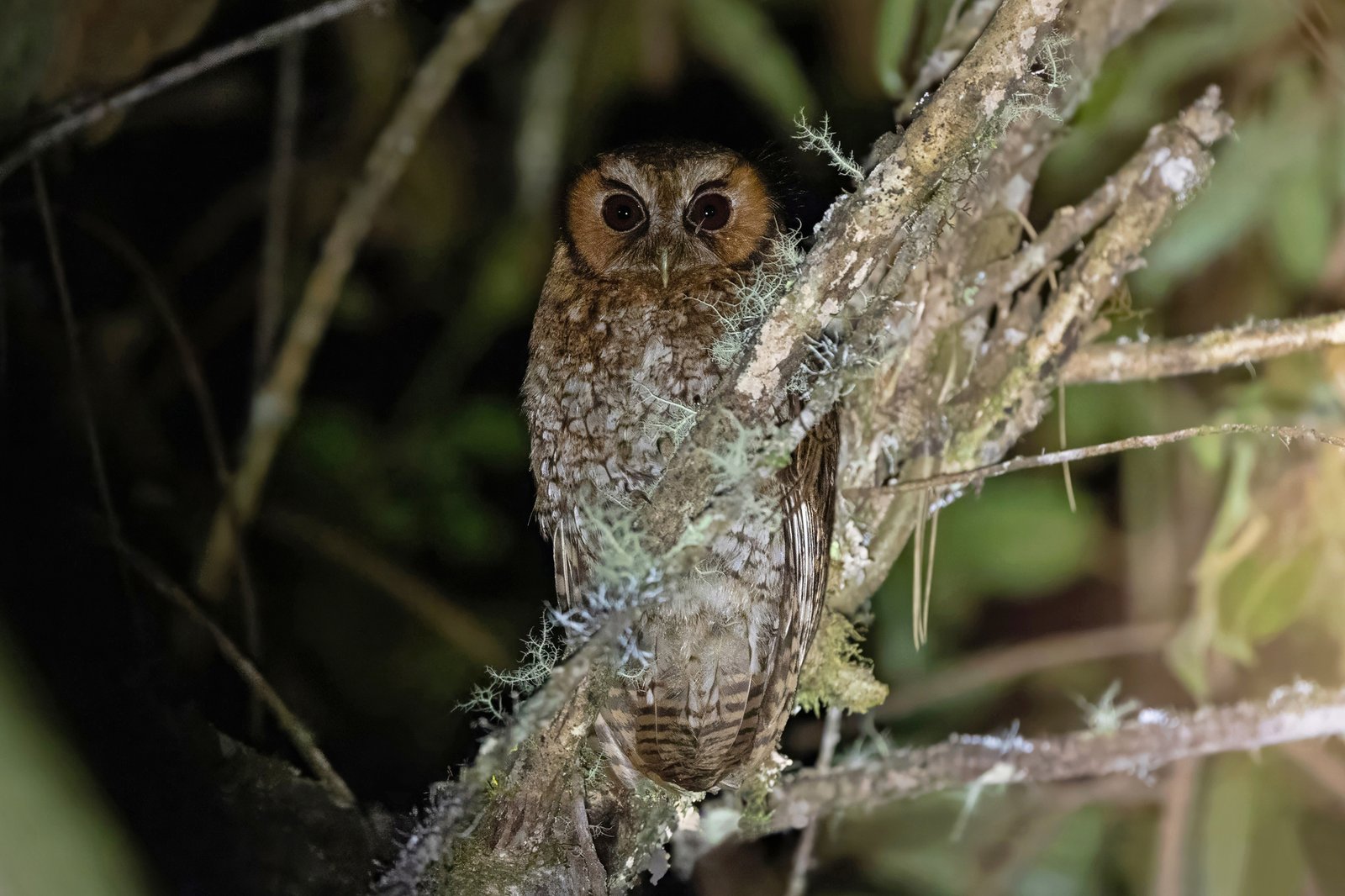
The Cloud-forest Screech Owl is a small, chestnut-brown screech owl with a broad black rim to the facial disc and boldly patterned underparts. It lives in wet cloud forest high on the eastern slope of the Andes in Peru and Bolivia. The species was described in 1981 from the Cordillera Vilcabamba in Peru.
Voice
A long, even series of rapid, soft notes, lasting several seconds. It sings at dusk and at night.
Recording: Jacob Wijpkema — CC BY-NC-SA 4.0 · xeno-canto
Identification
20–23 cm, with short ear tufts, dark brown eyes and pale eyebrows. The facial disc is rufous-brown, with a broad blackish rim. The upperparts are warm chestnut-brown, with fine dark vermiculation and whitish spots on the scapulars. The underparts are rufous-brown with large whitish, dark-edged spots, giving a scaly pattern. The sexes are alike.
Confusion species
Rufescent Screech Owl Megascops ingens is larger and plainer, without a distinct dark rim to the facial disc, and usually lives lower. Cinnamon Screech Owl Megascops petersoni is uniformly cinnamon-brown, without the dark-edged spots, and lives further north. White-throated Screech Owl Megascops albogularis has a white throat, yellow-orange eyes and a dark breast. Yungas Screech Owl Megascops hoyi has yellow eyes and lives further south in Bolivia.
Habitat
Wet, mossy cloud forest with many epiphytes, roughly between 1700 and 2600 m. It lives in the lower and middle layers of the forest. It hunts at night, mainly for large insects. Little is known about the nest; it probably nests in tree cavities.
Where the bird is most at home, classified by the vegetation units of the Andes and the west coast.


Range and movements
In Peru on the eastern slope of the Andes from Pasco and Junín south through the Cordillera Vilcabamba to Cusco and Puno. In Bolivia on the eastern slope in the north of the country, in La Paz. Absent from Colombia, Ecuador and the Galápagos.
- Resident
- dark = core range, pale = thinly spread
How and when to look
Along the roads through the cloud forest of the eastern slope in Cusco, such as the Manu road, at night in the upper cloud-forest zone. By day it roosts hidden in dense vegetation.
Conservation status
Least Concern. The range is fragmented and the species depends on undisturbed cloud forest; part of it lies in protected areas such as Manu National Park.
Scientific name
Megascops marshalli | (Weske & Terborgh, 1981)
Weske & Terborgh described the species in 1981 as Otus marshalli; because it was later moved to another genus, the author and year stand in brackets. The genus Megascops was introduced in 1848 by Kaup. The genus name comes from Greek megas, 'great', and skōps, a small owl (scops owl). The species name honours Joe Truesdell Marshall Jr. (1918–2015), American zoologist, ornithologist and specialist in screech owls. The specimen the first description was based on came from Cordillera Vilcabamba, Cusco, Peru.