All species › Owls › Owls › Yungas Screech Owl
Yungas Screech Owl | Megascops hoyi
Hoys schreeuwuil | Autillo fresco | Corujinha-das-yungas
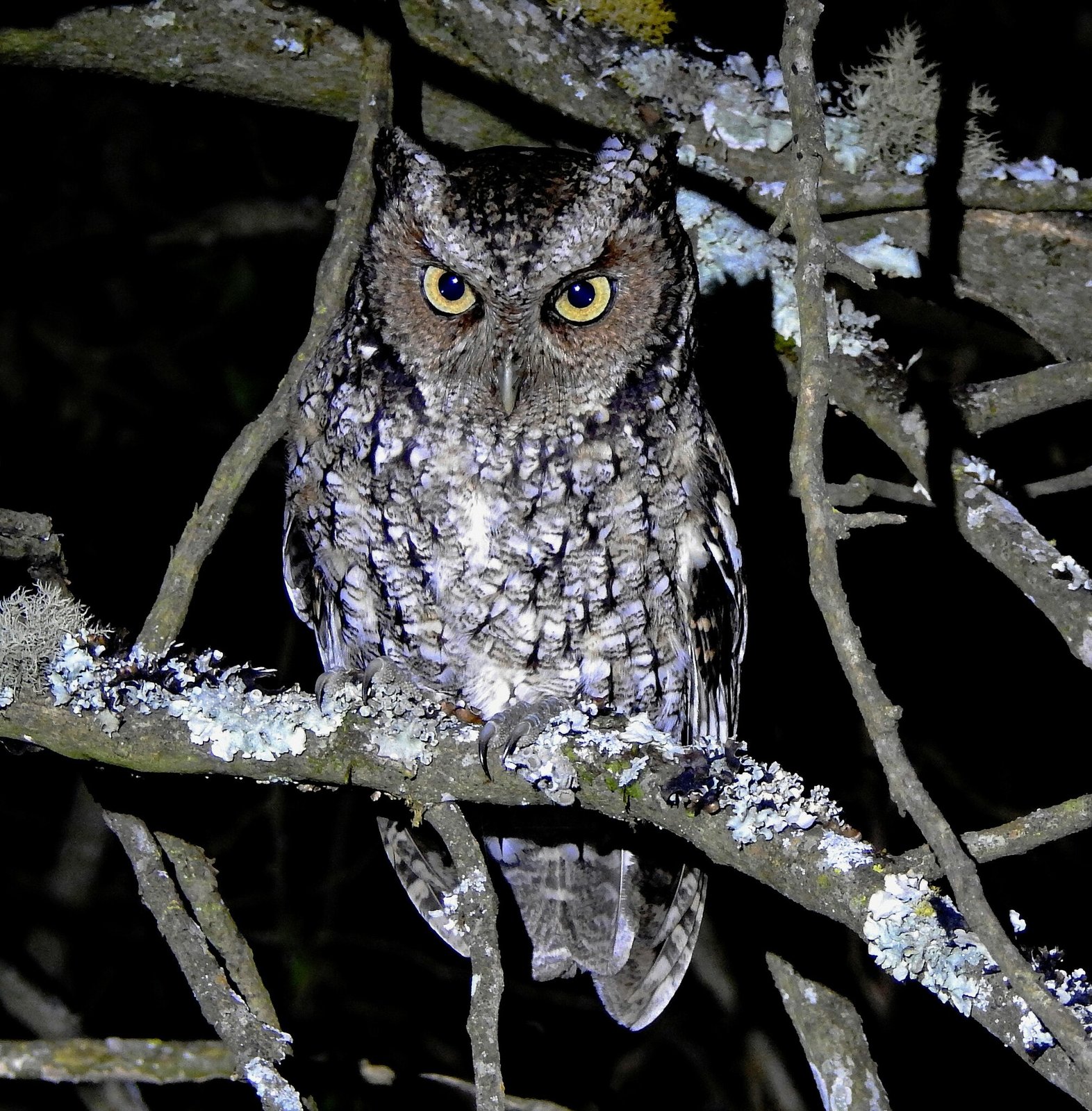
The Yungas Screech Owl is a medium-sized screech owl of the Yungas montane forests of southern Bolivia and north-western Argentina. The species was described in 1989 and named after Gunnar Hoy, an ornithologist who worked in north-western Argentina. In the guide area it is the screech owl of the southernmost montane forest on the eastern slope.
Voice
A long, rapid trill of short notes, mainly at dusk and at night.
Recording: Sjoerd Mayer — CC BY-NC-SA 3.0 · xeno-canto
Identification
23–25 cm, with short ear tufts, yellow eyes and a facial disc with a distinct dark rim. There is a greyish-brown and a rufous-brown morph. The upperparts are finely spotted and streaked, with a row of whitish spots on the scapulars. The underparts are paler, with dark streaks and fine cross-barring. The sexes are alike.
Confusion species
Tropical Screech Owl Megascops choliba lives lower and in more open country, has whiter underparts and sings a short trill with one or two separate final notes. Rufescent Screech Owl Megascops ingens lives further north, is larger and has brown eyes. Cloud-forest Screech Owl Megascops marshalli is chestnut-brown with dark-edged white spots and dark eyes, and lives further north. Yungas Pygmy Owl Glaucidium bolivianum is much smaller and lacks ear tufts.
Habitat
Humid Yungas montane forest, including higher forest with alder (Alnus) and Podocarpus, and wooded valleys along streams, roughly between 1000 and 2800 m. It hunts at night, mainly for large insects. It nests in tree cavities.
Where the bird is most at home, classified by the vegetation units of the Andes and the west coast.


Range and movements
In Bolivia on the eastern slope of the Andes in the south, in Chuquisaca and Tarija. Absent from Colombia, Ecuador, Peru and the Galápagos. Outside the guide area in north-western Argentina.
- Resident
- dark = core range, pale = thinly spread
How and when to look
In the Yungas forest of Tarija, at night along forest edges and roads through montane forest, where the song can be heard after sunset. By day it roosts hidden in dense foliage.
Conservation status
Least Concern. Its habitat is restricted to the southern Yungas, where logging and conversion to farmland reduce the forest locally.
Scientific name
Megascops hoyi | (König & Straneck, 1989)
König & Straneck described the species in 1989 as Otus hoyi; because it was later moved to another genus, the author and year stand in brackets. The genus Megascops was introduced in 1848 by Kaup. The genus name comes from Greek megas, 'great', and skōps, a small owl (scops owl). The species name honours Gunnar Arthur Höy (1901–1996), a Norwegian-born ornithologist who emigrated to Argentina in 1951 and became curator of natural history at the museum of the University of Salta. The specimen the first description was based on came from Northwestern Argentina.