All species › Owls › Owls › Choco Screech Owl
Choco Screech Owl | Megascops centralis
Chocóschreeuwuil | Autillo del Chocó | Corujinha-do-chocó
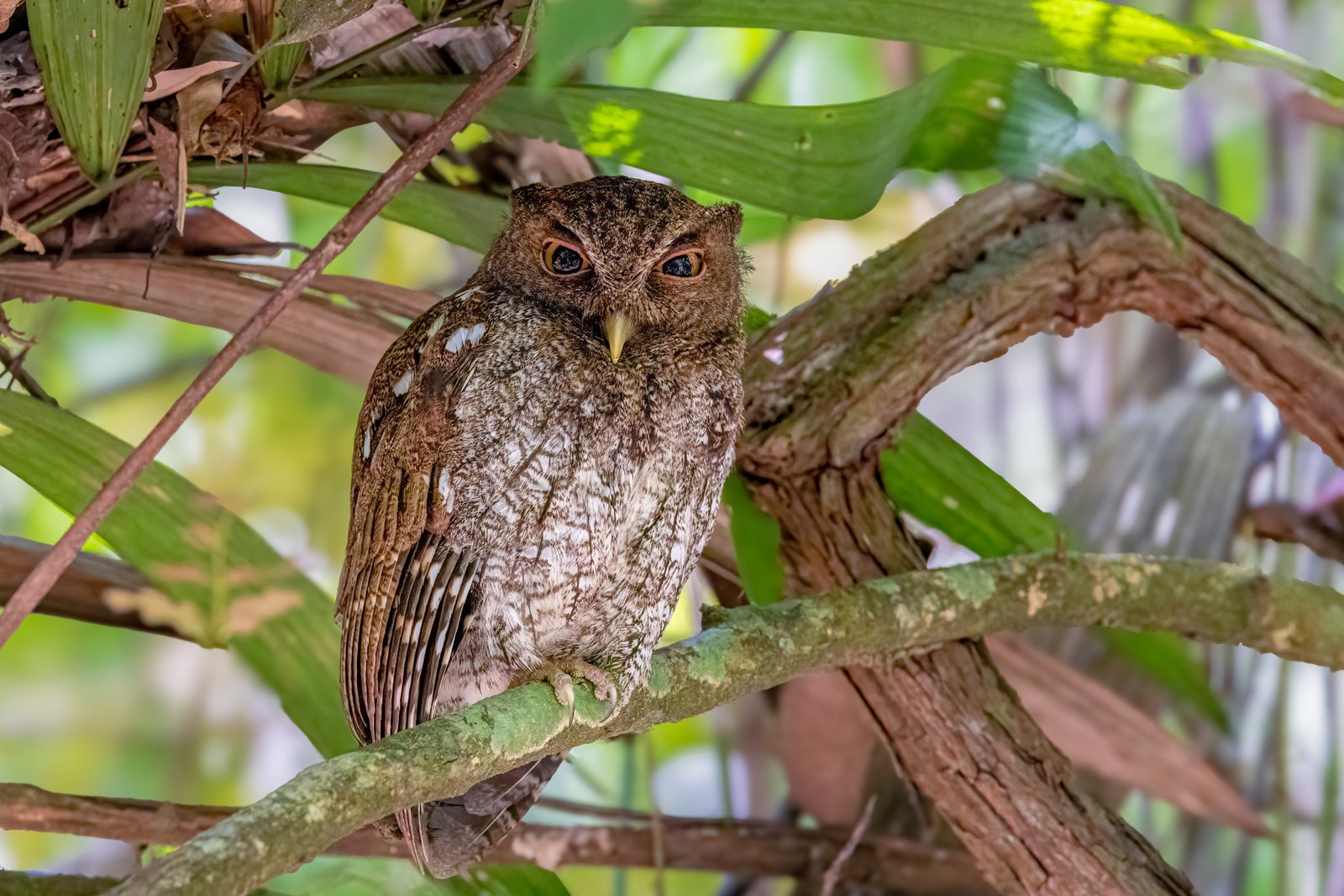
The Choco Screech Owl is the screech owl of the humid lowland and foothill forest on the Pacific side of Colombia and Ecuador. It was formerly treated as one species with Middle American and Foothill Screech Owls and is separated mainly by its voice and range.
Voice
A long, even trill of short notes that can last many seconds and gradually grows louder, mainly at dusk and at night.
Recording: José María Loaiza B. — CC BY-NC-SA 4.0 · xeno-canto
Identification
20–23 cm, with short ear tufts, yellow eyes and a facial disc with a narrow dark rim. There is a greyish-brown and a rufous-brown morph. The upperparts are finely vermiculated, with a row of whitish spots on the scapulars. The underparts are paler, with fine dark shaft streaks and dense, fine cross-barring. The sexes are alike.
Confusion species
Middle American Screech Owl Megascops guatemalae is practically identical in the field and occurs at most in the far north-west of Colombia. Foothill Screech Owl Megascops roraimae is very similar, but lives on the eastern side of the Andes. Tropical Screech Owl Megascops choliba has a broad black rim to the facial disc, coarser streaks on the underparts, and sings a short trill with one or two separate final notes. Rufescent Screech Owl Megascops ingens is larger, with brown eyes, and lives higher.
Habitat
Humid lowland and foothill forest, forest edges and old secondary forest, also semi-open country with tall trees, roughly from sea level to 1500 m. It hunts at night, mainly for large insects. It nests in tree cavities.
Where the bird is most at home, classified by the vegetation units of the Andes and the west coast.


Range and movements
In Colombia along the Pacific coast and in the western foothills of the Andes, and locally in the north of the country. In Ecuador in the humid west, south to the south-west. Absent from Peru, Bolivia and the Galápagos. Outside the guide area in eastern Panama.
- Resident
- dark = core range, pale = thinly spread
How and when to look
After sunset, listen for the long trill along forest edges and roads in the foothills of the western slope in Ecuador and in the Chocó of Colombia. By day it roosts hidden in dense foliage or among vines.
Conservation status
Not Evaluated as a separate species. The species is fairly common in suitable forest, but deforestation in the Chocó and in western Ecuador has greatly reduced its habitat.
Scientific name
Megascops centralis | (Hekstra, 1982)
Hekstra described the species in 1982 as Otus guatemalae centralis; because it was later moved to another genus, the author and year stand in brackets. The genus Megascops was introduced in 1848 by Kaup. The genus name comes from Greek megas, 'great', and skōps, a small owl (scops owl). The species name comes from Latin centralis, 'central'. It probably refers to Central America or a central position in the range. The specimen the first description was based on came from Andes de Cumaná, Venezuela.