All species › Owls › Owls › Foothill Screech Owl
Foothill Screech Owl | Megascops roraimae
Roraimaschreeuwuil | Autillo de Roraima | Corujinha-de-roraima
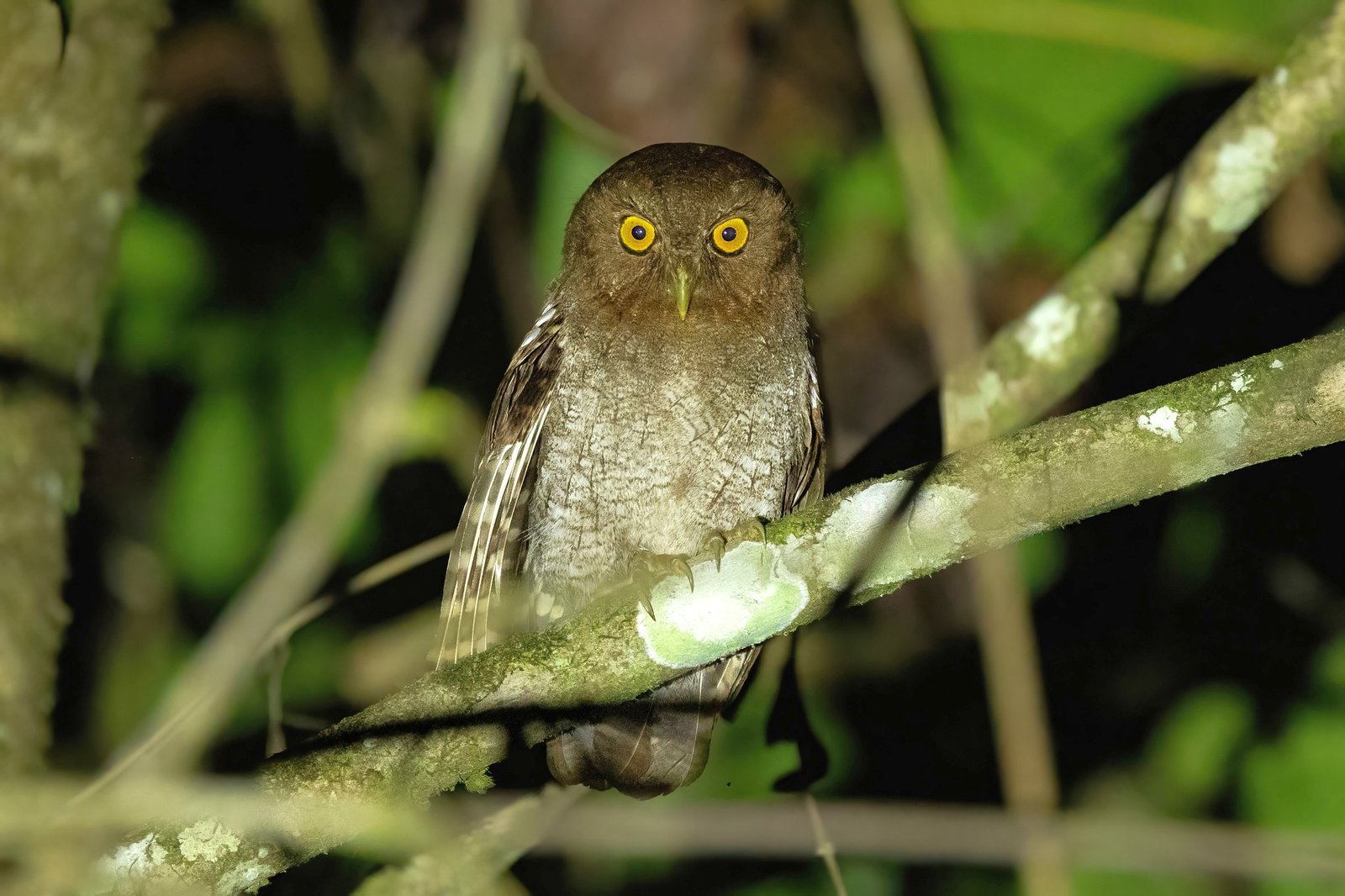
The Foothill Screech Owl is a small, short-tufted screech owl of humid foothill forest on the eastern slope of the Andes. It is named after the tepui Roraima in the Guiana Shield, home of the nominate form; in the guide area the form is napensis, which includes helleri and bolivianus. It is active at night and mainly gives itself away by its trilled song.
Voice
A wavering series of rapid notes lasting a few seconds, oooooorrrr, starting softly, rising in volume and pitch, then dropping slightly and fading at the end. Sings mainly at dusk and in the first hours of the night.
Recording: Paul Driver — CC BY-NC-SA 4.0 · xeno-canto
Identification
20–23 cm, with a round head, short ear tufts and yellow to amber eyes. There are brown and rufous morphs. The upperparts are brown with fine dark vermiculation and a row of pale spots on the scapulars. The facial disc is brown, with only a faint dark rim. The underparts are paler, with fine dark shaft streaks and cross-vermiculation. There is no pale nuchal collar. The sexes are alike.
Confusion species
Tawny-bellied Screech Owl Megascops watsonii lives in the lowlands below, is darker, with longer ear tufts and a tawny belly, and sings a long series of low hoots. Tropical Screech Owl Megascops choliba has a clear black rim to the facial disc and coarse herringbone streaks below, and lives in semi-open country. Rufescent Screech Owl Megascops ingens is larger, with brown eyes, and lives higher in montane forest. Cinnamon Screech Owl Megascops petersoni is warmer cinnamon-brown, with dark eyes, and lives in cloud forest higher up.
Habitat
Humid and wet foothill forest and the lower parts of montane rainforest, roughly between 250 and 1500 m, locally up to 1800 m. It lives in the middle and lower strata of the forest and at forest edges. It feeds mainly on large insects and other invertebrates, sometimes small vertebrates. It nests in a tree cavity.
Where the bird is most at home, classified by the vegetation units of the Andes and the west coast.


Range and movements
In Colombia along the eastern slope of the Andes. In Ecuador on the eastern slope. In Peru along the eastern slope from north to south. In Bolivia in the Andean foothills. Absent from the Pacific side and the Galápagos. Outside the guide area in the coastal mountains of Venezuela and on the tepuis of the Guiana Shield.
- Resident
- dark = core range, pale = thinly spread
How and when to look
Listen at dusk for the trilled song at lodges and along roads in the foothills of the eastern slope, for example in eastern Ecuador and in northern and central Peru. Birds then often perch at mid-level along a forest edge or trail.
Conservation status
Not evaluated as a separate species; on the Red List it is included in a more broadly defined screech owl. It is locally common in undisturbed foothill forest, but deforestation along the eastern slope is reducing its habitat.
Scientific name
Megascops roraimae | (Salvin, 1897)
Salvin described the species in 1897 as Scops roraimae; because it was later moved to another genus, the author and year stand in brackets. The genus Megascops was introduced in 1848 by Kaup. The genus name comes from Greek megas, 'great', and skōps, a small owl (scops owl). The species name refers to Roraima, a tepui on the border of Venezuela, Guyana and Brazil, not necessarily the type locality. The specimen the first description was based on came from Roraima, Guyana.