All species › Owls › Owls › Santa Marta Screech Owl
Santa Marta Screech Owl | Megascops gilesi
Santamartaschreeuwuil | Autillo de Santa Marta | Corujinha-de-santa-marta
The Santa Marta Screech Owl occurs only in the Sierra Nevada de Santa Marta in northern Colombia. A specimen from 1919 was already recognised as distinct, but the species was not described until 2017, partly on the basis of its song. It is one of the many endemic birds of this isolated mountain range.
Voice
An even trill of about ten notes per second, lasting just over two seconds, trrrrrrrrr. Sings mainly at dusk and at night.
Recording: Sergio Adrian Garcia-Murcia — CC BY-NC-SA 4.0 · xeno-canto
Identification
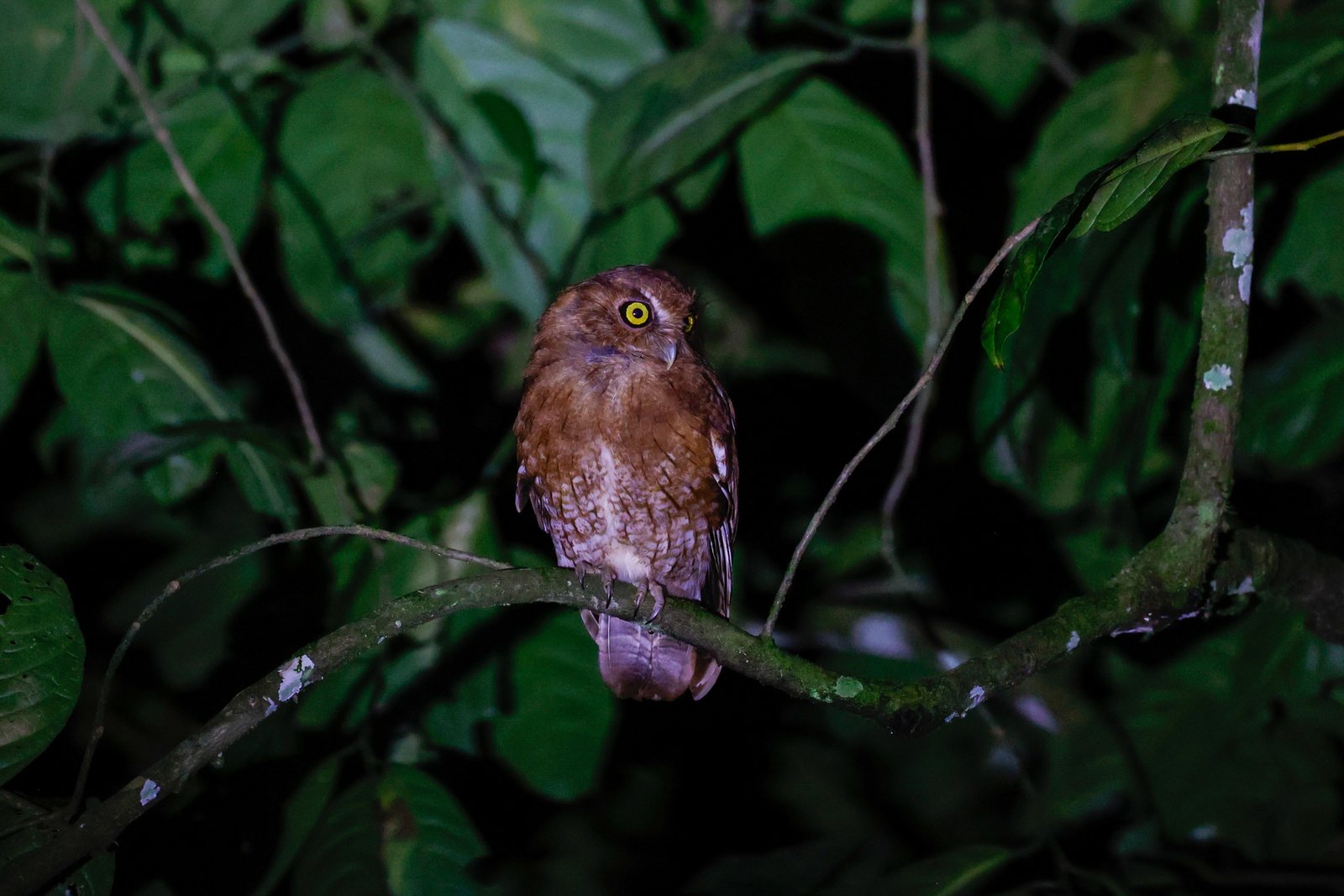
23–25 cm, a medium-sized screech owl with small ear tufts. There are rufous and greyish-brown morphs. The pattern is weak: the crown and back are finely barred, the breast has narrow dark brown shaft streaks and the belly is pale with indistinct light brown barring. The legs are feathered to the toes and golden buff. The sexes are alike.
Confusion species
Tropical Screech Owl Megascops choliba lives lower around the mountains, in drier and more open country, and has a clear black rim to the facial disc and coarse herringbone streaks below; its trill ends in a few separate notes. Mottled Owl Strix virgata is much larger, has no ear tufts and has dark eyes.
Habitat
Humid montane forest and forest edges, as far as known between about 1800 and 2500 m, possibly higher. Also in older secondary forest and at forest edges bordering plantations and pasture. The diet probably consists mainly of large insects. Little is known about the nest.
Where the bird is most at home, classified by the vegetation units of the Andes and the west coast.


Range and movements
Endemic to Colombia: only in the Sierra Nevada de Santa Marta, with most records from the San Lorenzo ridge and surroundings. Absent from Ecuador, Peru, Bolivia and the Galápagos.
- Resident
- dark = core range, pale = thinly spread
How and when to look
On the San Lorenzo ridge above Minca, where birds sing at dusk and at night along the road and near the lodges in montane forest.
Conservation status
Vulnerable. The range is very small and much of the original forest in the Sierra has been replaced by pine and eucalyptus plantations and pasture. The population is estimated at a few thousand mature birds and is probably declining.
Scientific name
Megascops gilesi | Krabbe, 2017
Krabbe described the species in 2017 and placed it straight away in the genus where it still stands. The genus Megascops was introduced in 1848 by Kaup. The genus name comes from Greek megas, 'great', and skōps, a small owl (scops owl). The species name honours Robert Giles, a British sponsor of conservation. The specimen the first description was based on came from Sierra Nevada de Santa Marta, Colombia.