All species › Owls › Owls › West Peruvian Screech Owl
West Peruvian Screech Owl | Megascops roboratus
Marañónschreeuwuil | Autillo peruano | Corujinha-peruana
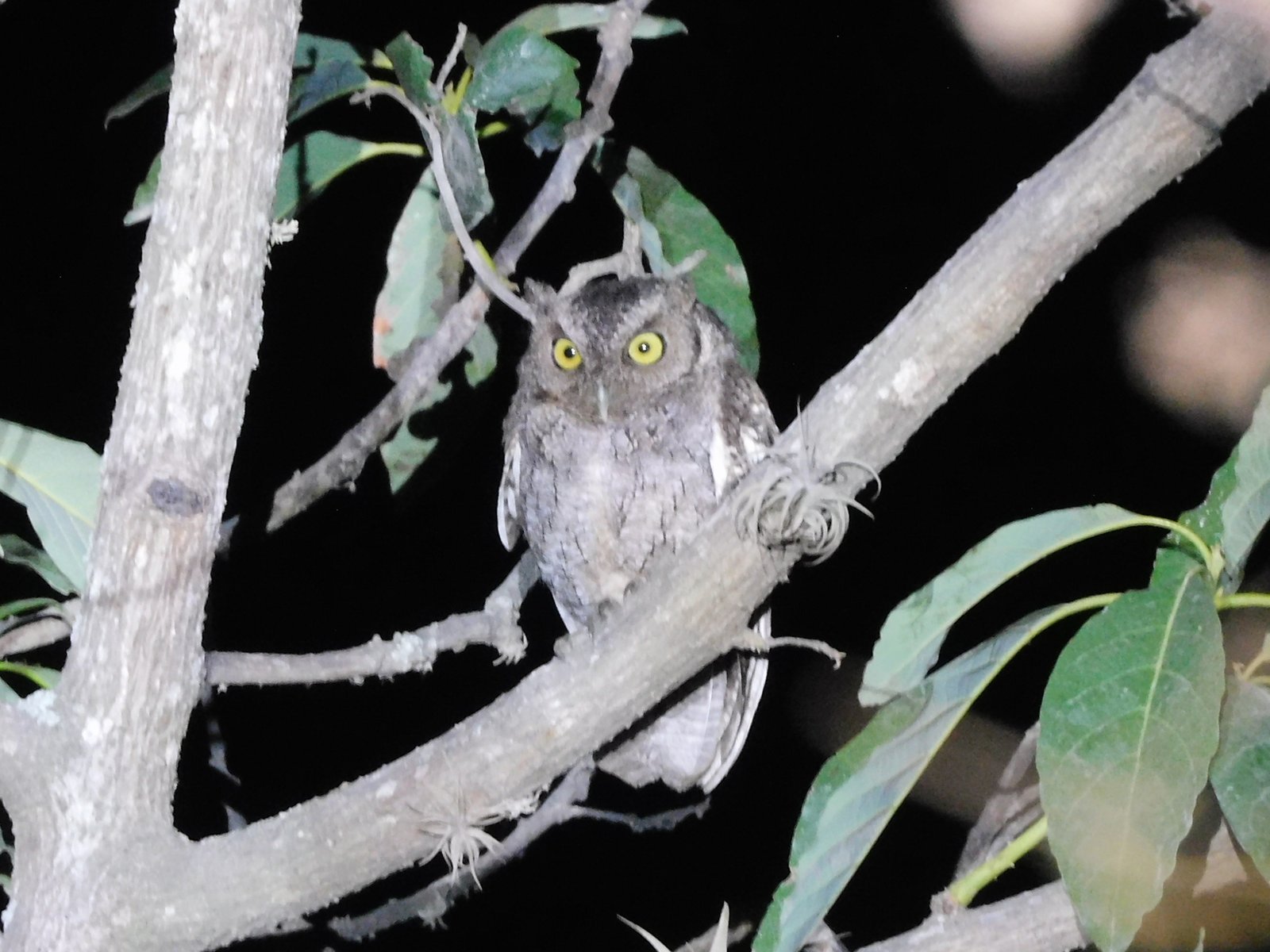
The West Peruvian Screech Owl is a grey-brown screech owl of dry forest and thorn scrub in south-western Ecuador and north-western Peru. The nominate form lives in the dry Marañón valley, the form pacificus in the Tumbesian region on the Pacific side. By day it roosts hidden in dense shrubs, vine tangles or a tree cavity.
Voice
A fast, slightly bouncing trill lasting a few seconds, trrrrrrrr, rising a little in volume and fading again. Sings mainly at dusk and before dawn.
Recording: John V. Moore — CC BY-NC-SA 4.0 · xeno-canto
Identification
20–23 cm, with short ear tufts and yellow eyes. The facial disc is grey with a clear black rim. The upperparts are grey-brown with dark streaks and fine vermiculation, with a row of white spots on the scapulars. The underparts are pale grey with dark shaft streaks and fine cross-bars, forming a herringbone pattern. The sexes are alike.
Confusion species
Pacific Pygmy Owl Glaucidium peruanum lives in the same dry forest, but is smaller, lacks ear tufts, has a longer tail and 'false eyes' on the nape, and is also active by day. Koepcke's Screech Owl Megascops koepckeae is larger and darker and usually lives higher, in montane scrub and Polylepis woodland. Tropical Screech Owl Megascops choliba is very similar to West Peruvian Screech Owl, but lives east of the Andes and has a different song.
Habitat
Dry deciduous forest, thorn scrub, columnar-cactus woodland and riparian woodland in dry valleys, from sea level to about 1800 m. It hunts from a perch for large insects, spiders and scorpions and sometimes small vertebrates. It nests in a tree cavity.
Where the bird is most at home, classified by the vegetation units of the Andes and the west coast.


Range and movements
In Ecuador in the dry south-west. In Peru in the north-west, in the departments of Tumbes, Piura, Lambayeque and Cajamarca, and in the Marañón valley. Absent from Colombia, Bolivia and the Galápagos. Does not occur outside the guide area.
- Resident
- dark = core range, pale = thinly spread
How and when to look
In Tumbesian dry forest in Tumbes and Piura and in dry forest around Jaén and Bagua in the Marañón valley. Listen at dusk near groves along dry riverbeds.
Conservation status
Least Concern. Clearing of dry forest for farming, cattle and charcoal reduces its habitat locally.
Scientific name
Megascops roboratus | (Bangs & Noble, 1918)
Bangs & Noble described the species in 1918 as Otus roboratus; because it was later moved to another genus, the author and year stand in brackets. The genus Megascops was introduced in 1848 by Kaup. The genus name comes from Greek megas, 'great', and skōps, a small owl (scops owl). The species name comes from Latin roboratus, 'strengthened, robust'. The specimen the first description was based on came from Bellavista, Cajamarca, Peru.