All species › Passerines › Tanagers and allies › Coal-crested Finch
Coal-crested Finch | Charitospiza eucosma
Meesgors | Monterita crestada | Mineirinho
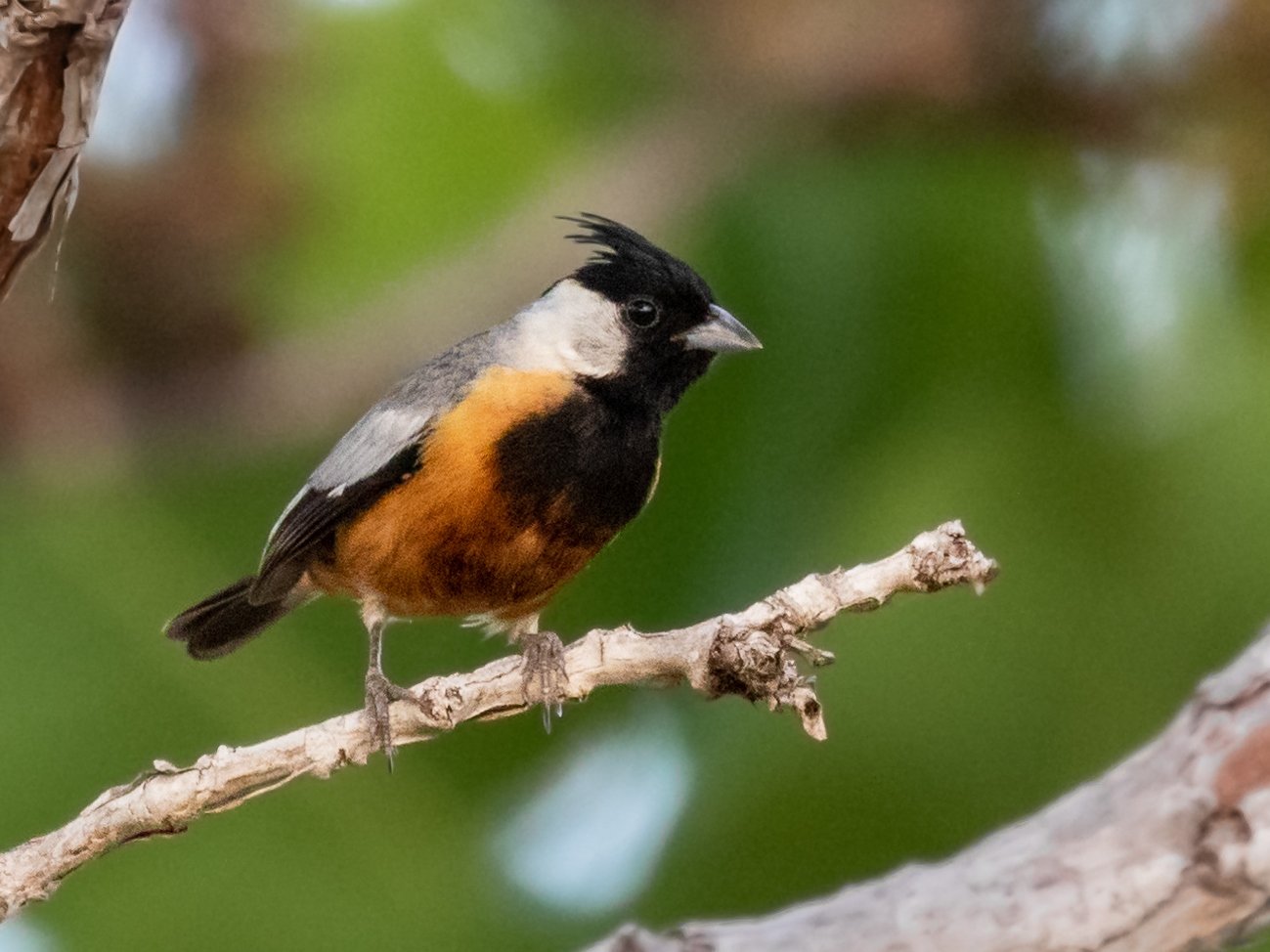
The Coal-crested Finch is a small, crested tanager of the Brazilian cerrado that reaches the guide area only in north-eastern Bolivia. The male is grey, black, white and chestnut, with a spiky black crest. It feeds largely on bare or burnt ground between the grass.
Voice
Usually quiet; the calls are soft and thin. The song is a short series of high, thin notes.
Recording: Jeremy Minns — CC BY-NC-SA 3.0 · xeno-canto
Identification
11.5 cm, with a short, conical bill and a spiky, erectile crest. The male has a black crown and crest, white cheeks and a black throat and central breast. The upperparts are grey, the flanks and belly rufous to chestnut; the wings and tail are dark with some white. The female also has a crest, but is brownish grey above and pale brown to ochre below, without black. Juveniles resemble the female, with a white belly.
Confusion species
Grey Pileated Finch Coryphospingus pileatus and Red Pileated Finch Coryphospingus cucullatus have a flat, red crown stripe instead of a spiky black crest, and lack the black throat and white cheeks. Female seedeaters (Sporophila) have no crest.
Habitat
Open cerrado and savanna with scattered shrubs and bare patches, often on recently burnt ground, between about 200 and 1200 m. It hops on the ground and eats grass seeds, fruit and arthropods; it rests and preens in dense shrubbery. The nest is a small cup of grass and spider web, low in a shrub; it breeds in the rainy season.
Where the bird is most at home, classified by the vegetation units of the Andes and the west coast.


Range and movements
In Bolivia only locally in the savannas and cerrado of the north-east, mainly in Beni. Absent from Colombia, Ecuador, Peru and the Galápagos. Most of the range lies outside the guide area, in central and eastern Brazil, with a few records from northern Argentina.
- Resident
- dark = core range, pale = thinly spread
How and when to look
In the savannas of Beni, search open, short-grass or burnt patches with shrubs; birds often sit on the ground or low in a shrub and give themselves away by the black crest.
Conservation status
Near Threatened. The population is declining as cerrado is converted to cropland and pasture.
Scientific name
Charitospiza eucosma | Oberholser, 1905
Oberholser described the species in 1905 and placed it straight away in the genus where it still stands. He introduced the genus Charitospiza in that same work. The genus name comes from Greek kharis, 'grace', and spiza, 'finch'. The species name comes from Greek eukosmos, 'well-adorned' or 'decorous'. The specimen the first description was based on came from Bahia, Brazil.