All species › Passerines › Tanagers and allies › Hooded Mountain Tanager
Hooded Mountain Tanager | Buthraupis montana
Blauwrugbergtangare | Tangara montana encapuchada | Sanhaço-montanhês-encapuzado
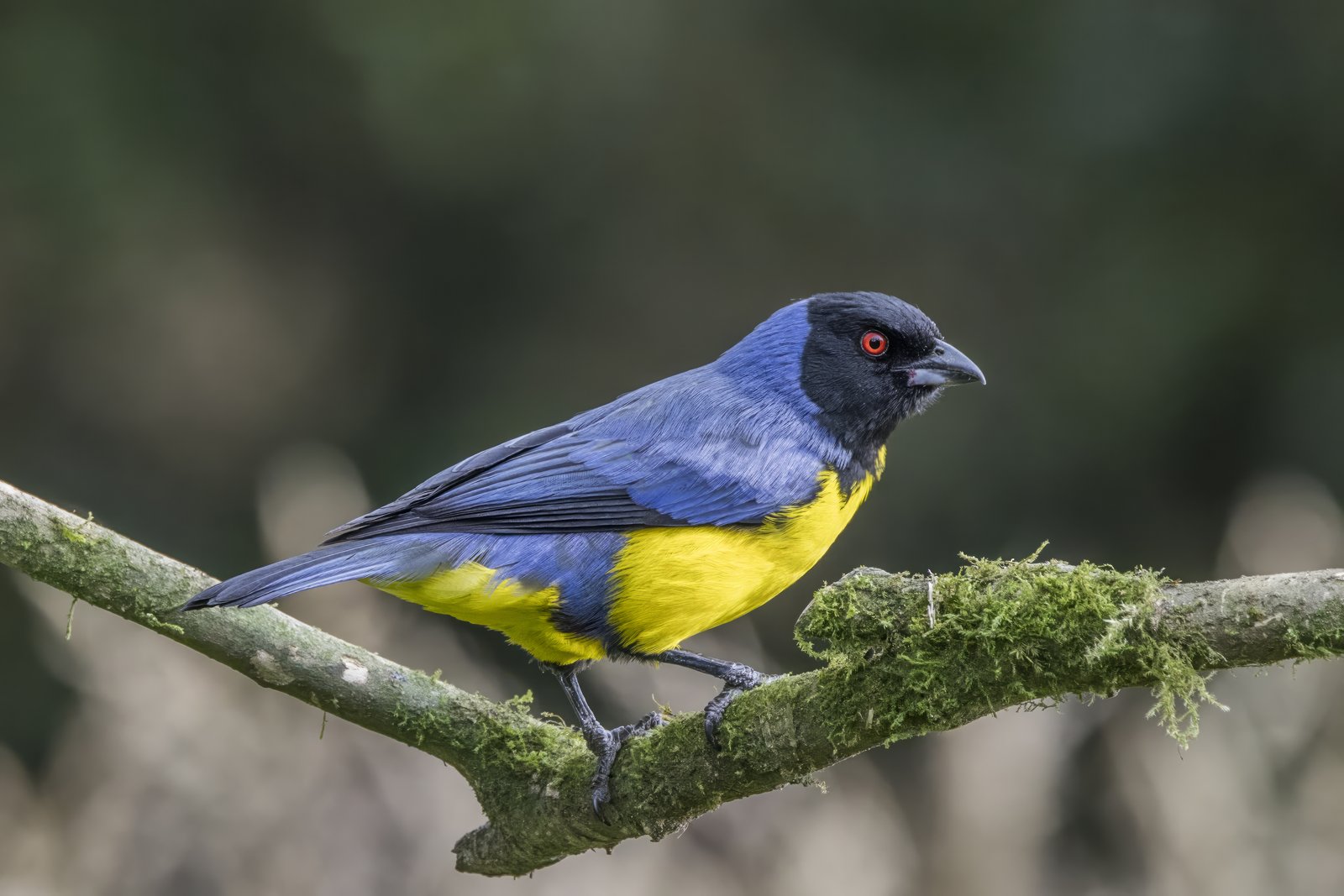
The Hooded Mountain Tanager is the largest mountain tanager of the Andes, with a black hood, a cobalt-blue back, deep yellow underparts and red eyes. It lives in noisy groups of four to ten birds that move through upper cloud forest, often forming the core of mixed flocks.
Voice
Groups give loud, ringing, repeated notes such as tee-tee-tee; in the early morning a rapid, somewhat husky series of notes is heard, often from several birds at once.
Recording: Mauricio Cuellar Ramirez (@Birding.travel) — CC BY-NC-SA 4.0 · xeno-canto
Identification
22–23 cm, with a fairly long tail and a stout black bill. The head and throat form a black hood; the eye is red. The back, rump and wing coverts are bright cobalt to purplish blue; the flight feathers and tail are black with blue edges. The underparts are deep yellow, the thighs black. The sexes are alike. Juveniles are duller, with a darker eye.
Confusion species
Black-chested Mountain Tanager Cnemathraupis eximia has a blue crown, a moss-green back, a black chest and a dark eye. Masked Mountain Tanager Tephrophilus wetmorei is smaller, with a yellow forehead around a black mask and an olive-green back. Blue-winged Mountain Tanager Anisognathus somptuosus is smaller, with a yellow crown patch, a black or olive back and blue wings. In central Peru, Golden-backed Mountain Tanager Cnemathraupis aureodorsalis has a golden-orange back.
Habitat
Humid upper montane forest and cloud forest, also forest edges and taller secondary growth, mostly from about 2500 to 3500 m, locally from about 2000 m. It forages at mid-height up into the canopy for fruit and berries, also insects. Little is known about the nest.
Where the bird is most at home, classified by the vegetation units of the Andes and the west coast.


Range and movements
In Colombia in all three Andean ranges and in the Sierra de Perijá. In Ecuador on both slopes of the Andes. In Peru mainly on the eastern slope of the Andes, from the north to Puno. In Bolivia on the eastern slope in La Paz and Cochabamba. Not on the Galápagos. Outside the guide area in western Venezuela.
- Resident
- dark = core range, pale = thinly spread
How and when to look
In upper cloud forest, watch for loudly calling groups flying from treetop to treetop, for example at Yanacocha and Papallacta in Ecuador or in Puracé National Park in Colombia; they are most active in the early morning.
Conservation status
Least Concern. Fairly common in continuous upper montane forest; declining locally because of deforestation.
Scientific name
Buthraupis montana | (d'Orbigny, ACVMD & de Lafresnaye, 1837)
D'Orbigny, ACVMD & de Lafresnaye described the species in 1837 as A[glaia] montana; because it was later moved to another genus, the author and year stand in brackets. The genus Buthraupis was introduced in 1851 by Cabanis. The genus name combines Ancient Greek bou-, 'huge', and thraupis, an unknown small bird whose name ornithologists use for tanagers. The species name comes from Latin montanus, 'of the mountains'. The specimen the first description was based on came from Yungas, Bolivia.