All species › Passerines › Tanagers and allies › Woodpecker Finch
Woodpecker Finch | Camarhynchus pallidus
Spechtvink | Pinzón carpintero | Tentilhão-pica-pau
The Woodpecker Finch is the best-known tool user among Darwin's finches. Holding a cactus spine or twig in its bill, it prises insect larvae out of holes and crevices in wood and bark. It is endemic to the Galápagos and lives mainly in the humid highlands of the larger islands.
Voice
The song is a short, simple series of clear notes. The call is a short, dry chip.
Recording: Patricio Mena Valenzuela — CC BY-NC-SA 4.0 · xeno-canto
Identification
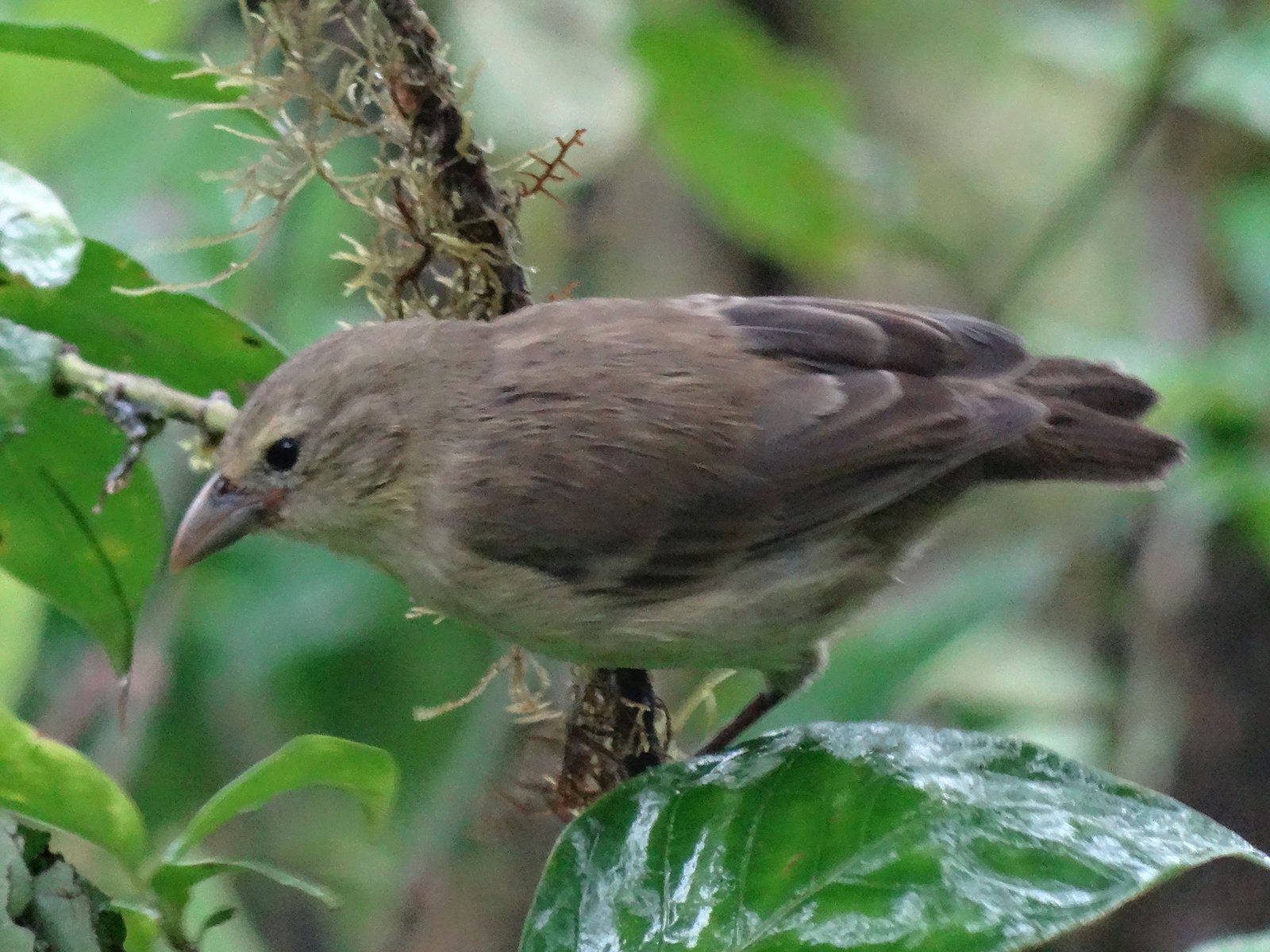
15 cm, a fairly large, plain finch with a long, straight, powerful bill. The upperparts are olive-brown, the underparts dingy white to pale brown, with at most faint streaking on the breast. The head is plain brownish, without obvious markings. Unlike many other Darwin's finches, males do not acquire black plumage. The sexes are alike; juveniles have a paler bill.
Confusion species
Small Tree Finch Camarhynchus parvulus is smaller, with a short, thick, parrot-like bill; older males have a black head. Mangrove Finch Camarhynchus heliobates is very similar but slightly smaller and occurs only in a few mangrove forests on Isabela. Green Warbler-Finch Certhidea olivacea is much smaller and has a thin, pointed bill. Vegetarian Finch Platyspiza crassirostris has a very short, thick bill.
Habitat
Mainly humid Scalesia forest and the humid highland zone, but on some islands also the transition zone and the arid lowland zone. It searches trunks, branches and dead wood for insects and their larvae, which it extracts from holes with its bill or with a spine or twig; in the dry season, when food is scarce, it uses tools more often. It also eats fruit.
Where the bird is most at home, classified by the vegetation units of the Andes and the west coast.


Range and movements
Endemic to the Galápagos, on several of the larger islands, including Santa Cruz, Isabela, Fernandina, Santiago and San Cristóbal. Absent from mainland Colombia, Ecuador, Peru and Bolivia.
- Resident
How and when to look
In the highlands of Santa Cruz, for example in the Scalesia forest at Los Gemelos, where birds work along mossy trunks and branches, chipping and probing. Listening quietly for tapping on wood helps to find them.
Conservation status
Near Threatened. Threats include the loss of highland forest to agriculture and invasive plants, and the introduced parasitic fly Philornis downsi, whose larvae attack nestlings.
Scientific name
Camarhynchus pallidus | (Sclater & Salvin, 1870)
Sclater & Salvin described the species in 1870 as Cactornis pallida; because it was later moved to another genus, the author and year stand in brackets. The genus Camarhynchus was introduced in 1837 by Gould. The genus name combines Ancient Greek kamara, 'arch' or 'vault', and rhunkhos, 'bill'. The species name is Latin pallidus, 'pale'. The specimen the first description was based on came from Santa Cruz Island, Galápagos.