All species › Passerines › Tanagers and allies › Blue-necked Tanager
Blue-necked Tanager | Stilpnia cyanicollis
Azuurkoptangare | Tangara cabeciazul | Saíra-de-cabeça-azul
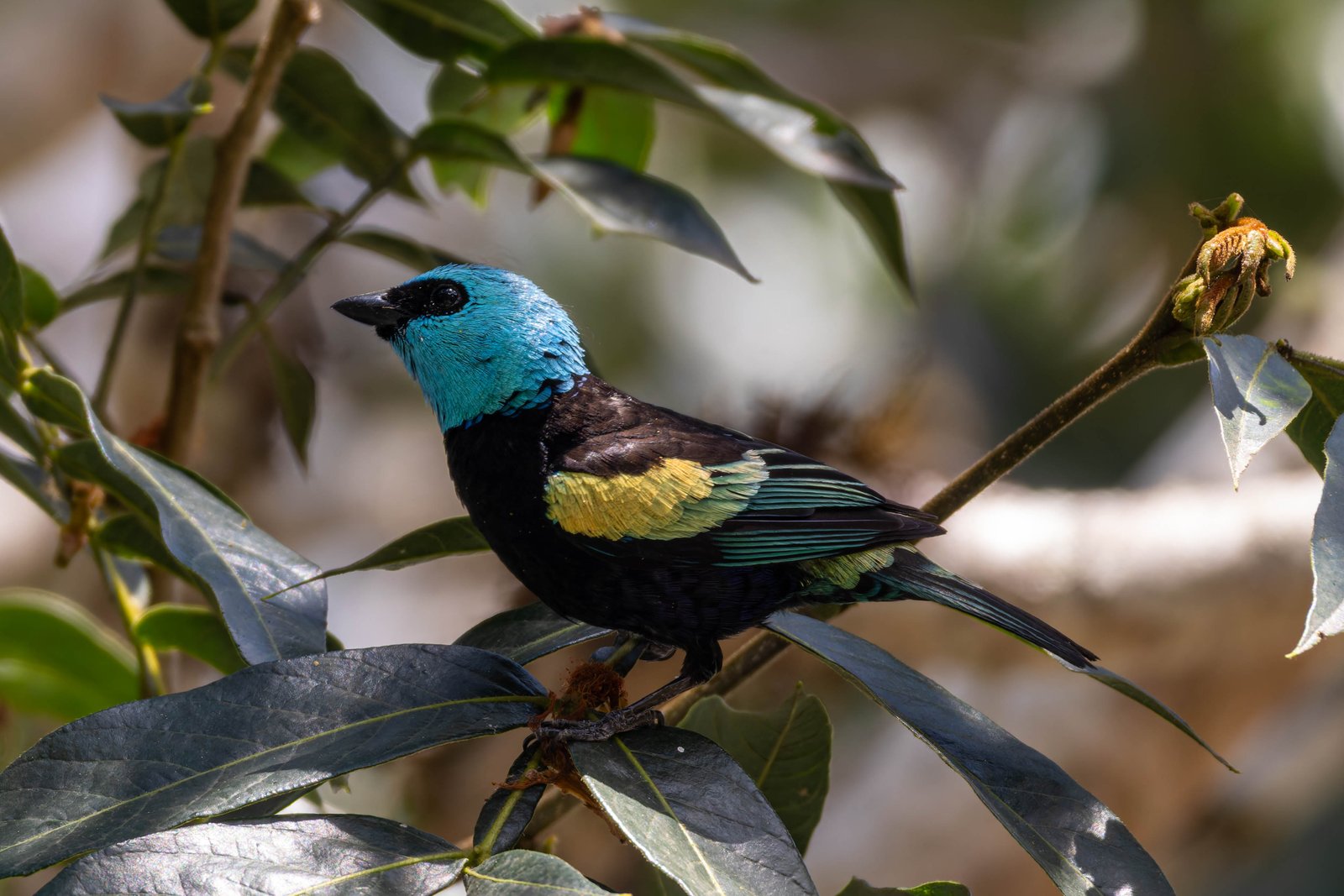
The Blue-necked Tanager is a tanager of the lower slopes and foothills of the Andes, from Colombia to Bolivia, with a glistening turquoise-blue head and a black body. It is one of the most common tanagers of forest edges and semi-open terrain at middle elevations, and lives in pairs or small groups, often in mixed flocks.
Voice
High, thin tseet calls and a dry chipping; the song is a rapid, thin series of high notes.
Recording: Jonas Nilsson — CC BY-NC-SA 4.0 · xeno-canto
Identification
13 cm. Head and neck are glistening turquoise-blue to azure, the throat purplish blue, with small black lores. The body is black. The lesser coverts form a golden-green to straw-coloured shoulder patch; the flight feathers are black with green-blue edges. Belly and undertail coverts are black, sometimes with blue-green spots. The sexes are almost alike. Juveniles are duller and greyer, with a less glossy head.
Confusion species
Masked Tanager Stilpnia nigrocincta has a paler, lavender-blue head, a black mask and a white belly, and lives lower, in the Amazonian lowlands. Golden-naped Tanager Chalcothraupis ruficervix is all blue with a golden patch on the nape. Flame-faced Tanager Tangara parzudakii has a red and yellow face and lives higher, in cloud forest.
Habitat
Edges and canopy of lower montane and foothill forest, secondary forest, scrub, clearings with scattered trees, coffee plantations and gardens, roughly between 500 and 2300 m, most numerous between 1000 and 1800 m. It eats fruit and searches branches for insects, in pairs or small groups. The cup nest is placed in a tree or shrub.
Where the bird is most at home, classified by the vegetation units of the Andes and the west coast.


Range and movements
In Colombia in all three Andean ranges and on the slopes down to the major valleys. In Ecuador on the western and eastern slopes of the Andes. In Peru along the eastern slope of the Andes throughout the country. In Bolivia on the eastern slope of the Andes in La Paz, Cochabamba and Santa Cruz. Does not occur on the Galápagos. Outside the guide area in western Venezuela and, isolated, in western and central Brazil.
- Resident
- dark = core range, pale = thinly spread
How and when to look
Search forest edges and roadsides through lower montane forest, for example at Mindo in Ecuador and along the Manu road in Peru; the birds often sit in fruiting trees at the forest edge and in open terrain.
Conservation status
Least Concern. Widespread and fairly common; it benefits from forest edges and semi-open terrain.
Scientific name
Stilpnia cyanicollis | (d'Orbigny, ACVMD & de Lafresnaye, 1837)
D'Orbigny, ACVMD & de Lafresnaye described the species in 1837 as A[glaia] cyanicollis; because it was later moved to another genus, the author and year stand in brackets. The genus Stilpnia was introduced in 2016 by Burns, Unitt & Mason. The genus name comes from Greek stilpnos, 'glittering' or 'glistening'. The specific name comes from Greek kuanos, 'dark blue', and Latin collis, 'neck', referring to the blue neck. The specimen the first description was based on came from Yuracarés region, Bolivia.