All species › Passerines › Tanagers and allies › Golden-hooded Tanager
Golden-hooded Tanager | Stilpnia larvata
Purpermaskertangare | Tangara capucha dorada | Saíra-de-capuz-dourado
The Golden-hooded Tanager is a tanager of humid lowland forest on the Pacific side of Colombia and Ecuador, with a golden-buff hood, a black mask bordered with purple-blue and a black breast above a white belly. In the guide area it reaches the southern limit of a range that extends to Mexico.
Voice
High, thin tseet calls and a short, dry chipping; the song is a rapid series of high, thin notes, sometimes like a soft twitter.
Recording: MiriamEaglemon — CC BY-NC-SA 4.0 · xeno-canto
Identification
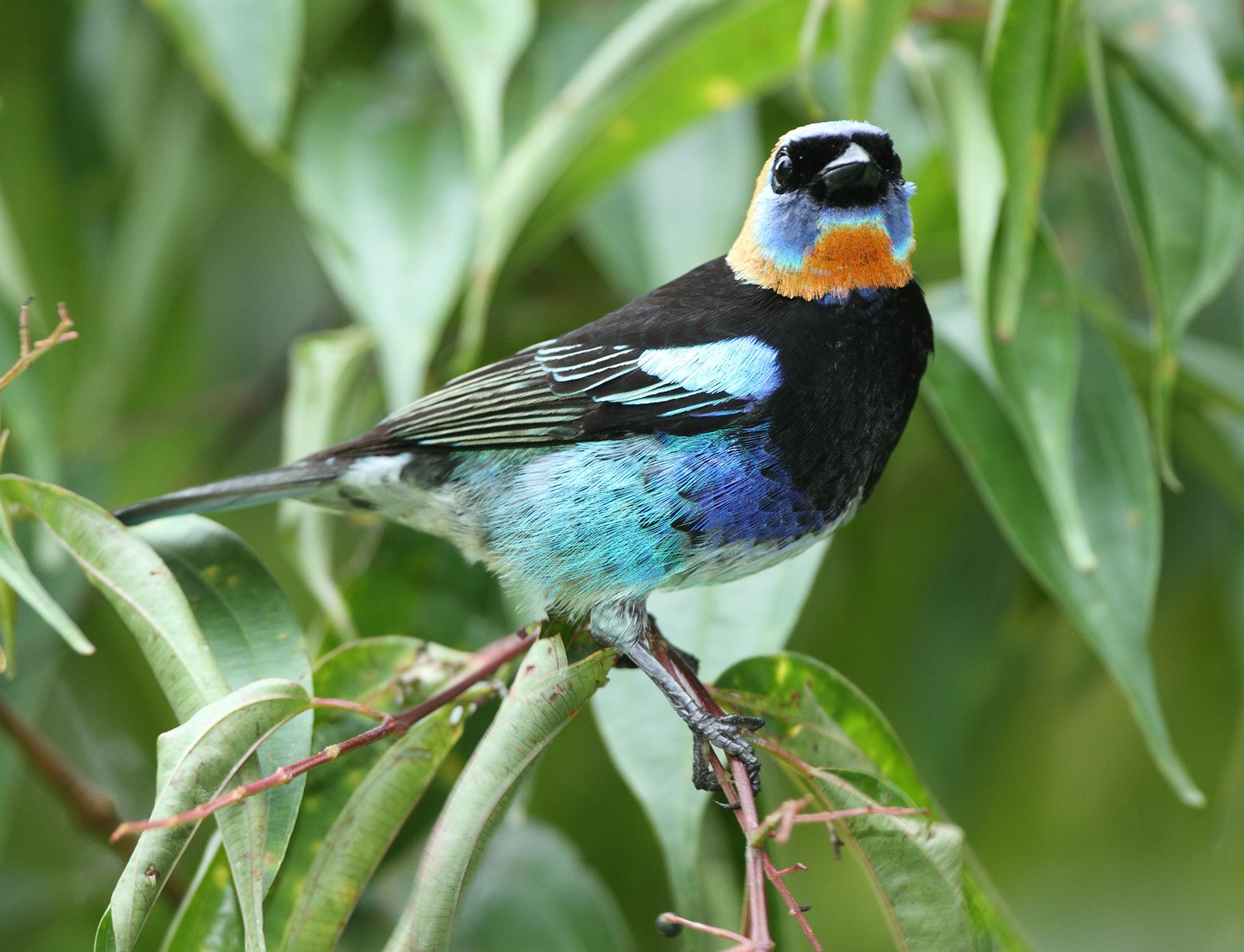
13 cm. Head and neck are golden-yellow to buffy yellow. Around bill and eye lies a black mask, bordered in front and below with purple-blue and pale blue. Back, breast and tail are black; shoulders and rump are pale blue, and the wings are black with blue edges. Belly and undertail coverts are white, the flanks blue. The sexes are almost alike. Juveniles are duller and greener, with a dull hood.
Confusion species
Masked Tanager Stilpnia nigrocincta has a lavender-blue instead of golden head and lives in the Amazonian lowlands east of the Andes. Bay-headed Tanager Tangara gyrola has a rufous head and a green body. Rufous-winged Tanager Tangara lavinia is green with a rufous head and rufous wings.
Habitat
Canopy and edges of humid lowland and foothill forest, secondary forest, clearings with scattered trees, cacao and banana plantations and gardens, mainly below 1200 m, locally higher. It eats small fruits and searches branches and leaves for insects, in pairs or small groups, often in mixed flocks. The cup nest is placed in a tree or shrub.
Where the bird is most at home, classified by the vegetation units of the Andes and the west coast.


Range and movements
In Colombia on the Pacific side, from the Chocó to Nariño, and in the north into the lowlands near the Gulf of Urabá and the lower Magdalena valley. In Ecuador in the west, mainly in the north-west, from Esmeraldas to Pichincha and northern Manabí. Does not occur in Peru, Bolivia or on the Galápagos. Outside the guide area from southern Mexico through Central America to Panama.
- Resident
- dark = core range, pale = thinly spread
How and when to look
Search forest edges and clearings in the lowlands and foothills of north-western Ecuador, for example at Milpe and Río Silanche and along the road to Esmeraldas; the birds often visit fruiting trees near houses.
Conservation status
Least Concern. Widespread and fairly common; it tolerates secondary forest and semi-open terrain well.
Scientific name
Stilpnia larvata | (Du Bus de Gisignies, B-AL, 1846)
Du Bus de Gisignies, B-AL described the species in 1846 as Calliste larvata; because it was later moved to another genus, the author and year stand in brackets. The genus Stilpnia was introduced in 2016 by Burns, Unitt & Mason. The genus name comes from Greek stilpnos, 'glittering' or 'glistening'. The specific name comes from Latin larvatus, 'masked', referring to the black mask. The specimen the first description was based on came from Tabasco, Mexico.