All species › Passerines › Tanagers and allies › Common Cactus Finch
Common Cactus Finch | Geospiza scandens
Cactusgrondvink | Pinzón cactero común | Tentilhão-dos-cactos
The Common Cactus Finch is a Darwin's finch closely tied to the Opuntia cacti of the arid lowlands of the Galápagos. With its long, pointed bill it takes nectar and pollen from cactus flowers and seeds from the fruits. The species plays a leading role in the well-known long-term study of evolution on the islet of Daphne Major.
Voice
The song is a short, simple phrase, often repeated. Each male sings a single song type, learned from its father when young.
Recording: Eric DeFonso — CC BY-NC-SA 3.0 · xeno-canto
Identification
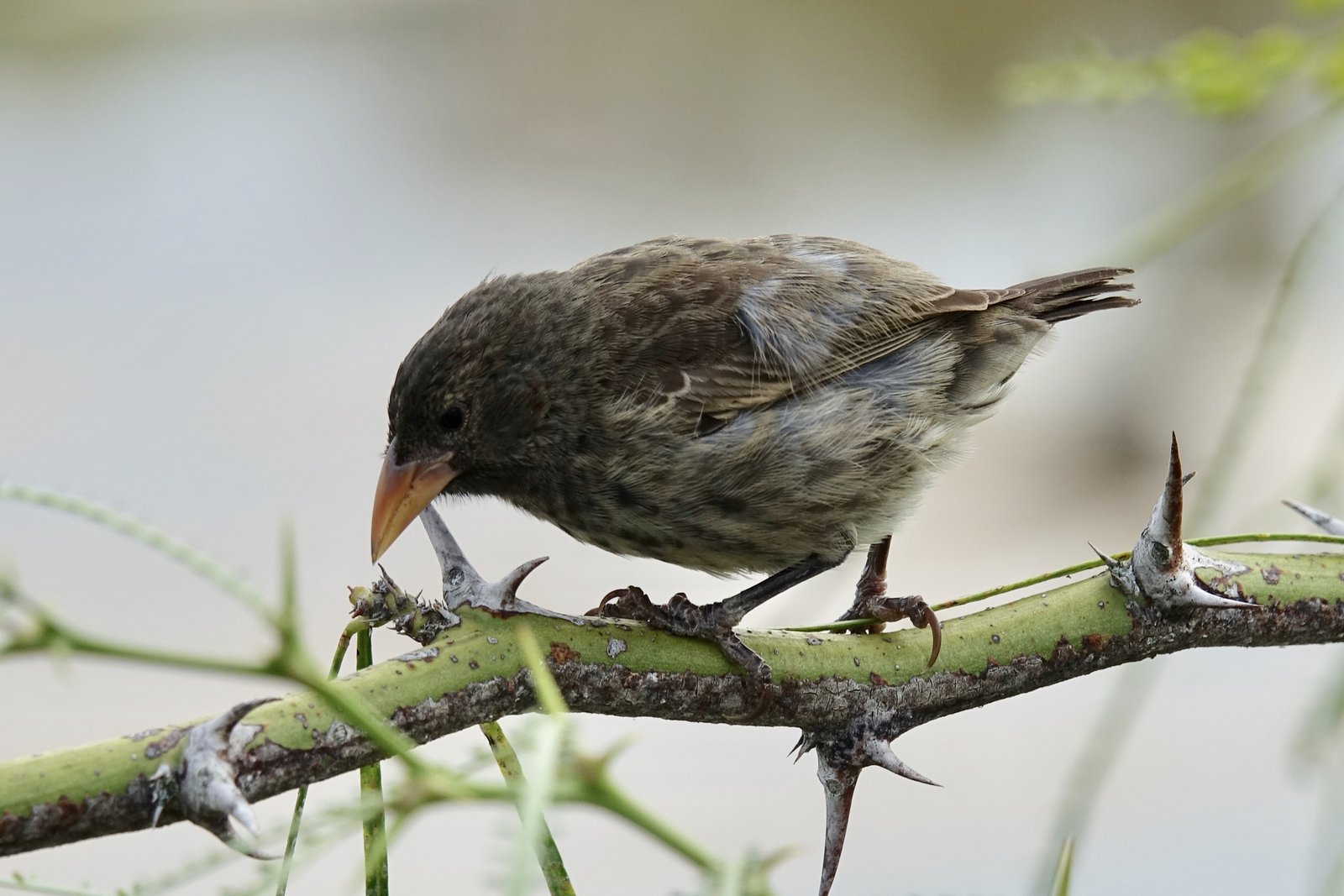
14 cm, with a long, pointed, slightly decurved bill. Adult males are entirely black, with a black bill; they become gradually blacker over several years. Females and young birds are greyish brown above and heavily streaked dark below, with a paler bill. After visiting cactus flowers birds often have yellow pollen on the forehead and bill.
Confusion species
Small Ground Finch Geospiza fuliginosa is smaller, with a short, conical bill. Other ground finches on the same islands have a shorter, deeper bill. On Española it is replaced by Espanola Cactus Finch Geospiza conirostris, with a heavier bill, and on Genovesa by Genovesa Cactus Finch Geospiza propinqua; these species do not overlap with Common Cactus Finch.
Habitat
The arid lowland zone with Opuntia cacti, and the adjacent coast and lava fields. It eats nectar, pollen and seeds of Opuntia, opens the cactus fruits and also takes insects and seeds of other plants. The nest is usually built in an Opuntia.
Where the bird is most at home, classified by the vegetation units of the Andes and the west coast.


Range and movements
Endemic to the Galápagos, on most of the central and northern islands, including Santa Cruz, Santiago, Isabela, San Cristóbal, Floreana, Santa Fe, Rábida, Pinta, Marchena and Daphne Major. Absent from Española, Genovesa and Fernandina. Absent from mainland Colombia, Ecuador, Peru and Bolivia.
- Resident
How and when to look
At flowering Opuntia cacti in the arid zone, such as around Puerto Ayora and the research station on Santa Cruz. The birds are tame and can often be watched at close range.
Conservation status
Least Concern. Introduced plants, goats and rats damage Opuntia stands, and the introduced parasitic fly Philornis downsi also affects this species. Numbers fall sharply in dry years.
Scientific name
Geospiza scandens | (Gould, 1837)
Gould described the species in 1837 as Cactornis scandens; because it was later moved to another genus, the author and year stand in brackets. The genus Geospiza was introduced in 1837 by Gould. The genus name comes from Greek gē, 'earth, ground', and spiza, 'finch': a ground finch. The species name comes from Latin scandens, 'climbing', after its clambering in cacti. The specimen the first description was based on came from Santiago Island, Galápagos.