All species › Passerines › Tanagers and allies › Medium Ground Finch
Medium Ground Finch | Geospiza fortis
Middelste grondvink | Pinzón terrestre mediano | Tentilhão-terrestre-médio
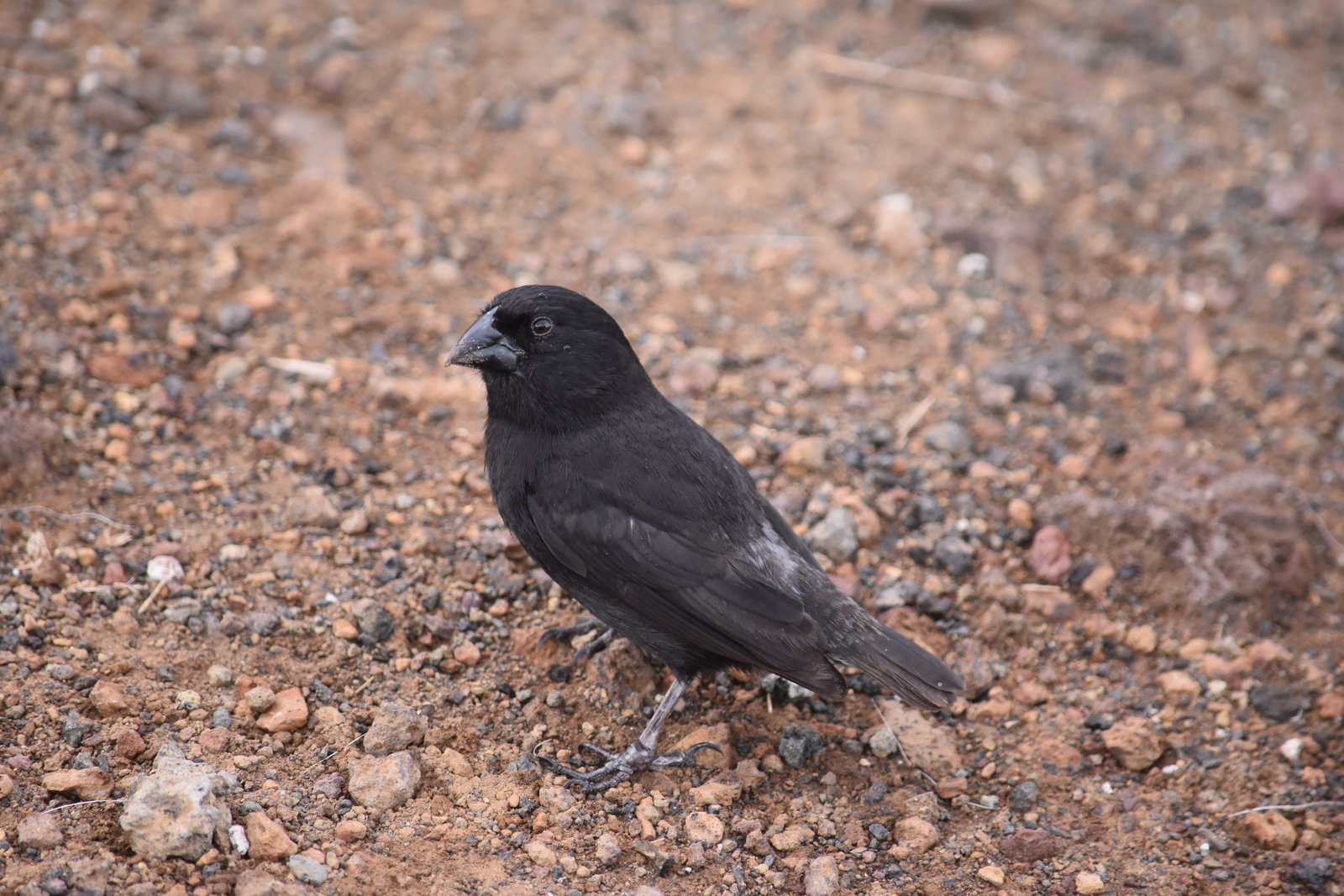
The Medium Ground Finch is one of the most numerous Darwin's finches of the Galápagos and the main subject of the long-term field study of evolution on the islet of Daphne Major. There it was measured how average bill size changed within a few years after drought and after the arrival of Large Ground Finch. The bill varies greatly in size, so the species grades towards both Small and Large Ground Finch.
Voice
The song is a short, simple phrase of a few notes, often repeated, each male always singing the same type, learned from its father when young. The call is a short chip.
Recording: Paul Driver — CC BY-NC-SA 4.0 · xeno-canto
Identification
12–13 cm, with a short, deep, conical bill that varies greatly in size between islands and individuals. Adult males are entirely black, with whitish edges to the undertail coverts; they become gradually blacker over several years. Females and young birds are greyish brown above and heavily streaked dark below. The bill is black in the breeding season, paler and horn-coloured outside it.
Confusion species
Small Ground Finch Geospiza fuliginosa is smaller, with a smaller, more pointed bill; small-billed birds cannot always be separated with certainty. Large Ground Finch Geospiza magnirostris is larger, with a very heavy bill and a more angular head. Common Cactus Finch Geospiza scandens has a longer, more pointed bill. The tree finches (Camarhynchus) have a parrot-like curved bill and are more olive above.
Habitat
Mainly the arid lowland zone with shrubs, Opuntia and lava fields, but also higher in Scalesia forest and the humid zone, and in gardens and villages. It eats mainly seeds of varied size, searched for on the ground, as well as flowers, buds and insects. It breeds in the rainy season; the nest is a domed structure with a side entrance, often in a cactus or shrub.
Where the bird is most at home, classified by the vegetation units of the Andes and the west coast.


Range and movements
Endemic to the Galápagos, on most of the central and larger islands, including Santa Cruz, Isabela, Santiago, Fernandina, San Cristóbal, Floreana, Pinzón, Rábida, Baltra and Daphne Major, and also on Pinta and Marchena. Absent from Española, Genovesa, Wolf and Darwin. Absent from mainland Colombia, Ecuador, Peru and Bolivia.
- Resident
How and when to look
Common in Puerto Ayora and around the research station on Santa Cruz, and in the arid zone of most visited islands. Compare the bill with that of Small Ground Finches in the same group; birds are tame and can often be watched at close range.
Conservation status
Least Concern and numerous. Numbers fluctuate strongly between dry and wet years. The introduced parasitic fly Philornis downsi causes high mortality among nestlings.
Scientific name
Geospiza fortis | Gould, 1837
Gould described the species in 1837 and placed it straight away in the genus where it still stands. He introduced the genus Geospiza in that same work. The genus name comes from Greek gē, 'earth, ground', and spiza, 'finch': a ground finch. The species name comes from Latin fortis, 'strong, powerful', after the stout bill. The specimen the first description was based on came from Galápagos Islands, Ecuador.