All species › Passerines › New World sparrows › Common Chlorospingus
Common Chlorospingus | Chlorospingus flavopectus
Briltangare | Clorospingo común | Clorospingo-comum
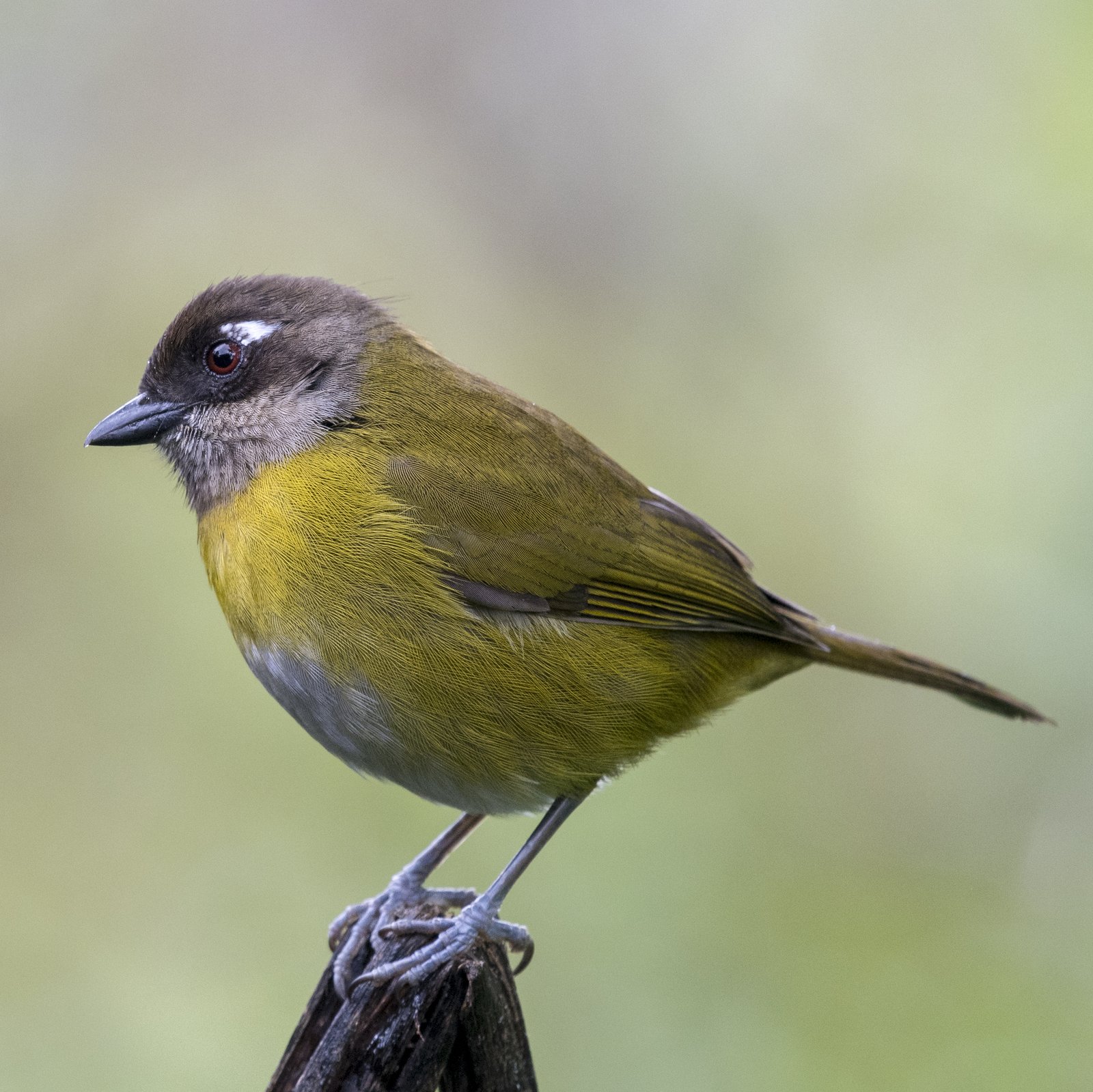
The Common Chlorospingus is the most widespread chlorospingus, from Mexico to north-western Argentina, and in the guide area one of the most numerous birds of montane forest. Small groups form the core of many mixed flocks in cloud forest. The species is geographically very variable; most forms have a white spot behind the eye.
Voice
A dry, sharp tchit, often repeated within groups. The song is a fast series of dry chip notes, sometimes accelerating into a short, shrill twitter.
Recording: Juan Freile — CC BY-NC-SA 4.0 · xeno-canto
Identification
13–14 cm, with a conical, dark bill. The upperparts are olive-green. The head is brownish to grey, usually with a distinct white spot or short streak behind the eye; some forms lack it. The throat is whitish, often finely speckled dark, the breast has a broad olive-yellow to yellow band, the belly is whitish and the flanks are olive. In many forms the iris is pale. The sexes are alike. Juveniles are duller, with a less distinct head pattern.
Confusion species
Ashy-throated Chlorospingus Chlorospingus canigularis has a pale grey, unspeckled throat and no white spot behind the eye, and more often stays high in the trees. Yellow-throated Chlorospingus Chlorospingus flavigularis has a bright yellow throat and a grey breast. Dusky Chlorospingus Chlorospingus semifuscus is greyer, without a yellow breast band. Oleaginous Hemispingus Sphenopsis frontalis is plain olive-yellow below, with a narrow yellow supercilium.
Habitat
Humid montane forest, cloud forest, forest edges, secondary forest and shrubby clearings, roughly between 1200 and 3000 m. It searches the lower and middle levels for insects and fruit and also takes nectar and berries; nearly always in small groups, often with tanagers, warblers and other species. The nest is a cup of moss and fibres, low to mid-level in a shrub or among epiphytes.
Where the bird is most at home, classified by the vegetation units of the Andes and the west coast.


Range and movements
In Colombia in all Andean ranges, also in the Sierra Nevada de Santa Marta and the Serranía de Perijá. In Ecuador on both slopes of the Andes. In Peru along the eastern slope over the whole length of the country and in the north also on the western slope. In Bolivia in the Yungas and on the eastern slope. Absent from the Galápagos. Outside the guide area from Mexico to Panama, in Venezuela and in north-western Argentina.
- Resident
- dark = core range, pale = thinly spread
How and when to look
Mixed flocks in cloud forest usually have a few Common Chlorospinguses as their core; follow their chip calls to find the flock. Then check the birds carefully, as the forms differ strongly from region to region.
Conservation status
Not evaluated in the taxonomy followed here. The species is common throughout the guide area and tolerates forest edges and secondary forest well.
Scientific name
Chlorospingus flavopectus | (de Lafresnaye, 1840)
De Lafresnaye described the species in 1840 as Arremon flavo-pectus; because it was later moved to another genus, the author and year stand in brackets. The genus Chlorospingus was introduced in 1851 by Cabanis. The genus name combines Greek khlōros, 'green', with spingos, a small bird, perhaps the chaffinch. The species name comes from Latin flavus, 'yellow', and pectus, 'breast': yellow-breasted. The specimen the first description was based on came from Bogotá, Colombia.