All species › Passerines › New World sparrows › Pirre Chlorospingus
Pirre Chlorospingus | Chlorospingus inornatus
Pirritangare | Clorospingo del Pirre | Clorospingo-de-pirre
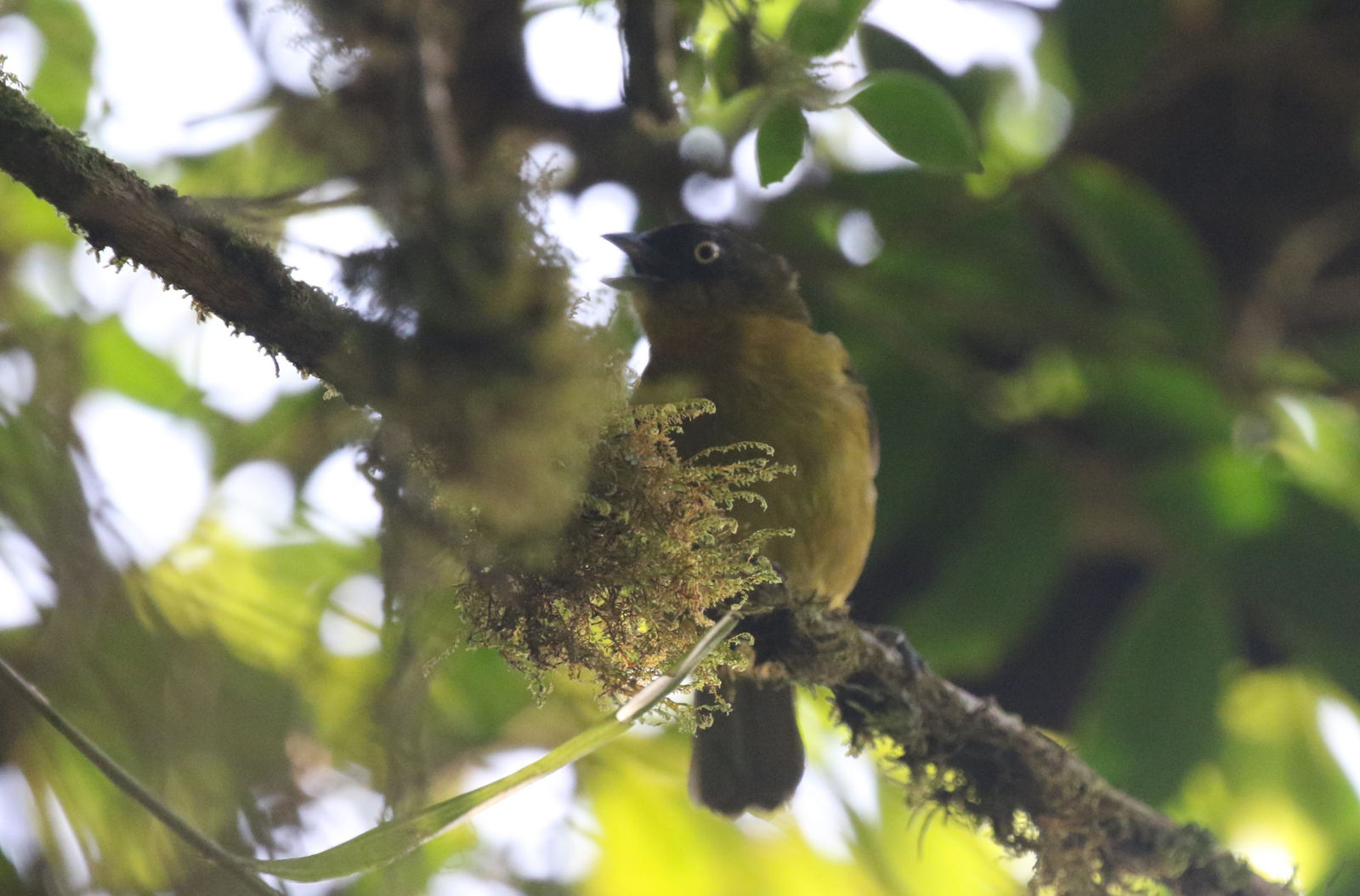
The Pirre Chlorospingus is a dark chlorospingus of the isolated mountains of eastern Darién, around Cerro Pirre in Panama. In the guide area it occurs only in the far north-west of Colombia, in the border mountains with Panama, where few records have been made. It lives in small groups in cloud forest.
Voice
Sharp chip calls and dry series of chip notes, as in related species; poorly described.
Recording: Cameron Rutt — CC BY-NC-SA 4.0 · xeno-canto
Identification
14 cm, fairly large for a chlorospingus, with a conical, dark bill. The head is dark sooty grey to blackish, without a white spot behind the eye. The upperparts are dark olive-green. The throat and breast are olive-yellow, the belly is greyish and the flanks are olive. The sexes are alike.
Confusion species
Tacarcuna Chlorospingus Chlorospingus tacarcunae from the mountains slightly further north has a paler, olive head and a yellowish throat. Common Chlorospingus Chlorospingus flavopectus has a white spot behind the eye and a whitish throat. Yellow-throated Chlorospingus Chlorospingus flavigularis has a bright yellow throat and a grey breast.
Habitat
Humid montane forest and cloud forest on the higher slopes and summits, roughly above 900 m. It searches the middle and upper levels for insects and small fruits, in small groups or in mixed flocks. Little is known about its breeding biology.
Where the bird is most at home, classified by the vegetation units of the Andes and the west coast.


Range and movements
In Colombia only in the far north-west, in the mountains of the Serranía del Darién on the border with Panama, with few records. Absent from Ecuador, Peru, Bolivia and the Galápagos. Outside the guide area in the mountains of eastern Darién in Panama, especially on Cerro Pirre.
- Resident
- dark = core range, pale = thinly spread
How and when to look
Its habitat in the guide area is remote and nearly inaccessible. Any record on the Colombian side merits documentation with a photograph or sound recording.
Conservation status
Least Concern. The range is small, but lies in remote, largely forested and partly protected mountains.
Scientific name
Chlorospingus inornatus | (Nelson, 1912)
Nelson described the species in 1912 as Hylospingus inornatus; because it was later moved to another genus, the author and year stand in brackets. The genus Chlorospingus was introduced in 1851 by Cabanis. The genus name combines Greek khlōros, 'green', with spingos, a small bird, perhaps the chaffinch. The species name is Latin inornatus, 'unadorned', referring to the plain plumage. The specimen the first description was based on came from Cerro Pirre, Panama.