All species › Passerines › New World warblers › Connecticut Warbler
Connecticut Warbler | Oporornis agilis
Connecticutzanger | Reinita de Connecticut | Mariquita-de-connecticut
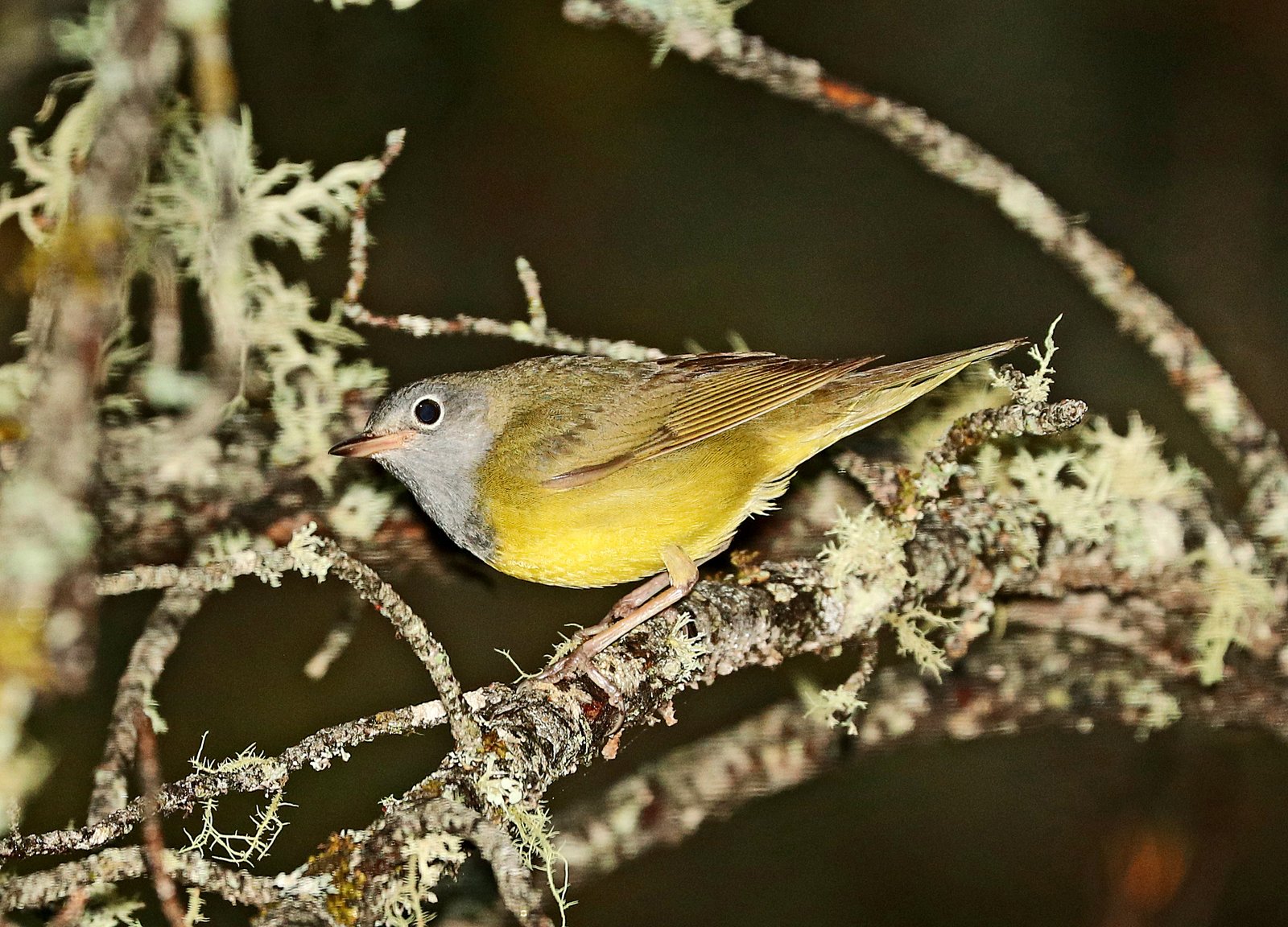
The Connecticut Warbler is a sturdy, ground-dwelling warbler with a grey hood and a complete white eye-ring, which breeds in the boreal bog forests of Canada. It migrates across the Caribbean to South America, and its winter quarters in Amazonia are still poorly known. In the guide area it is seen mainly on passage in northern Colombia, with a few winter records from south-eastern Peru and northern Bolivia.
Voice
The song, rarely heard on passage, is a loud, rhythmic chippa-choppa chippa-choppa. The call is a nasal, metallic pwik, but away from the breeding grounds the species is usually silent.
Recording: Michael Collins — CC BY-NC-SA 4.0 · xeno-canto
Identification
13.5–14.5 cm, stocky, with a fairly short tail and very long undertail coverts that reach far along the tail. The male has a plain grey hood extending onto the breast and a complete, conspicuous white eye-ring. The back and wings are olive-green and the underparts yellow. Females and young birds have a brownish-grey hood with a paler, brownish throat, and also a complete eye-ring. The legs are pink. It walks on the ground rather than hopping.
Confusion species
Mourning Warbler Geothlypis philadelphia is smaller, with shorter undertail coverts; the male has a black patch on the breast and no eye-ring, while females and young birds have at most a broken eye-ring and a yellowish throat. It hops rather than walks. Nashville Warbler Leiothlypis ruficapilla also has a white eye-ring but is smaller, with a yellow throat, and lives higher in the vegetation. Kentucky Warbler Geothlypis formosa has a yellow supercilium and a black cheek patch.
Habitat
On passage and in winter quarters in dense thickets, forest edges, secondary forest and the undergrowth of humid forest, also in riverside vegetation and on river islands in the Amazonian lowlands. It walks quietly over the ground and low branches, feeding on insects, spiders and small fruit. It does not breed in the guide area.
Where the bird is most at home, classified by the vegetation units of the Andes and the west coast.


Range and movements
In Colombia a scarce passage migrant, mainly in the north and on the slopes of the Sierra Nevada de Santa Marta. In Ecuador only a few records. In Peru a few winter records, mainly in the south-east, and in Bolivia a few records in the northern lowlands. Not known from the Galápagos. Outside the guide area it breeds in Canada and the northern United States; the main wintering area probably lies in Brazilian Amazonia.
- Winter visitor (c. Oct–Mar)
- Passage (Mar–Apr, Oct–Nov)
- dark = core range, pale = thinly spread
How and when to look
Search dense thickets and forest edges in northern Colombia in October and in April–May. A bird walking on the ground with a bobbing head and a complete white eye-ring deserves a second look.
Conservation status
Least Concern. Because of its secretive habits and poorly known winter quarters, numbers are uncertain; the breeding population appears to be declining.
Scientific name
Oporornis agilis | (Wilson, 1812)
Wilson described the species in 1812 as Sylvia agilis; because it was later moved to another genus, the author and year stand in brackets. The genus Oporornis was introduced in 1858 by Baird. The genus name comes from Greek opōra, 'late summer, autumn', and ornis, 'bird', for a species seen mainly on autumn migration. The species name comes from Latin agilis, 'agile, nimble', for the active bird. The specimen the first description was based on came from Connecticut, United States.