All species › Passerines › New World warblers › Tennessee Warbler
Tennessee Warbler | Leiothlypis peregrina
Tennesseezanger | Reinita verdillo | Mariquita-do-tennessee
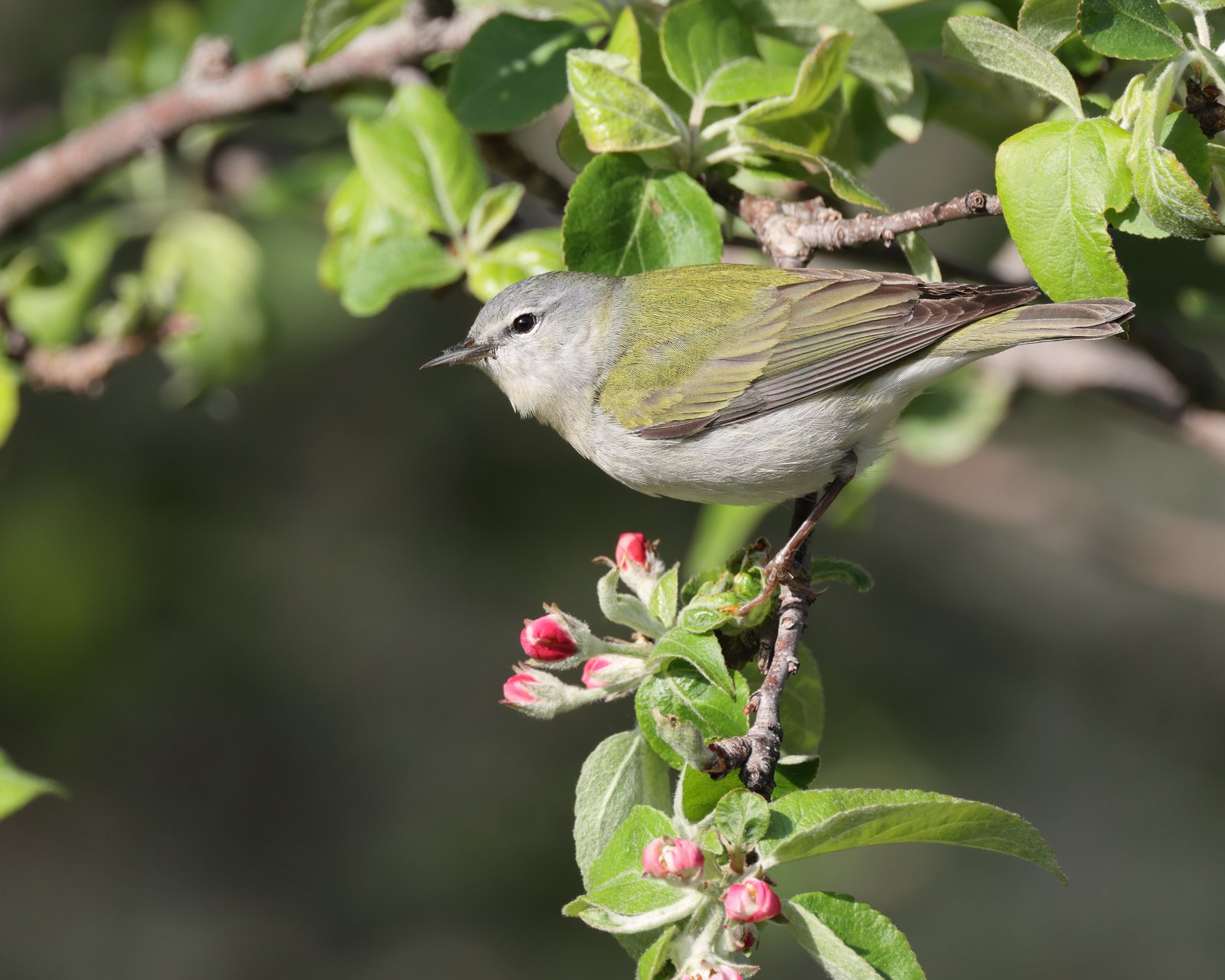
The Tennessee Warbler is a small green warbler with a fine, pointed bill, which breeds in the boreal forests of Canada and migrates in large numbers to Central America and northern South America. In the north of the guide area it is one of the most numerous North American warblers in winter, from the lowlands to high in the Andes. In winter quarters it takes much nectar and visits flowering trees in small groups.
Voice
The song is a loud, staccato chatter in three parts, accelerating towards the end; in March and April it is also heard in the guide area. The call is a sharp tsit; groups at flowering trees keep up a soft, constant twitter.
Recording: Paul Driver — CC BY-NC-SA 4.0 · xeno-canto
Identification
11.5–12.5 cm, with a short tail and a thin, pointed bill. In winter plumage it is olive-green above and pale yellow to dull white below, with white undertail coverts, a pale supercilium and a dark eye-line. There is sometimes a faint pale wing-bar. Before leaving in spring the male acquires a grey head with a white supercilium and white underparts. Young birds are yellower below, including the undertail.
Confusion species
Philadelphia Vireo Vireo philadelphicus is bulkier, with a thicker, hook-tipped bill, a greyer crown and a more yellowish throat and breast; it moves more slowly. Red-eyed Vireo Vireo olivaceus is larger, with a grey crown, a black-bordered white supercilium and a thick bill. Female American Yellow Warblers Setophaga aestiva are plain yellow with yellow edges in the wing and have no eye-line.
Habitat
Forest edges, secondary forest, shade coffee and cacao, gardens and parks with flowering trees, from sea level to about 3000 m, most numerous between 1000 and 2500 m. It feeds on insects, fruit and especially nectar, often at flowering Inga and Erythrina trees, and joins mixed flocks. It does not breed in the guide area.
Where the bird is most at home, classified by the vegetation units of the Andes and the west coast.


Range and movements
In Colombia a common winter visitor in all three Andean ranges, the Sierra Nevada de Santa Marta and the lower ground below them. In Ecuador mainly in the north and on the eastern slope, scarcer further south. In Peru scarce in the north, with only a few records further south. Not known or extremely rare in Bolivia and the Galápagos. Outside the guide area it breeds in Canada and the far northern United States and winters from southern Mexico to Venezuela.
- Winter visitor (c. Oct–Mar)
- dark = core range, pale = thinly spread
How and when to look
Check flowering trees in gardens, parks and coffee plantations in the Colombian Andes; between November and March Tennessee Warblers often gather there in small groups. Look for the white undertail coverts and the fine bill.
Conservation status
Least Concern. Numbers fluctuate strongly with outbreaks of spruce budworm on the Canadian breeding grounds.
Scientific name
Leiothlypis peregrina | (Wilson, 1811)
Wilson described the species in 1811 as Sylvia peregrina; because it was later moved to another genus, the author and year stand in brackets. The genus Leiothlypis was introduced in 2008 by Sangster. The genus name combines Greek leios, 'plain, smooth', with thlupis, an unidentified small bird mentioned by Aristotle. The species name comes from Latin peregrinus, 'wanderer, stranger'. The specimen the first description was based on came from Cumberland River, Tennessee, United States.