All species › Passerines › New World warblers › Blue-winged Warbler
Blue-winged Warbler | Vermivora cyanoptera
Blauwvleugelzanger | Reinita aliazul | Mariquita-de-asa-azul
The Blue-winged Warbler is a small yellow warbler with blue-grey wings and a narrow black eye-line, which breeds in the eastern United States and winters mainly in Central America. The guide area lies at the southern edge of the wintering range: it appears in small numbers in north-western Colombia. It regularly hybridizes with Golden-winged Warbler, and the hybrids also reach the tropics.
Voice
The song, rarely heard in winter quarters, is a buzzy, two-part beee-bzzz, the second part lower and rasping. The call is a dry chip; in flight a high, thin tsee.
Recording: Stephen Tyndel — CC BY-NC-SA 4.0 · xeno-canto
Identification
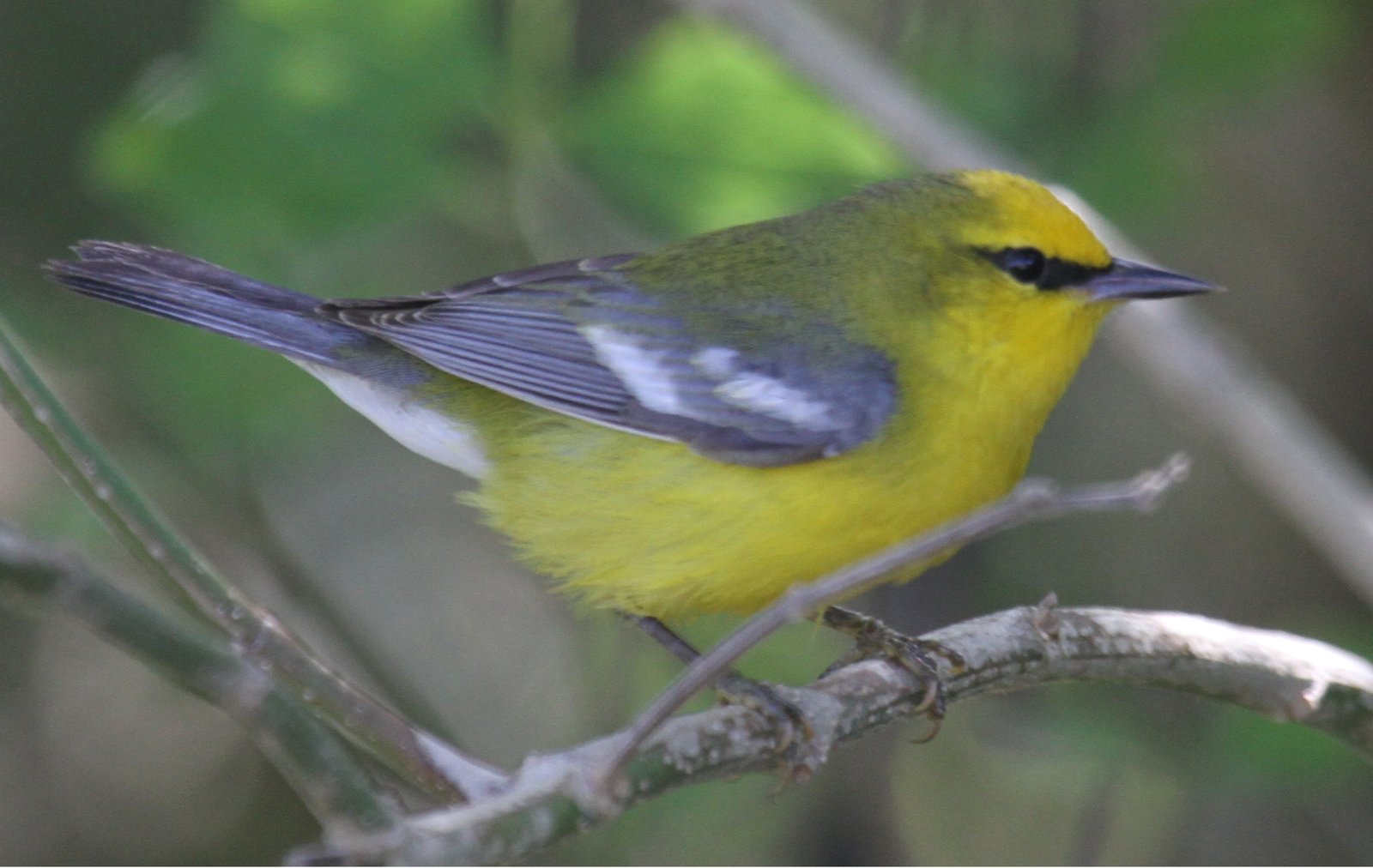
11.5–12 cm, with a sharply pointed, fairly long bill. The male has a bright yellow head and underparts, an olive-green back, blue-grey wings with two white wing-bars and a thin black line through the eye. The tail is blue-grey with white spots on the underside. The female is similar but has a more olive crown, a less sharp eye-line and less yellow. Young birds are duller, with a yellowish or olive tone.
Confusion species
Golden-winged Warbler Vermivora chrysoptera has a grey back, greyish-white underparts, a yellow wing patch and a black or grey throat and eye mask. Hybrids between the two show intermediate patterns, such as a yellow belly with a yellow wing patch or a white belly with white wing-bars. Prothonotary Warbler Protonotaria citrea lacks the eye-line and white wing-bars and has plain blue-grey wings. Female American Yellow Warblers Setophaga aestiva have yellow edges in the wing and no dark eye-line.
Habitat
In winter quarters in humid forest edges, secondary forest, scrub and shade coffee, mostly below 1500 m. It searches the middle and lower canopy for insects and spiders, often probing dead, curled leaves, and joins mixed flocks. It does not breed in the guide area.
Where the bird is most at home, classified by the vegetation units of the Andes and the west coast.


Range and movements
In Colombia a scarce winter visitor in the north-west and north, mainly in the Caribbean region, around the Sierra Nevada de Santa Marta and on the northern spurs of the Andes. Not or barely known from Ecuador, Peru, Bolivia and the Galápagos. Outside the guide area it breeds in the eastern United States and winters from southern Mexico to Panama.
- Winter visitor (c. Oct–Mar)
- dark = core range, pale = thinly spread
How and when to look
Search mixed flocks along forest edges in northern Colombia between October and April. Look for a yellow warbler probing dead leaves, and for the white wing-bars.
Conservation status
Least Concern. In North America the species is spreading north and is replacing Golden-winged Warbler there, partly through hybridization.
Scientific name
Vermivora cyanoptera | Olson & Reveal, 2009
Olson & Reveal described the species in 2009 and placed it straight away in the genus where it still stands. The genus Vermivora was introduced in 1827 by Swainson. The genus name comes from Latin vermis, 'worm', and -vorus, '-eating': 'worm-eater'. The species name comes from Greek kuanopteros, from kuanos, 'dark blue', and pteron, 'wing': 'blue-winged'. Olson and Reveal proposed it in 2009 because no other usable name was available for the species. The specimen the first description was based on came from (per the description).