All species › Passerines › New World warblers › Golden-winged Warbler
Golden-winged Warbler | Vermivora chrysoptera
Geelvleugelzanger | Reinita alidorada | Mariquita-de-asa-dourada
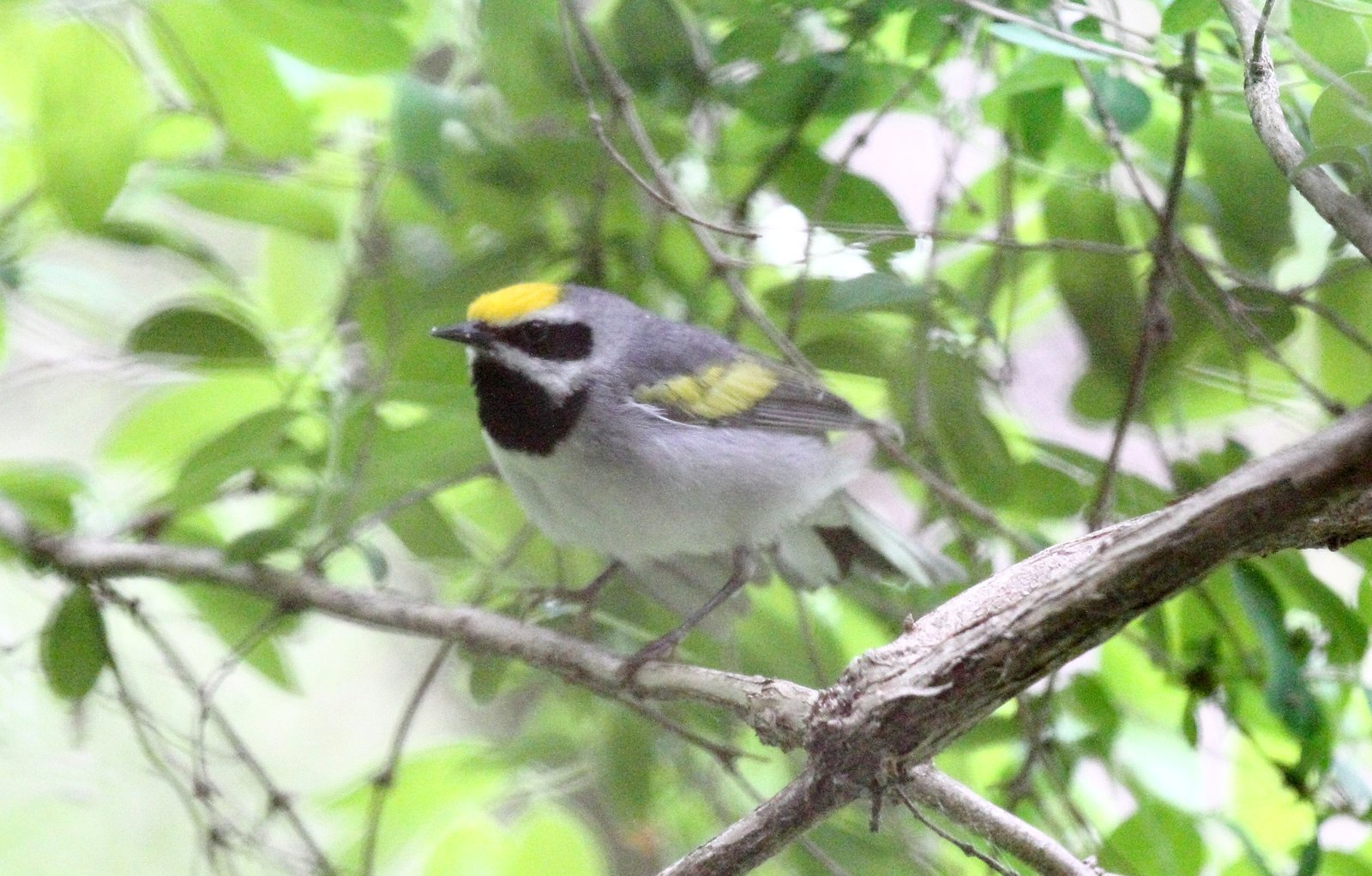
The Golden-winged Warbler is a small grey-and-white warbler with a yellow crown and a large yellow wing patch. A large part of the world population winters in the montane forests of Central America, Colombia and Venezuela. The species is declining steeply and hybridises with Blue-winged Warbler on the breeding grounds.
Voice
A sharp chip and a thin tseet. The song is a buzzy bee-bzz-bzz-bzz, with a higher first note; little heard on the wintering grounds.
Recording: Valerie Heemstra — CC BY-NC-SA 4.0 · xeno-canto
Identification
12 cm, with a pointed bill. The male is grey above and white below, with a yellow crown, a large yellow wing patch and a black mask and black throat, separated by a white supercilium and a white moustachial stripe. The female is duller, with a grey mask and grey throat. The tail has white spots.
Confusion species
Blue-winged Warbler Vermivora cyanoptera is yellow below, with a narrow black eye-line and two white wing bars; hybrids between the two species show intermediate patterns. Black-and-white Warbler Mniotilta varia is striped black and white, without yellow.
Habitat
On the wintering grounds in the canopy and at the edges of humid montane forest and cloud forest, in old secondary forest and in shade coffee, mainly between 900 and 2500 m. It forages in mixed flocks for insects and caterpillars, often in hanging dead leaves. It does not breed in the guide area.
Where the bird is most at home, classified by the vegetation units of the Andes and the west coast.


Range and movements
Winter visitor, mainly October to April. In Colombia scarce in all three Andean ranges and the Sierra Nevada de Santa Marta. In Ecuador rare, mainly in the north. In Peru exceptional. Absent from Bolivia and the Galápagos. Breeds in north-eastern North America and along the Appalachians and winters from Guatemala to Colombia and Venezuela.
- Winter visitor (c. Oct–Mar)
- dark = core range, pale = thinly spread
How and when to look
In the winter months, follow mixed flocks in montane forest and shade coffee on the slopes of the Colombian Andes; the bird often searches dead-leaf clusters in the canopy.
Conservation status
Near Threatened. The population has declined sharply in recent decades due to loss of young, shrubby growth on the breeding grounds, hybridisation with Blue-winged Warbler and deforestation of montane forest on the wintering grounds.
Scientific name
Vermivora chrysoptera | (Linnaeus, 1766)
Linnaeus described the species in 1766 as Motacilla chrysoptera; because it was later moved to another genus, the author and year stand in brackets. The genus Vermivora was introduced in 1827 by Swainson. The genus name comes from Latin vermis, 'worm', and -vorus, '-eating': 'worm-eater'. The species name comes from Greek khrusos, 'gold', and pteron, 'wing': 'golden-winged', after the yellow wing patch. The specimen the first description was based on came from Philadelphia, Pennsylvania, United States.