All species › Passerines › New World warblers › Prothonotary Warbler
Prothonotary Warbler | Protonotaria citrea
Citroenzanger | Reinita protonotaria | Mariquita-protonotária
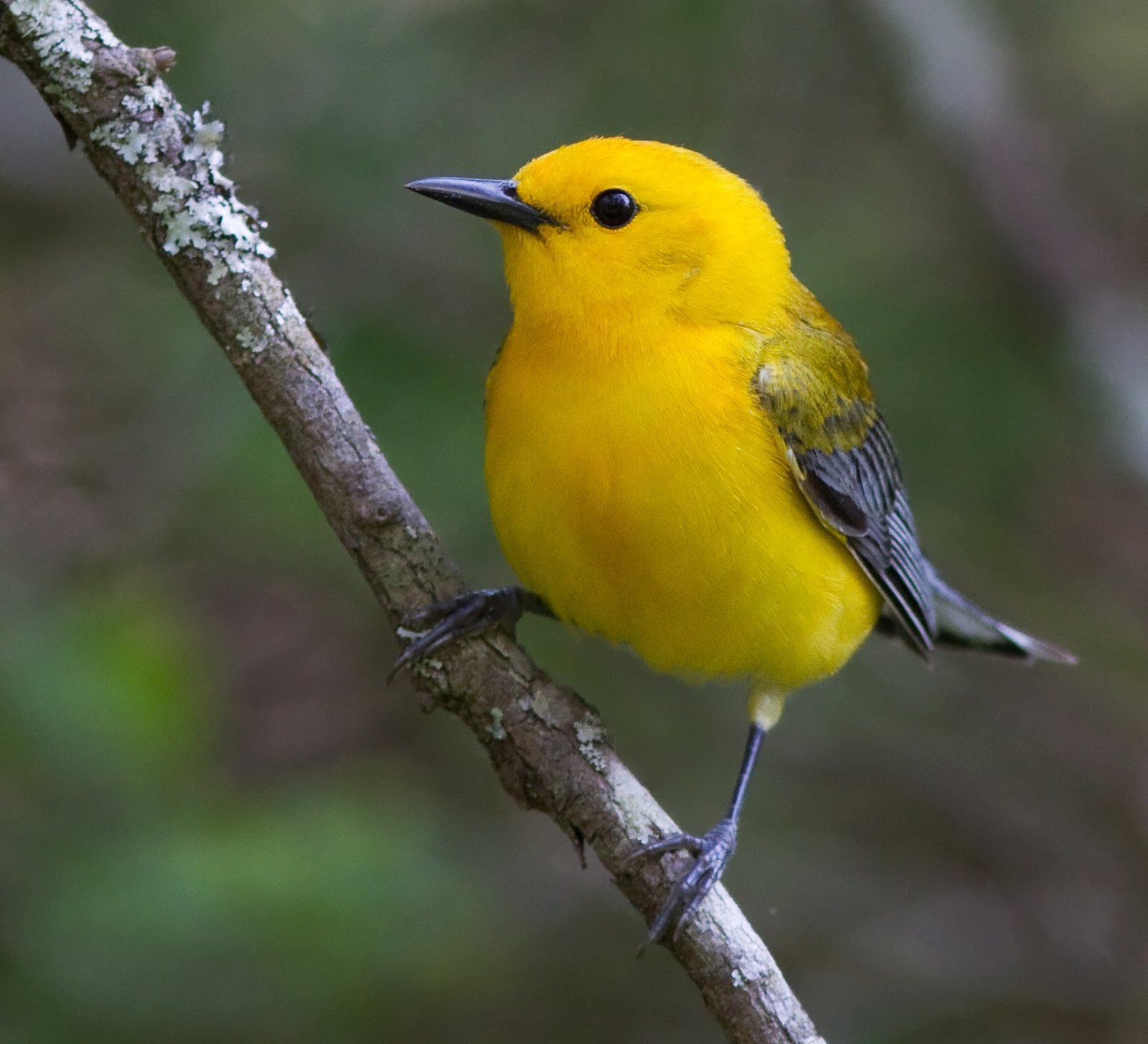
The Prothonotary Warbler is a golden-yellow warbler with blue-grey wings that is tied to water both on its breeding and wintering grounds. Unusually for a warbler, it nests in tree cavities in swamp forests of eastern North America, and it winters mainly in the mangroves of Central America and northern South America.
Voice
A loud, metallic chip, resembling the call of the waterthrushes. The song is a series of clear, even notes, sweet-sweet-sweet.
Recording: David Darrell-Lambert — CC BY-NC-SA 4.0 · xeno-canto
Identification
13–14 cm, with a fairly long, pointed black bill. The male has a golden-yellow head and underparts, an olive-green back, plain blue-grey wings without wing bars and a blue-grey tail with white spots. The female is duller yellow, with an olive crown. The undertail coverts are white. The dark eye stands out in the yellow head.
Confusion species
American Yellow Warbler Setophaga aestiva and Mangrove Warbler Setophaga petechia have yellow edges to olive wings, yellow tail spots and a shorter bill. Blue-winged Warbler Vermivora cyanoptera has a black eye-line and two white wing bars.
Habitat
On the wintering grounds mainly in mangroves, also in swamp forest, wet woodland along rivers and lakes and humid lowland forest, mostly below 500 m. It takes insects, spiders and small snails in the lower and middle levels and sometimes drinks nectar. It does not breed in the guide area.
Where the bird is most at home, classified by the vegetation units of the Andes and the west coast.


Range and movements
Winter visitor, mainly September to March. In Colombia fairly common in the mangroves of the Caribbean coast, scarcer on the Pacific coast and inland in the Magdalena valley. In Ecuador rare, mainly in the north-west. In Peru exceptional. Absent from Bolivia and the Galápagos. Breeds in the eastern United States and winters from southern Mexico to Colombia and Venezuela.
- Winter visitor (c. Oct–Mar)
- dark = core range, pale = thinly spread
How and when to look
In the winter months, search along mangroves and swamp forest on the Caribbean coast of Colombia, often low over the water; the loud call gives the bird away.
Conservation status
Least Concern. Decline of the North American population and loss of mangroves on the wintering grounds are the main threats.
Scientific name
Protonotaria citrea | (Boddaert, 1783)
Boddaert described the species in 1783 as Motacilla citrea; because it was later moved to another genus, the author and year stand in brackets. The genus Protonotaria was introduced in 1858 by Baird. The genus name comes from Late Latin protonotarius, 'prothonotary', a notary at the Byzantine court who wore golden-yellow robes, for the yellow plumage. The species name comes from Latin citreus, 'citrine, lemon-yellow', for the yellow plumage. The specimen the first description was based on came from Louisiana, United States.