All species › Passerines › New World warblers › Black-and-white Warbler
Black-and-white Warbler | Mniotilta varia
Bonte zanger | Chipe trepador | Mariquita-preta-e-branca
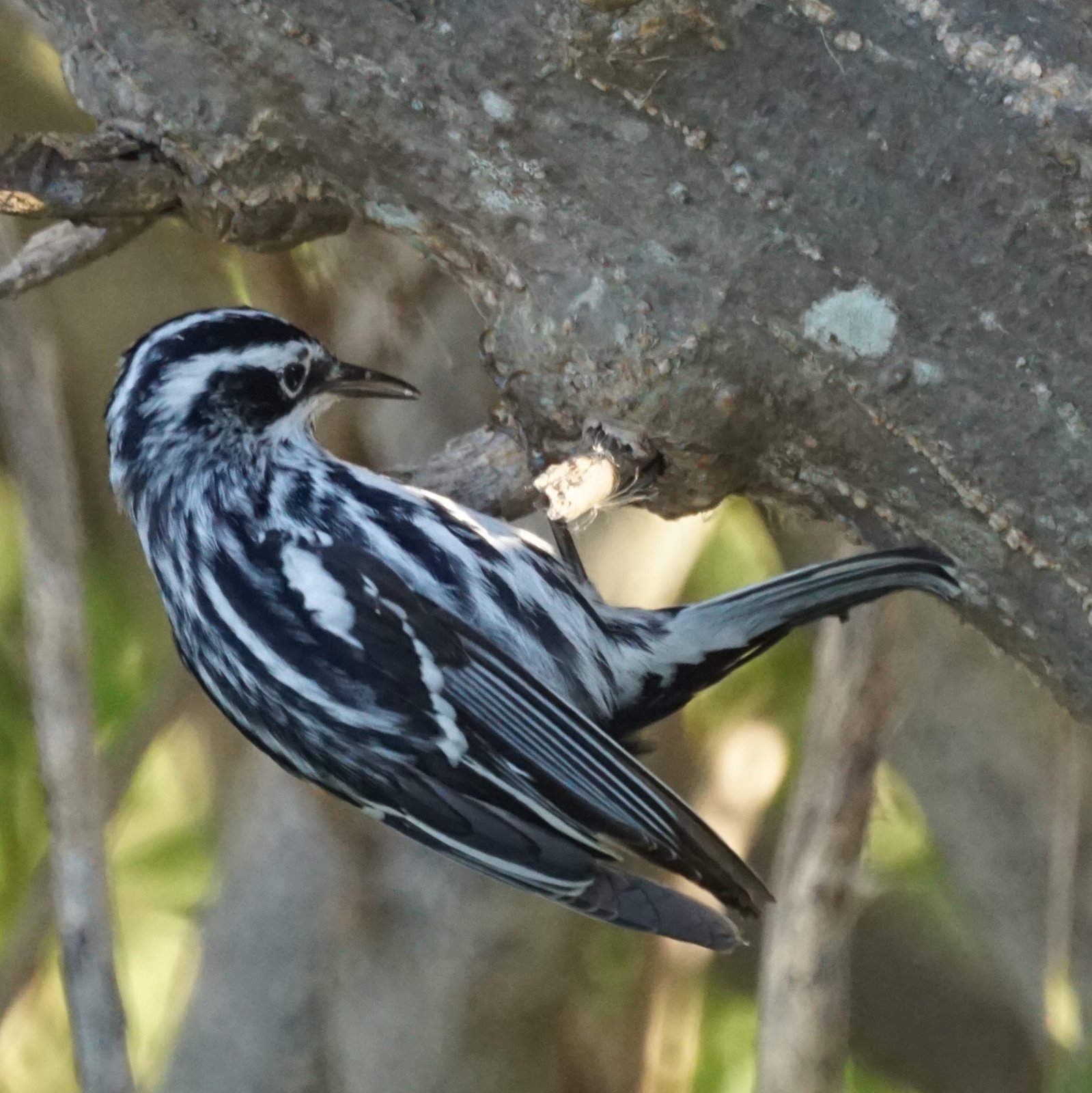
The Black-and-white Warbler is a black-and-white striped warbler that creeps along trunks and branches like a nuthatch. In winter it is the most widespread North American warbler in the montane forests of Colombia, where it travels with mixed flocks. Further south it quickly becomes rarer.
Voice
A sharp chik and a thin tseet. The song is a high, squeaky series of two-syllable notes, weesee-weesee-weesee, on the wintering grounds mainly heard in spring.
Recording: Bobby Wilcox — CC BY-NC-SA 4.0 · xeno-canto
Identification
12–13 cm, with a fairly long, slightly decurved bill. The entire plumage is striped black and white, with a white crown stripe between two black stripes, a white supercilium and two white wing bars. The male has a black throat and cheek (partly white in winter); the female has a white throat, a paler cheek and often a buff wash on the flanks. The undertail coverts are spotted black.
Confusion species
Breeding-plumaged male Blackpoll Warbler Setophaga striata has a solid black cap without a white crown stripe and white cheeks, and does not creep along trunks. Streaked Xenops Xenops rutilans also forages on branches, but is streaked brown and buff, with an upturned bill.
Habitat
On the wintering grounds in humid montane forest, cloud forest, forest edge, secondary forest and shade coffee, mainly between 500 and 2500 m, sometimes up to 3000 m, and also in the lowlands. It creeps along trunks and large branches, searching bark crevices for insects and spiders. It does not breed in the guide area.
Where the bird is most at home, classified by the vegetation units of the Andes and the west coast.


Range and movements
Winter visitor, mainly September to April. In Colombia fairly common in all three Andean ranges, the Sierra Nevada de Santa Marta and the northern lowlands. In Ecuador scarce, mainly on the Andean slopes in the north. In Peru rare, with a few records in the north. Absent from Bolivia and the Galápagos. Breeds in eastern and northern North America and winters from the southern United States to north-western South America.
- Winter visitor (c. Oct–Mar)
- dark = core range, pale = thinly spread
How and when to look
In the winter months, follow mixed flocks in montane forest and shade coffee in the Colombian Andes; the bird creeps along trunks and branches, often among tanagers and other warblers.
Conservation status
Least Concern. The North American population has declined; on the wintering grounds the species also uses secondary forest and shade coffee.
Scientific name
Mniotilta varia | (Linnaeus, 1766)
Linnaeus described the species in 1766 as Motacilla varia; because it was later moved to another genus, the author and year stand in brackets. The genus Mniotilta was introduced in 1816 by Vieillot. The genus name combines Greek mnion, 'seaweed' (presumably meant as mnioeis, 'mossy'), with tillō, 'to pluck': the bird that plucks moss. The species name comes from Latin varius, 'various, variegated'. The specimen the first description was based on came from Hispaniola.