All species › Passerines › New World warblers › Worm-eating Warbler
Worm-eating Warbler | Helmitheros vermivorum
Streepkopzanger | Reinita gusanera | Mariquita-comedora-de-larvas
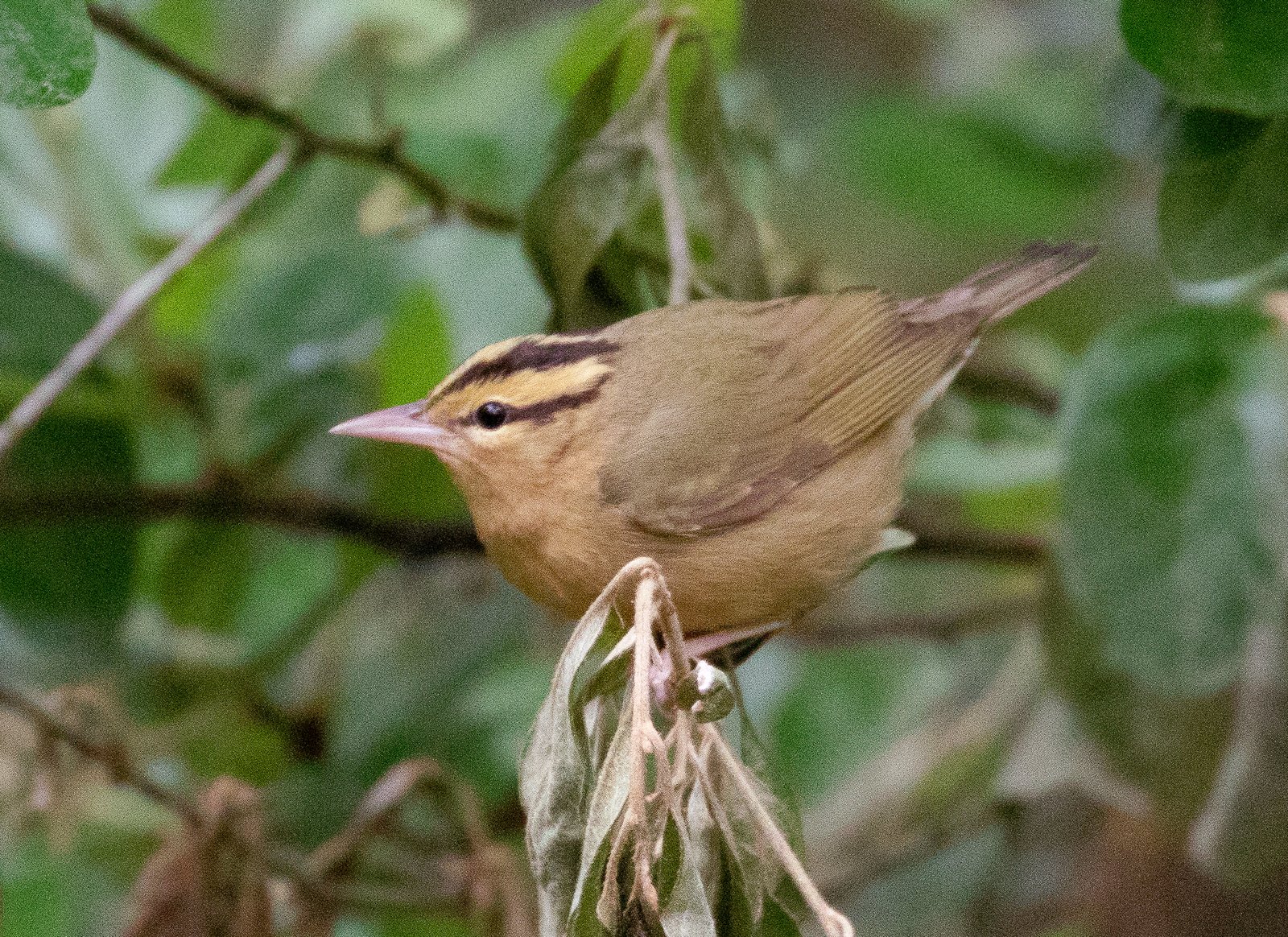
The Worm-eating Warbler is a plain olive-brown warbler with a boldly striped, buff head. It forages in hanging clusters of dead leaves, probing them for insects with its long, pointed bill. In the guide area it is a rare winter visitor to northern Colombia.
Voice
A dry, sharp chip and a thin tsee. The song is a dry, rapid, insect-like trill on one pitch.
Recording: Bobby Wilcox — CC BY-NC-SA 4.0 · xeno-canto
Identification
13 cm, with a fairly long, pointed bill and a short tail. The head is warm buff with four black stripes: two broad crown stripes and two eye-stripes. The upperparts are plain olive-grey without wing bars; the underparts are pale buff, paler on the belly. The legs are pink. The sexes are alike.
Confusion species
Three-striped Warbler Basileuterus tristriatus also has black head stripes, but has a dark cheek patch and olive-yellow underparts, and lives in small groups in montane forest. Swainson's Warbler Limnothlypis swainsonii has a plain rufous-brown crown without black stripes. Ovenbird Seiurus aurocapilla has streaked underparts and a white eye-ring.
Habitat
On the wintering grounds in the middle and lower levels of humid forest and forest edge, often in dense growth on slopes, also in shade coffee, mainly between 500 and 1500 m. It searches hanging clusters of dead leaves for insects and larvae and often joins mixed flocks. It does not breed in the guide area.
Where the bird is most at home, classified by the vegetation units of the Andes and the west coast.


Range and movements
Rare winter visitor, mainly October to March. In Colombia a few records in the north, including the Sierra Nevada de Santa Marta and the northern lowlands. In Ecuador exceptional at most. Absent from Peru, Bolivia and the Galápagos. Breeds in the eastern United States and winters in Mexico, Central America and the Caribbean south to Panama.
- Winter visitor (c. Oct–Mar)
- dark = core range, pale = thinly spread
How and when to look
In mixed flocks in northern Colombia, watch for a bird working upside down in dead-leaf clusters; the striped head then stands out.
Conservation status
Least Concern. Fragmentation of large deciduous forests on the breeding grounds and deforestation on the wintering grounds may affect the population locally.
Scientific name
Helmitheros vermivorum | (Gmelin, 1789)
Gmelin described the species in 1789 as Motacilla vermivora; because it was later moved to another genus, the author and year stand in brackets. The genus Helmitheros was introduced in 1819 by Rafinesque. The genus name combines Greek helmins, 'worm', with -thēras, 'hunter'. The species name combines Latin vermis, 'worm', and -vorus, '-eating'. The specimen the first description was based on came from Philadelphia, Pennsylvania, United States.