All species › Passerines › New World warblers › Louisiana Waterthrush
Louisiana Waterthrush | Parkesia motacilla
Louisianawaterlijster | Reinita charquera de Luisiana | Mariquita-da-luisiana
The Louisiana Waterthrush is the southern counterpart of the Northern Waterthrush and breeds along fast-flowing streams in eastern North America. On the wintering grounds, too, it stays tied to running water. The guide area lies at the southern edge of its winter range, where it is scarcer than the Northern Waterthrush.
Voice
A loud, sharp chip, slightly fuller than the call of Northern Waterthrush. The song begins with a few clear, descending whistles, followed by a rapid, jumbled ending.
Recording: Jacob Saucier — CC BY-NC-SA 4.0 · xeno-canto
Identification
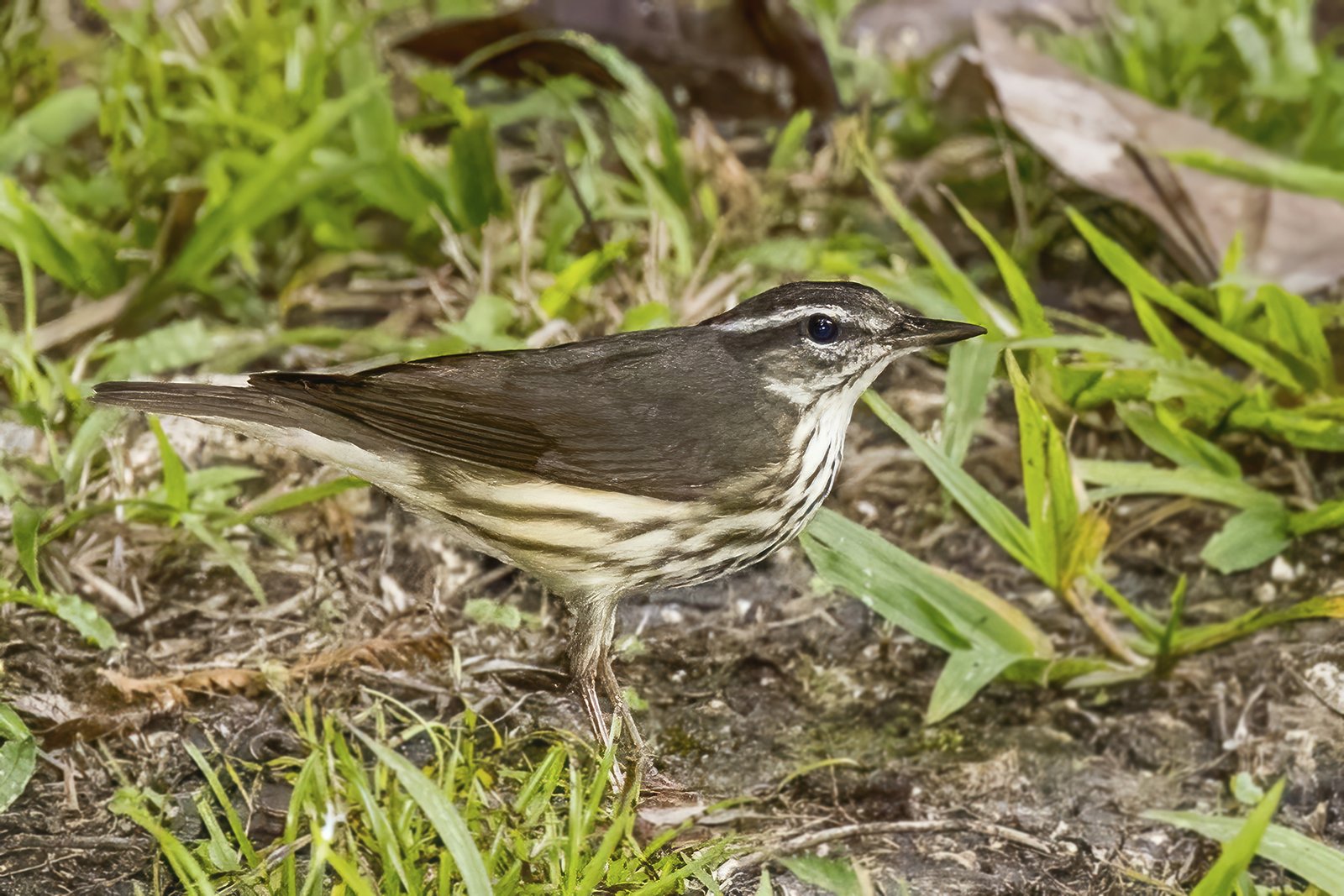
15 cm, with a fairly heavy bill. The upperparts are plain greyish brown. A broad white supercilium that widens behind the eye; often pale yellow in front of the eye. The throat is white and unstreaked. The underparts are white with dark brown streaks; the flanks and undertail coverts are pale buff. The legs are bright pink. The sexes are alike.
Confusion species
Northern Waterthrush Parkesia noveboracensis has a narrower, yellowish supercilium of even width, a streaked throat and evenly coloured, often yellowish underparts without buff flanks; it lives more by still water. Buff-rumped Warbler Myiothlypis fulvicauda also lives by mountain streams, but has unstreaked underparts and a buff rump and tail base.
Habitat
On the wintering grounds along clear, flowing streams and small rivers in forest and forest edge, mainly in the foothills and on the lower mountain slopes up to about 2000 m. It walks over stones and gravel, feeding on insects and other invertebrates in and beside the water, constantly bobbing its rear. It does not breed in the guide area.
Where the bird is most at home, classified by the vegetation units of the Andes and the west coast.


Range and movements
Winter visitor and passage migrant, mainly August to March; it arrives early in autumn and leaves early in spring. In Colombia scarce, mainly in the north and on the lower Andean slopes. In Ecuador rare, with a few records. Absent from Peru, Bolivia and the Galápagos. Breeds in the eastern United States and winters from Mexico and the Caribbean to Panama and northern South America.
- Winter visitor (c. Oct–Mar)
- Passage (Mar–Apr, Oct–Nov)
- dark = core range, pale = thinly spread
How and when to look
Early in the winter, walk slowly along clear forest streams in the foothills of northern Colombia; the bird walks from stone to stone and flies off low along the stream with a sharp chip.
Conservation status
Least Concern. The species depends on clean, forested streams and is therefore sensitive to pollution, logging and disturbance of watercourses.
Scientific name
Parkesia motacilla | (Vieillot, 1809)
Vieillot described the species in 1809 as Turdus motacilla; because it was later moved to another genus, the author and year stand in brackets. The genus Parkesia was introduced in 2008 by Sangster. The genus name honours the American ornithologist Kenneth Carroll Parkes (1922–2007), long-time Curator of Birds at the Carnegie Museum of Natural History. The species name is Latin motacilla, 'wagtail', for the constant bobbing of the tail. The specimen the first description was based on came from Kentucky, United States.