All species › Passerines › Ovenbirds and woodcreepers › Cordilleran Canastero
Cordilleran Canastero | Asthenes modesta
Andescanastero | Canastero pálido | Lenheiro-da-cordilheira
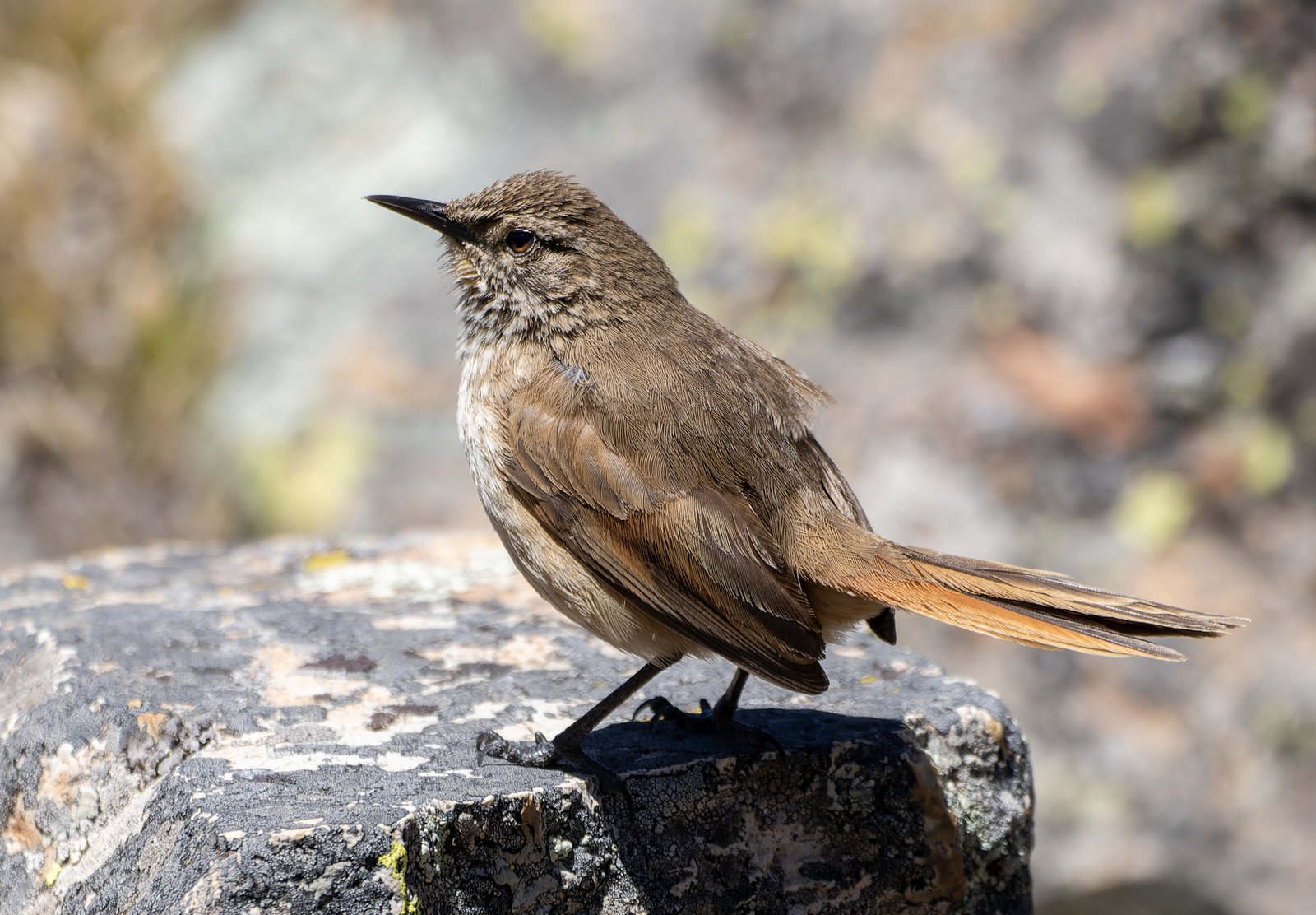
The Cordilleran Canastero is a pale, almost unstreaked canastero of open, dry grassland and scrub in the southern Andes. It forages much on the ground and runs between the grass tussocks, often with its tail slightly cocked. Within the guide area it occurs in the puna of Peru and Bolivia.
Voice
The song is a fast, rising trill that ends abruptly, sometimes with a few introductory notes. Calls are a short, low pyup or tjit.
Recording: Barry Edmonston — CC BY-NC-SA 4.0 · xeno-canto
Identification
15–16 cm, with a thin bill and a medium-length tail. The upperparts are dull dark greyish brown and unstreaked, with a narrow, pale buff supercilium and a whitish cheek with dark streaks. The wings have chestnut edges and the outer tail feathers are largely rufous. The throat has an orange-rufous patch, which is lacking in juveniles. The underparts are pale greyish buff; juveniles are mottled on the breast and belly. The sexes are alike.
Confusion species
Streak-throated Canastero Asthenes humilis is darker, with a finely streaked throat and little rufous in the tail. Streak-backed Canastero Asthenes wyatti has a clearly streaked back. Rusty-vented Canastero Asthenes dorbignyi has rufous undertail coverts and a white throat and lives more in scrub. Sharp-billed Canastero Asthenes pyrrholeuca has a longer, slimmer tail and lives lower.
Habitat
Puna and dry to semi-humid grassland, often with rock outcrops and scattered low shrubs; also dry montane scrub, Polylepis thickets and open dry woodland. In the guide area mainly between 3000 and 4500 m. It forages for insects on the ground and low in the vegetation. The nest is a domed ball of twigs and grass in a low shrub or among rocks.
Where the bird is most at home, classified by the vegetation units of the Andes and the west coast.


Range and movements
Peru: in the Andes from Junín south to Cusco and Puno. Bolivia: on the altiplano in the west and on the eastern slope in La Paz and Cochabamba, south to Potosí and Tarija. Absent from Colombia, Ecuador and the Galápagos. Outside the guide area in Chile and Argentina, where it locally occurs down to near sea level.
- Resident
- dark = core range, pale = thinly spread
How and when to look
Search open, dry puna grassland with low shrubs; the bird runs over the ground and often perches briefly on a stone or small shrub. The rufous outer tail feathers show when it flies off.
Conservation status
Least Concern. The species has a large range and is locally common.
Scientific name
Asthenes modesta | (Eyton, 1852)
Eyton described the species in 1852 as Synallaxis modestus; because it was later moved to another genus, the author and year stand in brackets. The genus Asthenes was introduced in 1853 by Reichenbach. The genus name comes from Ancient Greek asthenēs, 'insignificant', 'weak'. The species name comes from Latin modestus, 'modest', for the plain plumage. The specimen the first description was based on came from Bolivia (uncertain).