All species › Passerines › Ovenbirds and woodcreepers › Sharp-billed Canastero
Sharp-billed Canastero | Asthenes pyrrholeuca
Kleine canastero | Canastero coludo | Lenheiro-de-rabo-comprido
The Sharp-billed Canastero is a slender, long-tailed canastero with a thin, pointed bill that breeds in the dry shrub-steppes of Argentina and Chile. After the breeding season part of the population moves north. In the guide area it is a winter visitor to southern Bolivia.
Voice
The song is a two-part trill. The contact call is a short, rising whistle.
Recording: José Dellacasa Bravo — CC BY-NC-SA 4.0 · xeno-canto
Identification
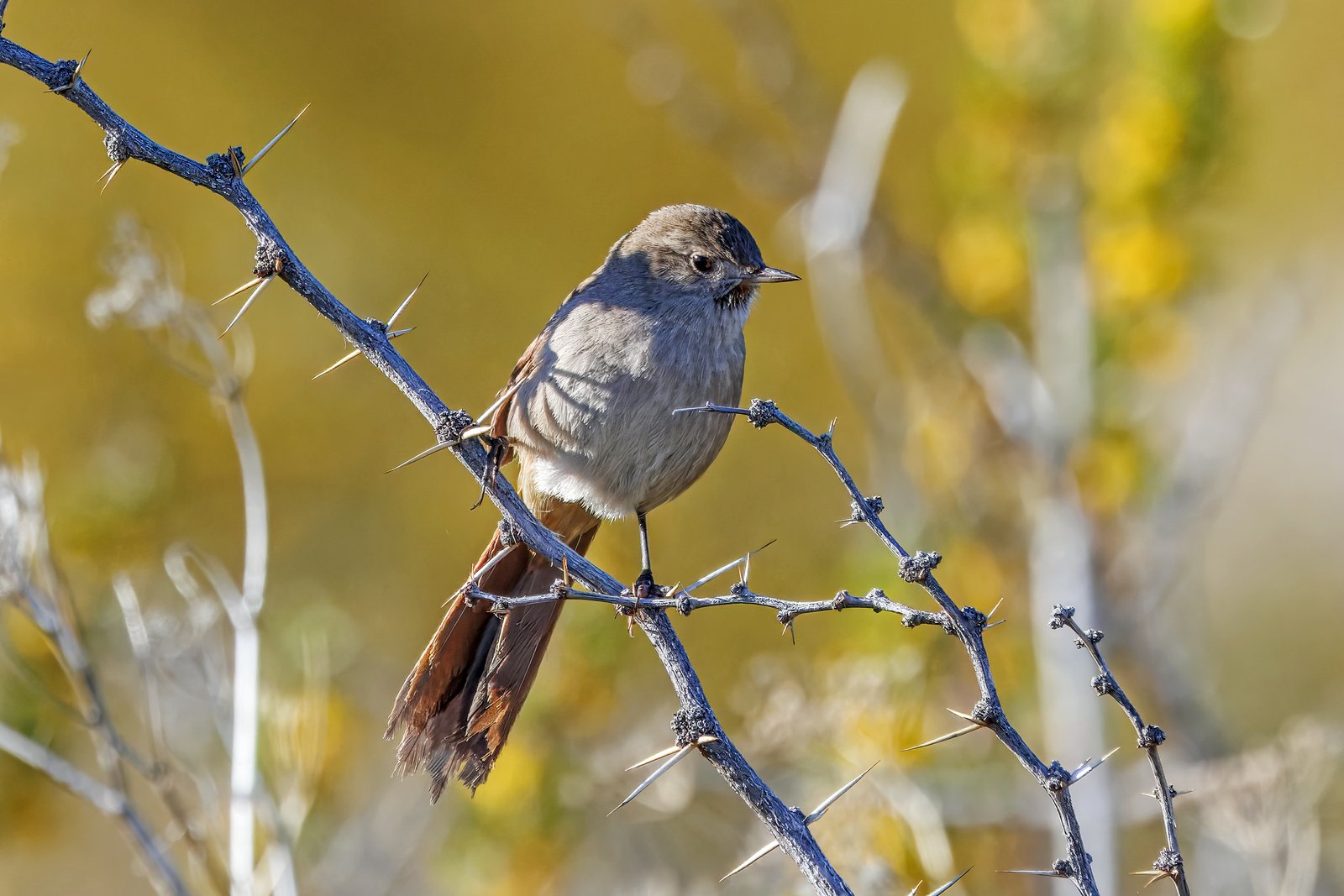
14–15 cm, one of the smallest canasteros, with a thin, pointed bill and a long, graduated tail. The face is greyish brown with a paler supercilium, the crown dull brown and the upperparts greyish brown and unstreaked. The chin and upper throat are rufous to tawny, with fine streaks. The underparts are greyish white. In the subspecies sordida, which winters in Bolivia, the outer tail feathers are entirely rufous. Juveniles lack the throat patch and have a mottled breast. The sexes are alike.
Confusion species
Short-billed Canastero Asthenes baeri lives in the same Chaco scrub, but has a shorter, thicker bill and a shorter tail. Cordilleran Canastero Asthenes modesta is stockier, with a shorter tail, and lives much higher in the puna. Spinetails (Synallaxis) have a darker tail and often a rufous crown or wings.
Habitat
In the breeding range semi-arid to arid shrub-steppe and rocky grassland. In winter also in tall grass, wet places and Chaco scrub. Mostly from sea level to 2000 m, locally to 3000 m. It forages for insects low in shrubs and in the vegetation. The nest is a domed ball of twigs in a thorny shrub.
Where the bird is most at home, classified by the vegetation units of the Andes and the west coast.


Range and movements
Bolivia: winter visitor to the south, especially in the Chaco and the dry valleys of Tarija, Chuquisaca and Santa Cruz. Absent from Colombia, Ecuador, Peru and the Galápagos. Breeds outside the guide area in Chile and western and southern Argentina; also winters in northern Argentina, Paraguay and Uruguay, and is a vagrant to Brazil.
- Summer visitor (c. Apr–Sep)
- dark = core range, pale = thinly spread
How and when to look
Search dry scrub and Chaco scrub in southern Bolivia during the austral winter. The bird moves low through the shrubs and often holds its long tail cocked at an angle.
Conservation status
Least Concern. The species has a very large range and is fairly common across much of it; the population is thought to be declining, partly through grazing of the scrub.
Scientific name
Asthenes pyrrholeuca | (Vieillot, 1817)
Vieillot described the species in 1817 as Sylvia pyrrholeuca; because it was later moved to another genus, the author and year stand in brackets. The genus Asthenes was introduced in 1853 by Reichenbach. The genus name comes from Ancient Greek asthenēs, 'insignificant', 'weak'. The species name comes from Greek purrhos, 'flame-coloured', and leukos, 'white', for the rufous and white in the plumage. The specimen the first description was based on came from Paraguay.