All species › Passerines › Ovenbirds and woodcreepers › Black-throated Thistletail
Black-throated Thistletail | Asthenes harterti
Zwartkeeldistelstaart | Colicardo golinegro | Rabo-de-cardo-de-garganta-preta
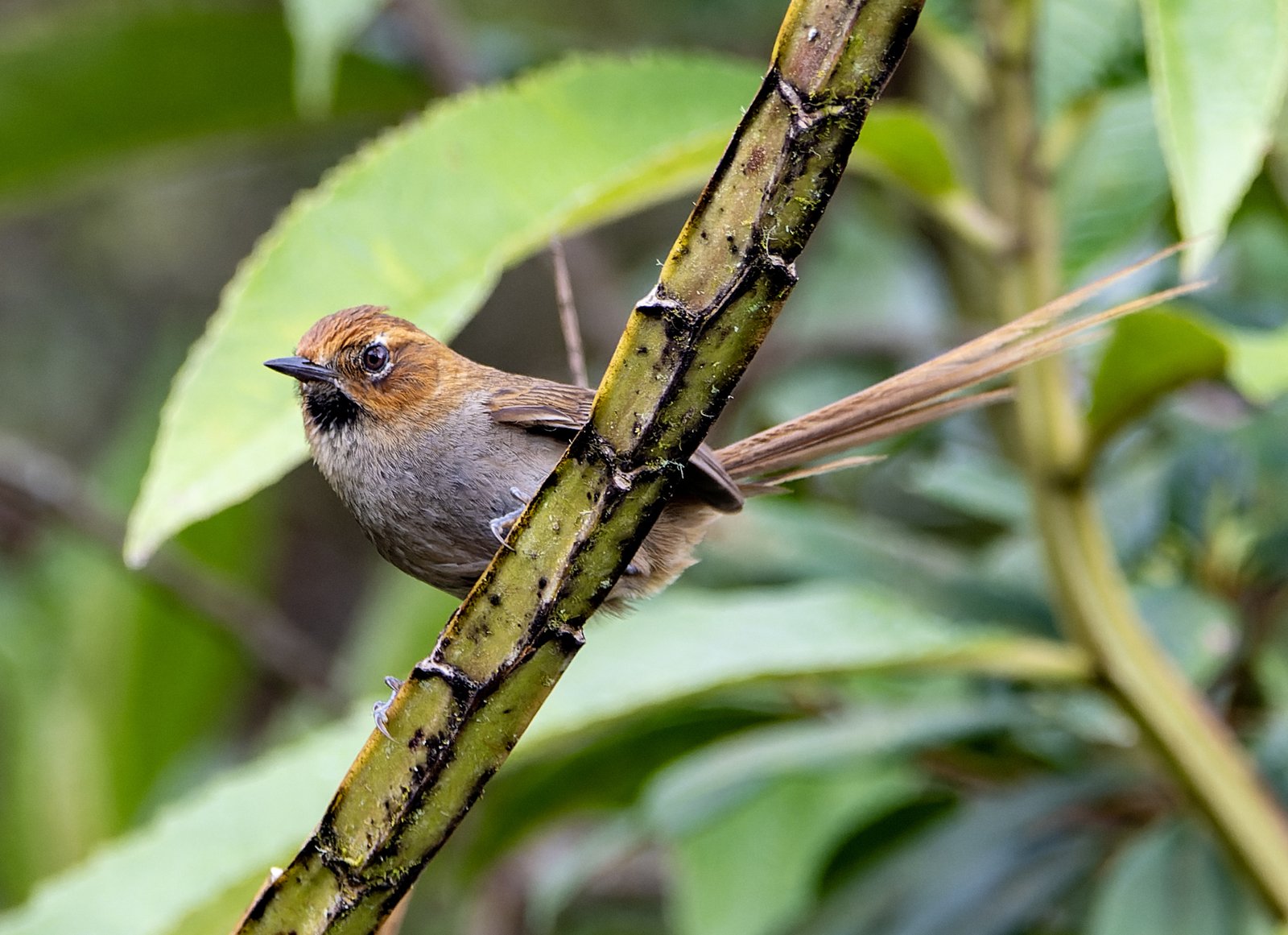
The Black-throated Thistletail is a dark, rufous-brown thistletail with a black throat that occurs only in Bolivia. Thistletails are canasteros with a long, deeply forked tail of frayed feathers. It lives in dense shrubbery and elfin forest at the treeline on the eastern slope of the Andes.
Voice
The song is a series of emphatic, squeaky notes that speeds up, slows down and drops slightly at the end. The alarm call is a rodent-like psee-a.
Recording: Jacob Wijpkema — CC BY-NC-SA 4.0 · xeno-canto
Identification
17–18 cm, much of it tail; the long tail is deeply forked, with frayed feather tips. The crown, back, wings and tail are dark rufous-brown. The face is rufous-brown with a light brown supercilium. The chin is greyish white and the throat black with whitish streaks. The underparts are mostly brownish grey, with browner flanks. In the southern subspecies bejaranoi the face and neck show some ochre and the underparts are paler, with ochre flanks. The sexes are alike.
Confusion species
Puna Thistletail Asthenes helleri has a greyish-brown face, a white chin and a smaller blackish throat patch, and lives farther northwest, in extreme western La Paz and in Peru. Azara's Spinetail Synallaxis azarae lives at forest edges at lower elevations and has a rufous crown and wings and a tail without a deep fork.
Habitat
Elfin forest and shrubbery at the treeline, cloud forest edges and the transition to humid grassland, between about 2900 and 3400 m. It forages for insects low in dense shrubbery and bamboo. The nest is a domed ball of moss and grass, low in the vegetation.
Where the bird is most at home, classified by the vegetation units of the Andes and the west coast.


Range and movements
Endemic to Bolivia: on the eastern slope of the Andes in La Paz, Cochabamba and Santa Cruz; the nominate form in the north, bejaranoi farther south. Absent from Colombia, Ecuador, Peru and the Galápagos.
- Resident
- dark = core range, pale = thinly spread
How and when to look
Search at the treeline above the yungas, for example along roads over the eastern slope in La Paz and Cochabamba. The bird usually stays in dense shrubbery; listen for the squeaky song.
Conservation status
Least Concern. The range is small; burning of shrubbery and grassland at the treeline can degrade its habitat locally.
Scientific name
Asthenes harterti | (Berlepsch, 1901) (GBIF: Schizoeaca harterti)
Berlepsch described the species in 1901 as Schizoeaca harterti; because it was later moved to another genus, the author and year stand in brackets. The genus Asthenes was introduced in 1853 by Reichenbach. The genus name comes from Ancient Greek asthenēs, 'insignificant', 'weak'. The species name honours Ernst Hartert (1859–1933), a German ornithologist and curator of Walter Rothschild's museum at Tring. The specimen the first description was based on came from Unduavi, La Paz, Bolivia.