All species › Passerines › Ovenbirds and woodcreepers › Puna Thistletail
Puna Thistletail | Asthenes helleri
Punadistelstaart | Colicardo de la puna | Rabo-de-cardo-da-puna
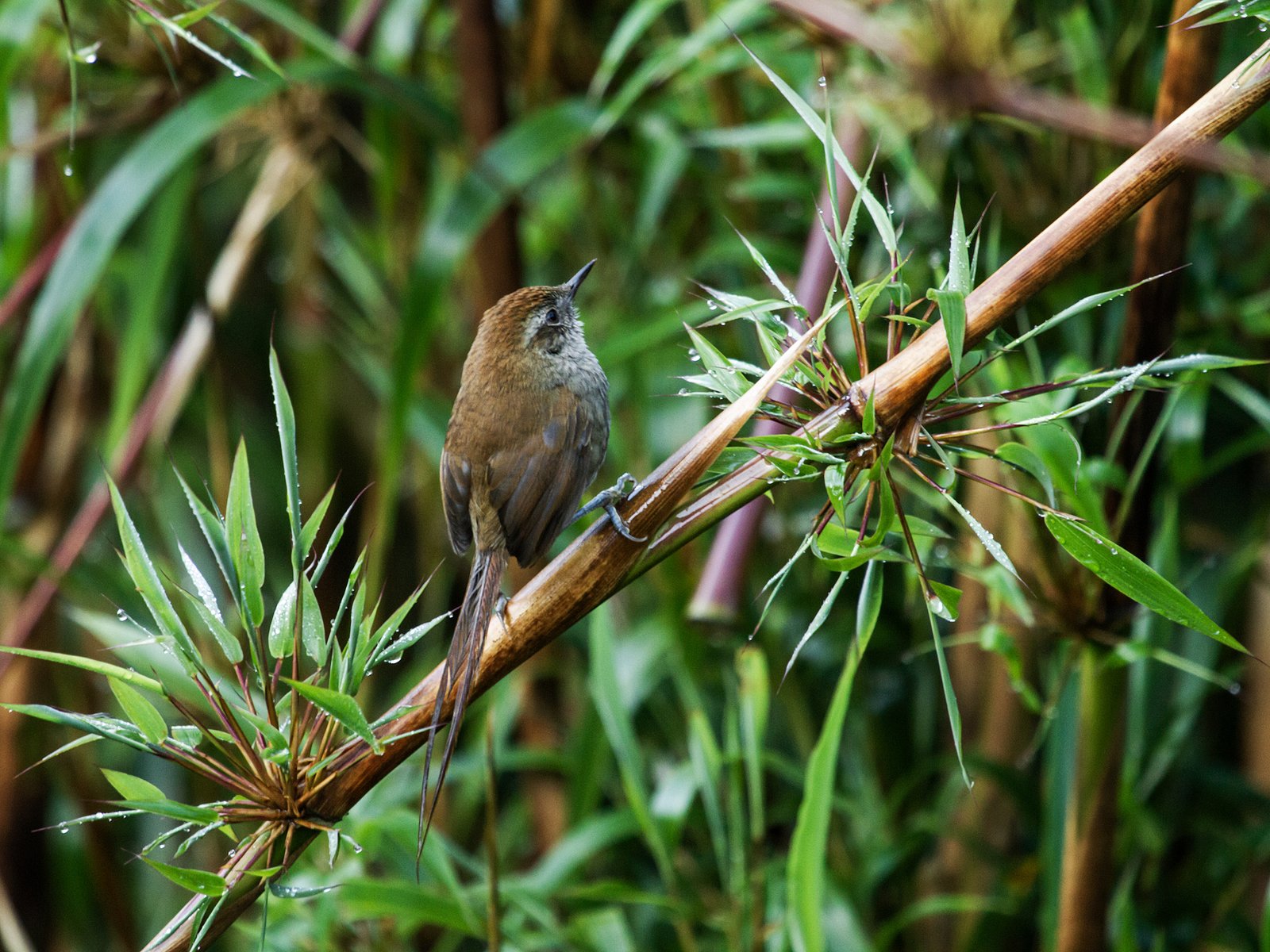
The Puna Thistletail is a thistletail of elfin forest at the treeline in southeastern Peru and extreme western Bolivia. It lives mainly where dense Chusquea bamboo forms the understorey. Like the other thistletails it has a long, deeply forked tail with frayed feathers.
Voice
Both sexes sing a short burst of high, sputtering notes that speeds up, grows louder and fades at the end. The call is a sharp, sibilant note, like pyeek or feet.
Recording: Jacob Wijpkema — CC BY-NC-SA 4.0 · xeno-canto
Identification
17–18 cm, with a long, deeply forked tail that is brighter brown than the back. The face is brownish grey with a greyish supercilium; the crown and back are dark rufous-brown. The chin is white and the throat has a blackish patch with pale flecks. The underparts are mostly grey. The sexes are alike.
Confusion species
Black-throated Thistletail Asthenes harterti has a rufous-brown face and a larger black throat, and lives farther southeast in Bolivia. Vilcabamba Thistletail Asthenes vilcabambae lives in the Cordillera Vilcabamba and in Ayacucho in Peru, west of this species, and is mainly separated by range. Eye-ringed Thistletail Asthenes palpebralis has a pale eye-ring and lives in central Peru.
Habitat
Elfin forest at the treeline, usually with a dense understorey of Chusquea bamboo, and shrubbery at the edge of humid grassland, between about 2700 and 3700 m. It forages for insects low in the dense vegetation. The nest is a domed ball of moss and grass in dense shrubbery.
Where the bird is most at home, classified by the vegetation units of the Andes and the west coast.


Range and movements
Peru: on the eastern slope of the Andes from Cusco southeast to Puno. Bolivia: only in extreme western La Paz. Absent from Colombia, Ecuador and the Galápagos.
- Resident
- dark = core range, pale = thinly spread
How and when to look
Search bamboo-rich elfin forest at the treeline, for example along the road from Cusco to Manu near the Acjanaco pass. The bird usually stays in cover; listen for the sputtering song.
Conservation status
Least Concern. The range is small; burning of grassland and shrubbery at the treeline can degrade its habitat locally.
Scientific name
Asthenes helleri | (Chapman, 1923) (GBIF: Schizoeaca helleri)
Chapman described the species in 1923 as Schizoeaca helleri; because it was later moved to another genus, the author and year stand in brackets. The genus Asthenes was introduced in 1853 by Reichenbach. The genus name comes from Ancient Greek asthenēs, 'insignificant', 'weak'. The species name honours Edmund Heller (1875–1939), an American naturalist and collector, later director of the Milwaukee Zoo. The specimen the first description was based on came from Cedrobamba, Machu Picchu, Cusco, Peru.