All species › Passerines › Ovenbirds and woodcreepers › Vilcabamba Thistletail
Vilcabamba Thistletail | Asthenes vilcabambae
Vilcabambadistelstaart | Colicardo de Vilcabamba | Cauda-de-cardo-de-vilcabamba
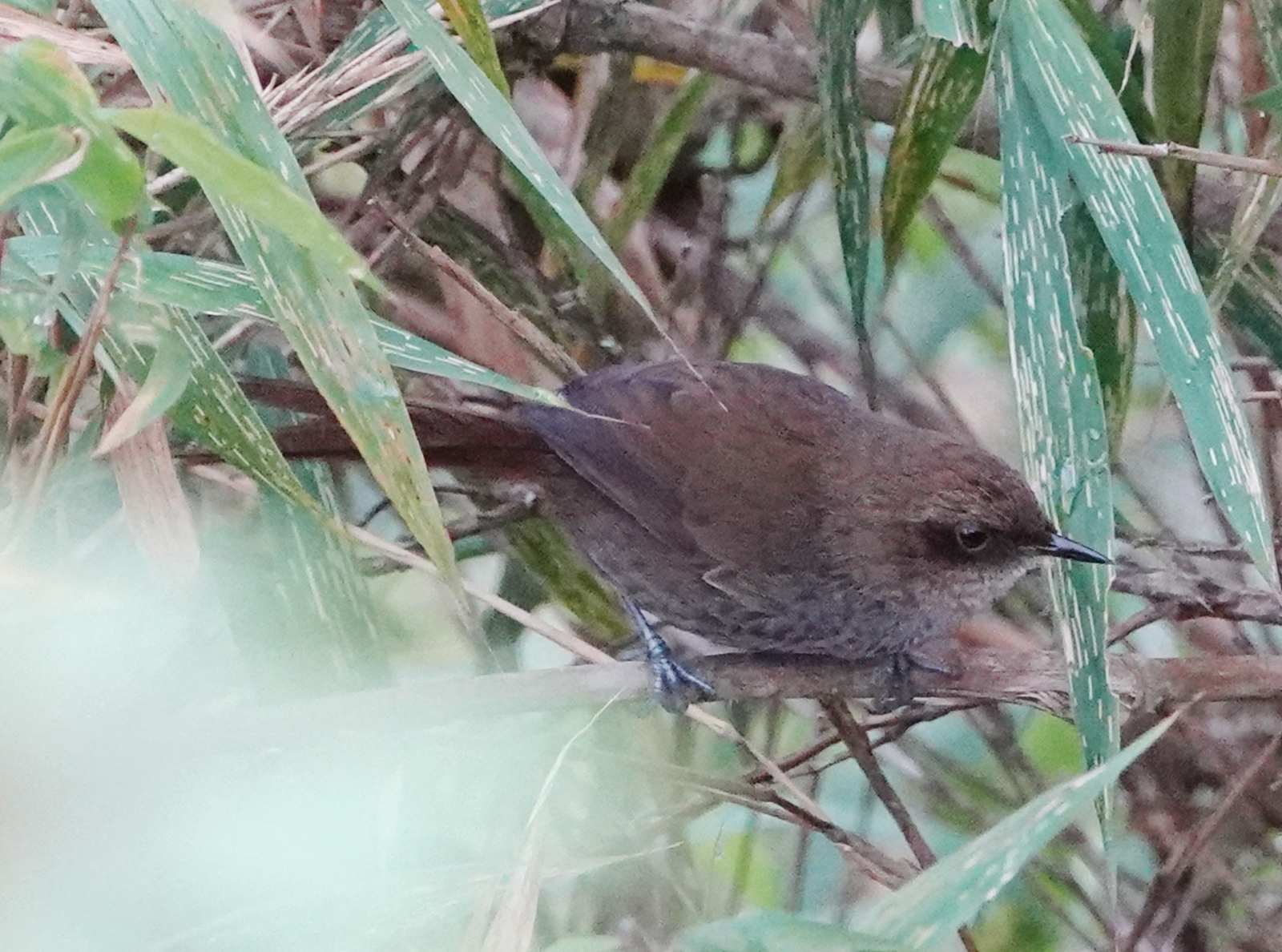
The Vilcabamba Thistletail is a dark brown ovenbird with a long, forked tail, endemic to a few remote ridges in central Peru. It lives at the treeline in elfin forest and dense Chusquea bamboo. The species was only described in the 1970s and was long treated as a subspecies of White-chinned Thistletail.
Voice
The song starts with a few clear, slightly rising notes that speed up into a fast trill and ends on a lower note. A second song consists of short, fast bursts of three or four slurred notes. The call is a short pyeek.
Recording: Josh Beck — CC BY-NC-SA 4.0 · xeno-canto
Identification
18–20 cm, with a short, pointed bill and a long, deeply forked tail whose tips look ragged because of the loose barbs. The upperparts are brown, the crown with faint dark spots, the wings dark brown with rufous edges. A pale forehead and a broad, pale supercilium. The chin is ochre to tawny, the throat pale greyish brown, the rest of the underparts darker grey with faint scaling and browner flanks. The sexes are alike.
Confusion species
Eye-ringed Thistletail Asthenes palpebralis, in Junín, has a broad white eye-ring and a more rufous face. Puna Thistletail Asthenes helleri lives further south-east, beyond the Urubamba valley. Ayacucho Thistletail Asthenes ayacuchensis lives west of the Apurímac. Spinetails such as Vilcabamba Spinetail Cranioleuca weskei climb in branches and have a shorter, unforked tail.
Habitat
Elfin forest and Polylepis groves at the treeline, with a preference for dense Chusquea bamboo, in smaller numbers also in grassland above and in the upper cloud forest, mostly between 2800 and 3600 m. It searches for insects in dense vegetation, usually low in the shrubs. Little is known about its breeding biology.
Where the bird is most at home, classified by the vegetation units of the Andes and the west coast.


Range and movements
Endemic to Peru: in the northern and central Cordillera Vilcabamba, east of the Apurímac, in Junín and Cusco; much of the range lies in Otishi National Park. Absent from Colombia, Ecuador, Bolivia and the Galápagos.
- Resident
- dark = core range, pale = thinly spread
How and when to look
The area is remote and can be reached almost only on multi-day treks. Search dense bamboo at the treeline and listen for the accelerating trill; the bird usually stays low and hidden.
Conservation status
Least Concern. The range is small but largely remote and partly protected; fires and grazing at the treeline are a local threat.
Scientific name
Asthenes vilcabambae | (Vaurie, Weske & Terborgh, 1972) (GBIF: Schizoeaca vilcabambae)
Vaurie, Weske & Terborgh described the species in 1972 as Schizoeaca fuliginosa vilcabambae; because it was later moved to another genus, the author and year stand in brackets. The genus Asthenes was introduced in 1853 by Reichenbach. The genus name comes from Ancient Greek asthenēs, 'insignificant', 'weak'. The species name refers to the Cordillera de Vilcabamba in Peru. The specimen the first description was based on came from Cordillera de Vilcabamba, Cusco, Peru.