All species › Passerines › Ovenbirds and woodcreepers › Canyon Canastero
Canyon Canastero | Asthenes pudibunda
Kloofcanastero | Canastero de quebradas | Lenheiro-dos-cânions
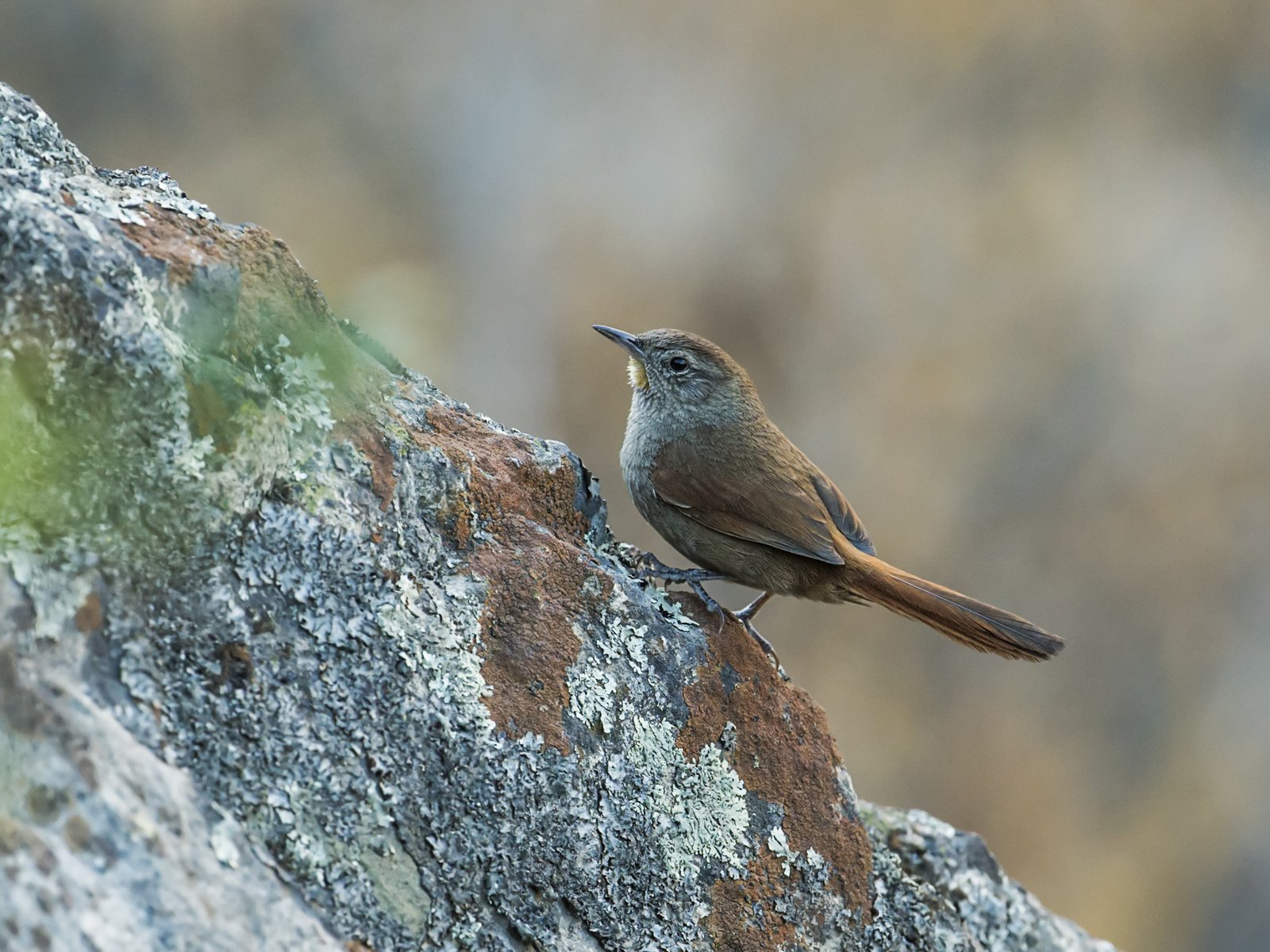
The Canyon Canastero is a greyish-brown canastero of dry, rocky ravines on the western slope of the Peruvian Andes. It keeps to thorny scrub on steep slopes and sings from a shrub or rock. Of the three subspecies, two live only in Peru.
Voice
The song is a loud, accelerating trill, preceded by a few introductory notes, often given from a rock or shrub. The call is a repeated kee-whit.
Recording: Heraldo V. Norambuena — CC BY-NC-SA 4.0 · xeno-canto
Identification
15–17 cm, with a short, straight bill and a fairly long, graduated tail with rufous outer feathers. The upperparts are warm dark brown, the uppertail coverts chestnut. A narrow, buff supercilium and a greyish-brown face. The chin and upper throat are pale tawny-orange, darker chestnut in the northern subspecies neglecta. The underparts are greyish brown; the southern subspecies grisior is paler and greyer. The sexes are alike.
Confusion species
Rusty-fronted Canastero Asthenes ottonis has a rufous forehead and a longer tail and lives further east. Pale-tailed Canastero Asthenes huancavelicae has pale outer tail feathers. Dark-winged Canastero Asthenes arequipae, in the south-west, has dark wings without rufous. Cactus Canastero Pseudasthenes cactorum lives lower, on slopes with columnar cacti, and has a longer, slightly decurved bill.
Habitat
Dry, rocky montane scrub, often in ravines and canyons, sometimes in Polylepis woodland, mostly between 2400 and 3700 m, locally up to 4000 m. It searches for insects among shrubs and on the ground. Little is known about the nest; breeding activity has been recorded in May.
Where the bird is most at home, classified by the vegetation units of the Andes and the west coast.


Range and movements
Peru: on the western slope of the Andes, from La Libertad and Ancash (neglecta) through Lima (pudibunda) south from Huancavelica to Tacna (grisior). Absent from Colombia, Ecuador, Bolivia and the Galápagos. Outside the guide area in the far north of Chile, south to Tarapacá.
- Resident
- dark = core range, pale = thinly spread
How and when to look
Search rocky ravines with scrub on the western slope, for example in the valleys above Lima; the bird gives itself away by its loud trill in the early morning.
Conservation status
Least Concern. Its habitat, dry and steep slopes, is little used; grazing and wood cutting are a local threat.
Scientific name
Asthenes pudibunda | (Sclater, 1874)
Sclater described the species in 1874 as Synallaxis pudibunda; because it was later moved to another genus, the author and year stand in brackets. The genus Asthenes was introduced in 1853 by Reichenbach. The genus name comes from Ancient Greek asthenēs, 'insignificant', 'weak'. The species name comes from Latin pudibundus, 'bashful', 'modest'. The specimen the first description was based on came from Obrajillo near Canta, Lima, Peru.