All species › Passerines › Ovenbirds and woodcreepers › Rusty-fronted Canastero
Rusty-fronted Canastero | Asthenes ottonis
Garlepps canastero | Canastero frentirrufo | Lenheiro-de-testa-ferrugínea
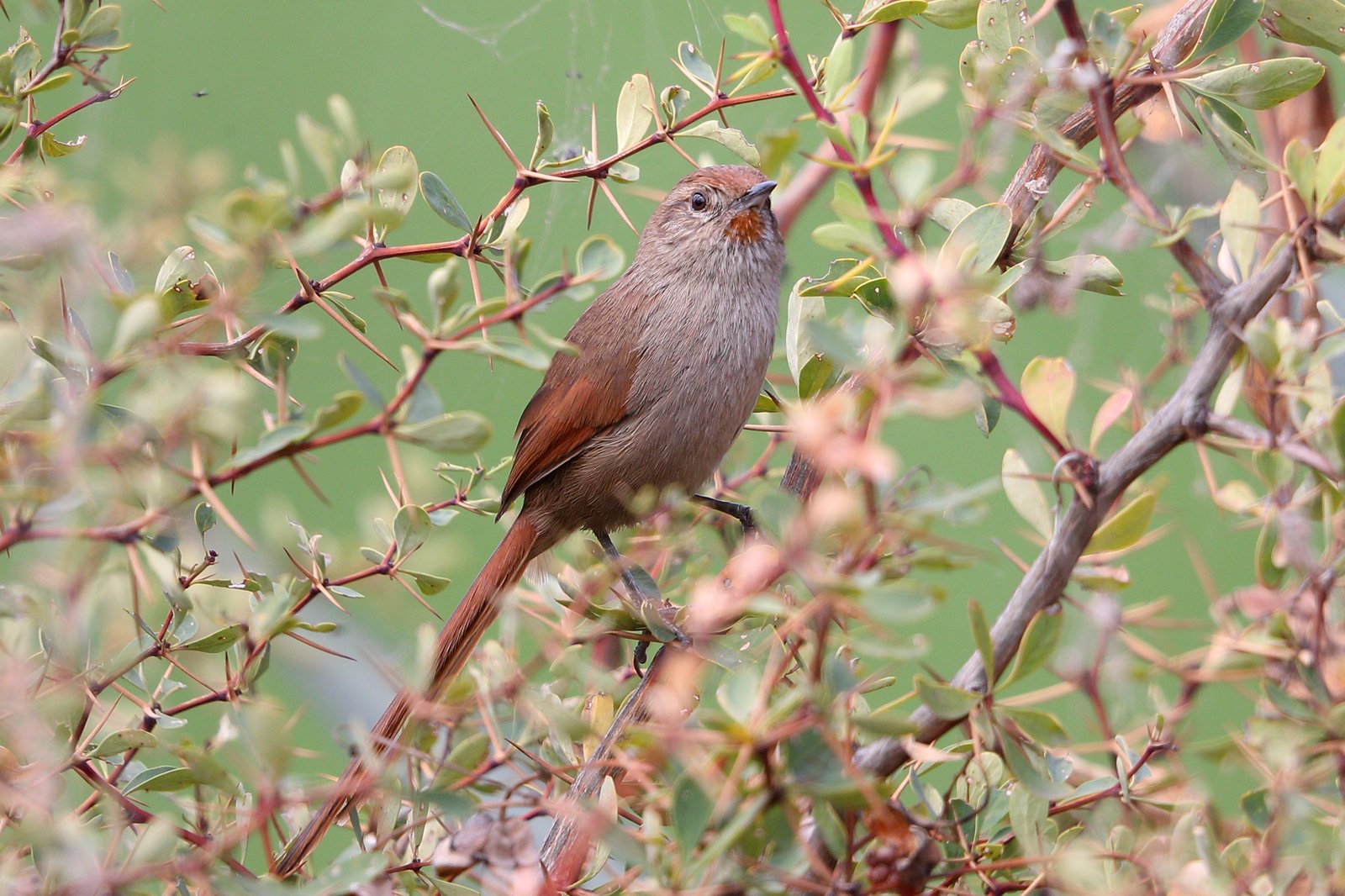
The Rusty-fronted Canastero is a rufous-brown canastero with a long tail, endemic to the Andes of southern and central Peru. The rufous forehead gives the English name. The Dutch name and the scientific name refer to the collector Otto Garlepp.
Voice
The song starts with three high, rising notes and then falls into a fast, descending series. The call is a sharp, high veer and a nasal djeeh.
Recording: Ross Gallardy — CC BY-NC-SA 4.0 · xeno-canto
Identification
18–19 cm, with a short, straight bill and a long, graduated tail. The forehead is rufous, crown and back are warm brown. Wings and tail are largely chestnut. Throat and breast are orange-rufous to buff with fine streaks, the belly is paler. The sexes are alike.
Confusion species
Canyon Canastero Asthenes pudibunda lacks the rufous forehead, has a shorter tail and lives on the western slope. Pale-tailed Canastero Asthenes huancavelicae has pale outer tail feathers and greyer underparts. Line-fronted Canastero Asthenes urubambensis has a streaked forehead and lives higher, mainly in Polylepis woodland. Rusty-crowned Tit-Spinetail Leptasthenura pileata has a rufous crown but a streaked back and a thin, pointed tail.
Habitat
Humid to dry montane scrub and edges of Polylepis woodland, also shrubby ravines and hedges along fields, roughly between 2750 and 4000 m. It searches for insects in shrubs and on the ground. Nothing is known about the nest and breeding biology.
Where the bird is most at home, classified by the vegetation units of the Andes and the west coast.


Range and movements
Endemic to Peru: in the Andes of the south and centre, in Huancavelica, Ayacucho, Apurímac and Cusco. Absent from Colombia, Ecuador, Bolivia and the Galápagos.
- Resident
- dark = core range, pale = thinly spread
How and when to look
Search shrubby ravines and woodland edges in the highlands between Ayacucho, Abancay and Cusco; the bird sings early in the morning from the top of a shrub.
Conservation status
Least Concern. Scrub and Polylepis woodland are locally degraded by fires, wood cutting and grazing, but the species tolerates some disturbance.
Scientific name
Asthenes ottonis | (Berlepsch, 1901)
Berlepsch described the species in 1901 as Siptornis Ottonis; because it was later moved to another genus, the author and year stand in brackets. The genus Asthenes was introduced in 1853 by Reichenbach. The genus name comes from Ancient Greek asthenēs, 'insignificant', 'weak'. The species name honours Otto Garlepp (1864–1959), a German collector in Peru from 1895 to 1912. The specimen the first description was based on came from Anta, Cusco, Peru.