All species › Passerines › Ovenbirds and woodcreepers › Streak-throated Canastero
Streak-throated Canastero | Asthenes humilis
Streepkeelcanastero | Canastero gorjiestriado | Lenheiro-de-garganta-listrada
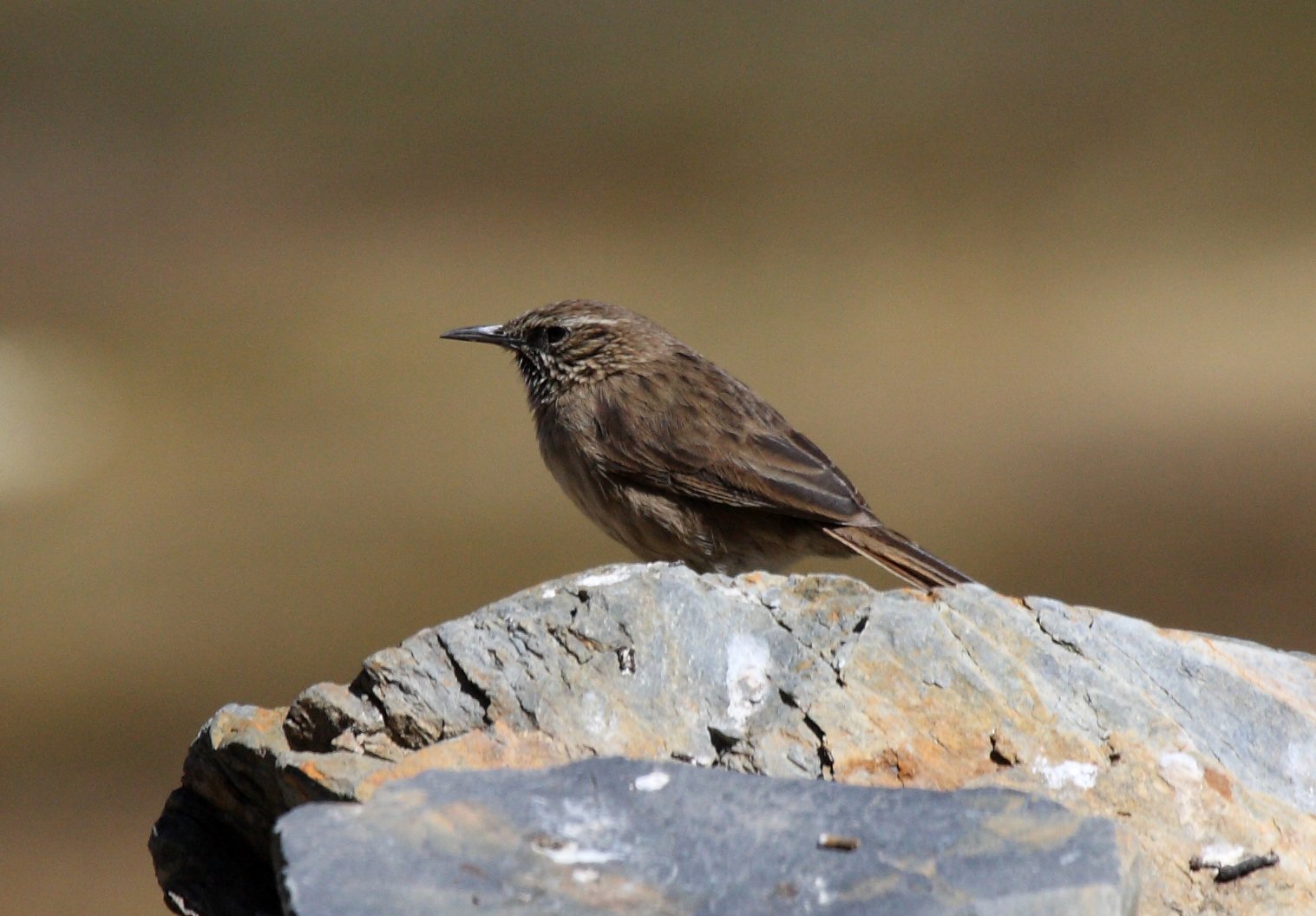
The Streak-throated Canastero is a stocky, dark canastero of rocky puna grassland in Peru and northern Bolivia. It often walks and runs over the ground among tussocks and stones, with its short tail slightly cocked. The finely streaked throat with an orange-rufous chin separates it from the other canasteros of the puna.
Voice
The probable song is a soft, quavering trill of 2 to 5 seconds. Also a double or triple trill of about one second and a contact call of two or three pit notes.
Recording: Niels Krabbe — CC BY-NC-SA 3.0 · xeno-canto
Identification
15–16 cm, with a relatively short tail. The upperparts are dark brown with faint streaks, with a dull whitish-buff supercilium. The chin is orange-rufous; the throat carries thin blackish streaks that fade on the upper breast. The underparts are pale brown, with warmer buff flanks. Juveniles have less orange on the chin and fainter throat streaks. The sexes are alike.
Confusion species
Cordilleran Canastero Asthenes modesta is paler, with an unstreaked throat, lighter underparts and rufous outer tail feathers. Streak-backed Canastero Asthenes wyatti has a clearly streaked back and a tail with much rufous. Cinclodes of the genus Cinclodes are larger, with a pale wing band in flight.
Habitat
Puna grassland, often with rock outcrops and sometimes with scattered shrubs, between about 2750 and 4800 m. It forages for insects on the ground among stones and tussocks. The nest is a domed ball of grass, hidden among stones or in a tussock.
Where the bird is most at home, classified by the vegetation units of the Andes and the west coast.


Range and movements
Peru: in the Andes from Cajamarca south through La Libertad, Ancash, Huancavelica and Ayacucho to Cusco and Puno. Bolivia: only in the north, in La Paz and Cochabamba. Absent from Colombia, Ecuador and the Galápagos.
- Resident
- dark = core range, pale = thinly spread
How and when to look
Walk slowly through rocky puna grassland and watch for a dark bird running off between the stones. It sometimes perches on a rock with its tail slightly raised.
Conservation status
Least Concern. The species is fairly common in suitable habitat; overgrazing may have a local effect.
Scientific name
Asthenes humilis | (Cabanis, 1873)
Cabanis described the species in 1873 as Synallaxis humilis; because it was later moved to another genus, the author and year stand in brackets. The genus Asthenes was introduced in 1853 by Reichenbach. The genus name comes from Ancient Greek asthenēs, 'insignificant', 'weak'. The species name comes from Latin humilis, 'low', 'humble', 'inconspicuous'. The specimen the first description was based on came from Maraynioc, Junín, Peru.