All species › Passerines › Ovenbirds and woodcreepers › Streak-backed Canastero
Streak-backed Canastero | Asthenes wyatti
Streeprugcanastero | Canastero dorsilistado | Lenheiro-de-dorso-listrado
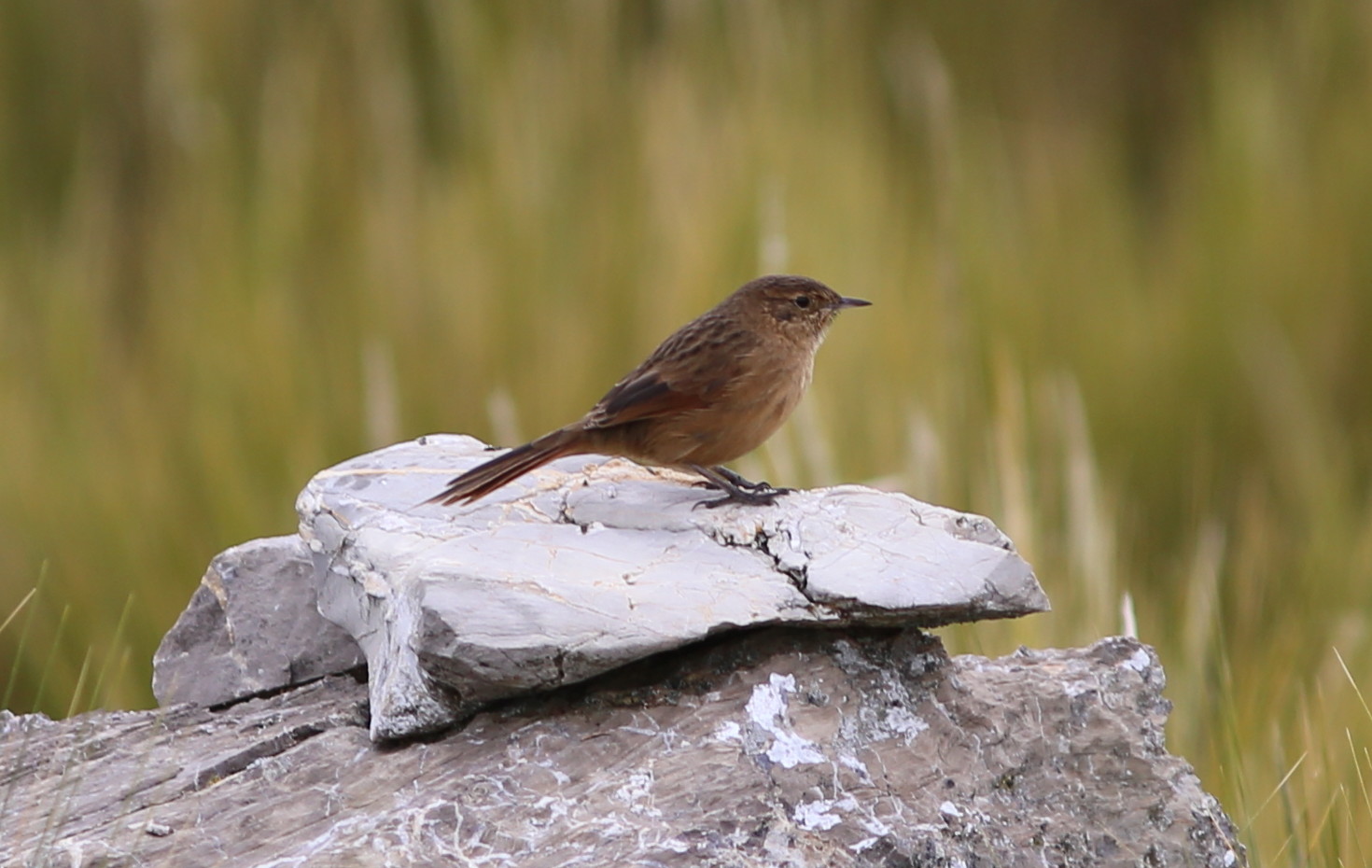
The Streak-backed Canastero is the canastero with the largest range in the high mountains of the guide area, from the páramo of Colombia to the puna of Bolivia. It lives in open grassland with tussocks, rocks and low shrubs and often sings from a shrub, sometimes with several birds at once. In the arrangement followed here, the species also includes the birds split elsewhere as Puna Canastero (Asthenes sclateri).
Voice
The song is a dry, rattling phrase that rises and accelerates and then drops off abruptly, often given from a shrub and sometimes answered by neighbours. Calls include a short, shrill trill, a sharp chick and high tink notes.
Recording: Juan Freile — CC BY-NC-SA 4.0 · xeno-canto
Identification
16–18 cm, with a thin bill and a long tail. The crown, nape, back and rump are olive-brown with dark streaks. A narrow buff supercilium runs above a greyish-brown and blackish speckled face. The wings have rufous edges forming a wing band, and the tail is mostly rufous. The throat is pale, with a small orange-rufous chin patch; the underparts are warm buff, with a light brown breast. The subspecies differ in the amount of streaking, the tone of the underparts and the amount of rufous in wings and tail. The sexes are alike.
Confusion species
Many-striped Canastero Asthenes flammulata is clearly streaked below as well and has a more heavily streaked crown. Cordilleran Canastero Asthenes modesta has an unstreaked back. Junin Canastero Asthenes virgata and Scribble-tailed Canastero Asthenes maculicauda have a heavily streaked crown and a tail with little rufous. Streak-throated Canastero Asthenes humilis has an almost unstreaked, dark brown back and a streaked throat.
Habitat
Páramo and puna with tussock grass, often dry, with rock outcrops and low shrubs; in the south also locally in Polylepis woodland with a tussock understorey. In the north mainly between 3000 and 4500 m, in the south also lower, down to about 2000 m. It forages for insects on the ground and low in the vegetation. The nest is a domed ball of grass in a tussock or shrub.
Where the bird is most at home, classified by the vegetation units of the Andes and the west coast.


Range and movements
Colombia: in the Sierra Nevada de Santa Marta, the Serranía del Perijá and the Eastern Andes in Norte de Santander. Ecuador: locally in the Andes of the centre and south. Peru: scattered in the Andes from north to south, to around Lake Titicaca. Bolivia: in La Paz, around Lake Titicaca and from Cochabamba to Potosí. Absent from the Galápagos. Outside the guide area in Venezuela and Argentina.
- Resident
- dark = core range, pale = thinly spread
How and when to look
Search tussock slopes with rocks and low shrubs in the highlands in the early morning; singing birds then often sit on top of a shrub.
Conservation status
Least Concern. The species is widespread and locally common; burning and overgrazing can degrade its habitat.
Scientific name
Asthenes wyatti | (Sclater & Salvin, 1871)
Sclater & Salvin described the species in 1871 as Synallaxis wyatti; because it was later moved to another genus, the author and year stand in brackets. The genus Asthenes was introduced in 1853 by Reichenbach. The genus name comes from Ancient Greek asthenēs, 'insignificant', 'weak'. The species name honours Claude Wilmott Wyatt (1842–1900), an English ornithologist who collected in Colombia in 1870. The specimen the first description was based on came from Páramo de Pamplona, Norte de Santander, Colombia.