All species › Pigeons and doves › Doves and pigeons › Croaking Ground Dove
Croaking Ground Dove | Columbina cruziana
Peruaanse steenduif | Tortolita peruana | Rolinha-coaxante
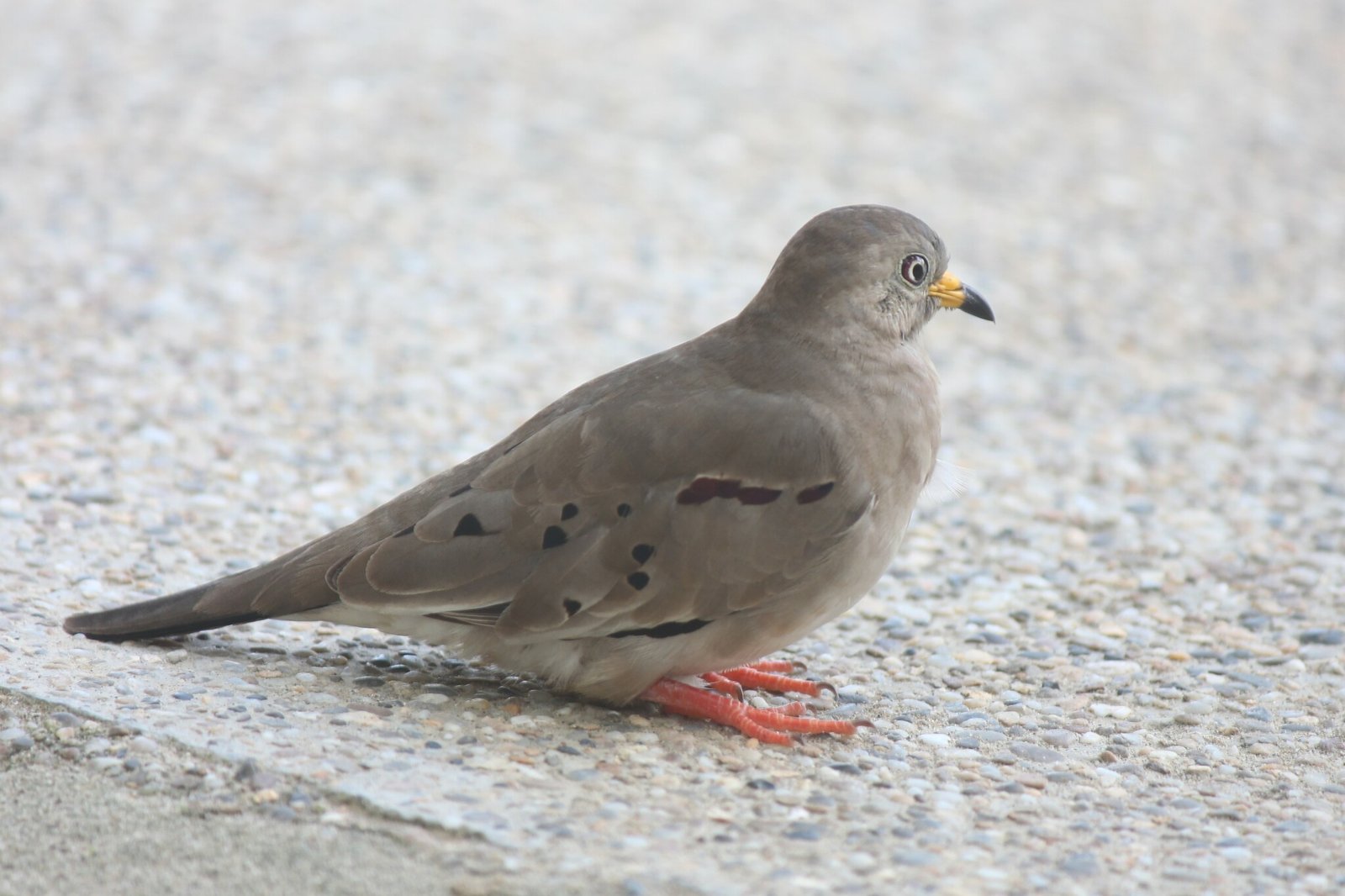
The Croaking Ground Dove is the common ground dove of the dry Pacific coast of Ecuador and Peru, with a yellow bill base and a croaking, frog-like call. It lives in desert oases, irrigated farmland and towns, and is one of the most numerous birds in Lima.
Voice
A low, croaking, frog-like grrr-oop or kroak, single or repeated; very different from the cooing of other ground doves.
Recording: Cristian Pinto — CC BY-NC-SA 4.0 · xeno-canto
Identification
16–18 cm, compact, with a short tail. The male has a bluish-grey head and is otherwise pale greyish brown, pinkish grey below. A narrow purplish-brown band runs across the scapulars, and there are black spots on the wing coverts. The bill base and the bare skin around the eye are yellow to orange. The underwing coverts are black. The female is browner and duller, with the same yellow bill base. Juveniles have pale feather fringes.
Confusion species
Ecuadorian Ground Dove Columbina buckleyi lacks the yellow bill base and purplish-brown scapular band and lives mainly in dry forest. Ruddy Ground Dove Columbina talpacoti is rufous (male) or rufous-brown (female). Eared Dove Zenaida auriculata and West Peruvian Dove Zenaida meloda are much larger and longer-tailed.
Habitat
Coastal desert with oases, irrigated farmland in the coastal valleys, dry scrub, riparian woodland, gardens, parks and towns, from sea level to about 2500 m on the west slope of the Andes and in the Marañón valley. It searches the ground for seeds, often in small groups.
Where the bird is most at home, classified by the vegetation units of the Andes and the west coast.


Range and movements
In Ecuador in the western lowlands, mainly in the dry zone from Manabí to El Oro and Loja. In Peru along the entire coast and on the west slope of the Andes, and in the Marañón valley. Absent from Colombia, Bolivia and the Galápagos. Outside the guide area in the far north of Chile.
- Resident
- dark = core range, pale = thinly spread
How and when to look
In parks, gardens and on the streets of Lima and the other coastal towns of Peru, and in the fields of the coastal valleys; the croaking call gives the bird away.
Conservation status
Least Concern. Very common; it benefits from irrigation and settlement.
Scientific name
Columbina cruziana | (Prévost, 1842)
Prévost described the species in 1842 as Columba Cruziana; because it was later moved to another genus, the author and year stand in brackets. The genus Columbina was introduced in 1825 by Spix. The genus name comes from Latin columbinus, 'of a dove, dove-like'. The species name refers to Santa Cruz in Bolivia, the stated type locality; this is erroneous, as the type specimens probably came from the coast of Tacna, now in Chile. The specimen the first description was based on came from coast of Tacna, Peru.